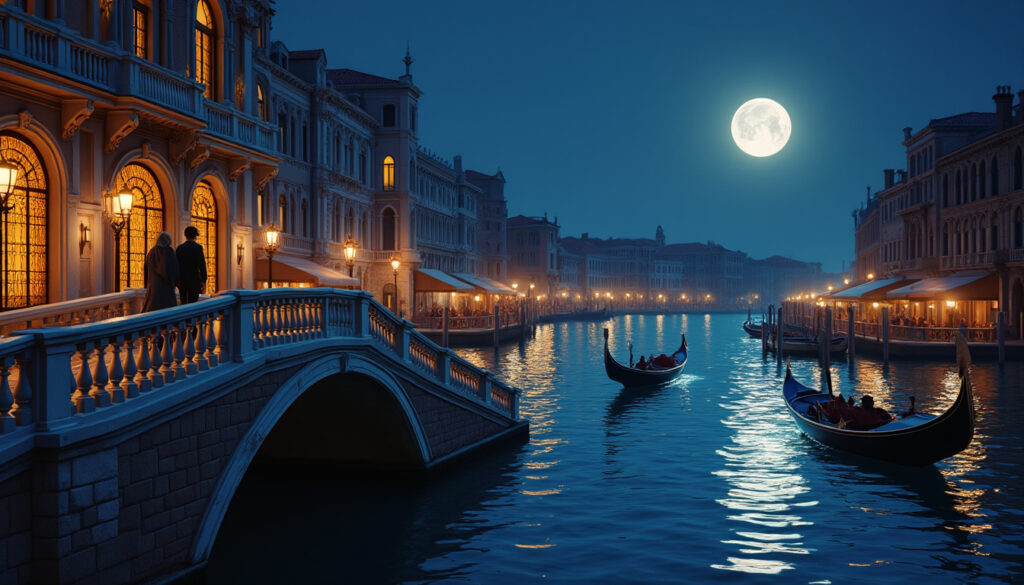
In a cinematic journey of vibrant colors, Venice, the Moon, and You by Dino Risi stands as an emblematic work of Italian neo-realism. With a vaudeville ambiance and enchanting settings, the film utilizes the magic of the city of Venice to explore universal themes of love, illusions, and disillusionments. Featuring invaluable talents such as Alberto Sordi and Marisa Allasio, Risi succeeds in capturing both the beauty of Italian life of the time and the underlying tensions of a society undergoing profound change, inviting the viewer to lose themselves in a vivid postcard tinged with nostalgia.
Through the emblematic work of Dino Risi, “Venice, the Moon, and You” emerges as a vivid postcard of post-war Italy. This film, shot in 1958, skillfully blends the codes of neo-realism with a colorful aesthetic, allowing it to capture both the romantic essence of Venice and the social tensions of the era. Risi, with his sharp eye, manages to provide a critique that is both light and poignant of the morals of his time, while valuing an idealized vision of the city.
The Historical Context: A Colorful Backdrop
The period leading up to the release of “Venice, the Moon, and You” was marked by a significant economic boom in Italy. As the remnants of the war slowly began to fade, society sought to anchor itself in a new narrative. This context becomes crucial to understanding Risi’s work. His characters, often disenchanted with their reality, are in search of escape.
This film holds particular importance as it sits at the intersection of several genres. Through a light comedy, this work addresses serious underlying themes. The collages of colors display on screen, reminding viewers of the vitality of Venice’s tourist spots while hiding an emotional depth often unexplored in productions of the time. The juxtaposition of the passage of time and fleeting pleasures is evident in every scene.
Dino Risi: Artisan of Chromatic Neo-Realism
Dino Risi is more than just a director; he is an engaged artist who wields cinematic language with brilliance. In “Venice, the Moon, and You,” he relies on the mastery of cinematographer Tonino Delli Colli to influence the aesthetic. The chromatic palette, dazzling and vibrant, seems to say, “Look at Venice from this angle.” Moving within a world that is both romantic and comedic, Risi manages to capture the beauty of the city while providing social critique.
The colors, ever-present, are both a hymn to the city and a caricature of the characters’ behaviors. This approach limits the use of depth and evokes the superficial aspect of the emerging consumer society. The darker aspects of neo-realism are here softened, replaced by a lightness that masks a more somber reality. One could almost say that the film’s tone resembles that of this tourist Venice, iridescent with false pretenses.
The Characters: A Balance Between Fantasy and Reality
The protagonists of “Venice, the Moon, and You” skillfully oscillate between dream and disillusionment. Bepi, the gondolier, finds himself swept into a whirlwind of romantic misunderstandings, while those around him display behaviors typical of Italian comedy. A vibrant gallery of characters is thus composed, each reflecting skewed aspirations in their own way. Yet, in the light of their interactions, the quest for happiness often transforms into sarcasm.
- Bepi: a clumsy hero, caught between romance and bitter realities.
- Nina: the fiancée plagued by doubts in a consumerist world.
- Toni: the silent antagonist, embodying values of material security.
Through their dynamics, Risi highlights universal themes: love, despair, and financial responsibility. Each character crosses paths that seem preordained, illustrating that sometimes, behind the laughter lies a heavy burden of societal conventions. Summer flings, wedding promises destroyed by deceptions, are tinged with a skillfully measured melancholy. Thus, an ambivalent climate settles in, where comedy meets darker underlying plots.
A Critical Look at Italian Society
Risi, through the prism of his work, conducts a true social critique. Beyond the laughter, he points out the aspirations of the middle class, reduced to standardizations; this phenomenon observed, for example, in the pursuit of material comfort. The film may appear comedic, but one must not forget the social reality it reflects: a society in transformation.
This critique is all the more striking when one observes the shift from tradition to modernity. The scenes, although often light, filter through difficult realities. The emphasis on conflicts between old values and new aspirations, between dream and reality, is palpable. Thus, Risi depicts the workings of a world in imbalance.
The Echoes of Neo-Realism in Modernity
Ultimately, “Venice, the Moon, and You” resonates beyond the years, even after several decades. Its legacy extends and fuels discussions around universal themes. The influences of neo-realism are still present but are presented in a refined, colorful form. Risi offers a showcase of the past while embarking on a path towards a new aesthetic.
In this way, Risi’s work is not limited to a time or a movement; it is an integral part of Italian artistic expression. The city of Venice, filmed as a character in its own right, becomes a reflection of the hopes and disillusionments of a society in full revolution. And ultimately, it is not merely a simple postcard but a true societal mirror.
At the heart of Dino Risi‘s work, “Venice, the Moon, and You” stands as a striking reflection of the pink neo-realism, enriched by a dazzling chromatic palette. This film, shot in 1958, humorously and lightly depicts an Italian society in transformation, blending tradition and modernity. Through the misadventures of Bepi, a gondolier with frustrated ambitions, Risi captures the essence of tourist comedy, a genre that is both light and revealing, where love, illusion, and the quest for wealth intertwine.
Risi demonstrates remarkable skill in infusing his narrative with unexpected depth. Far from being a mere postcard of Venice, the film explores essential social and economic themes while remaining accessible and entertaining. Thanks to memorable characters like Alberto Sordi and Marisa Allasio, comedy also becomes a mirror of an Italian culture on the verge of transition. The settings, deliberately embellished and sometimes clichéd, highlight the dualities of everyday life: on one hand, the beauty of Venice and, on the other, the realities of a world amidst economic reinvention.
Through a flamboyant Technicolor, Risi scrutinizes the contradiction between the sublime and the trivial. The landscapes of Venice, too perfect, become the symbol of unreachable dreams. Thus, “Venice, the Moon, and You” constitutes not only entertainment but also an underlying critique of a time when consumerism begins to dominate individual aspirations.