
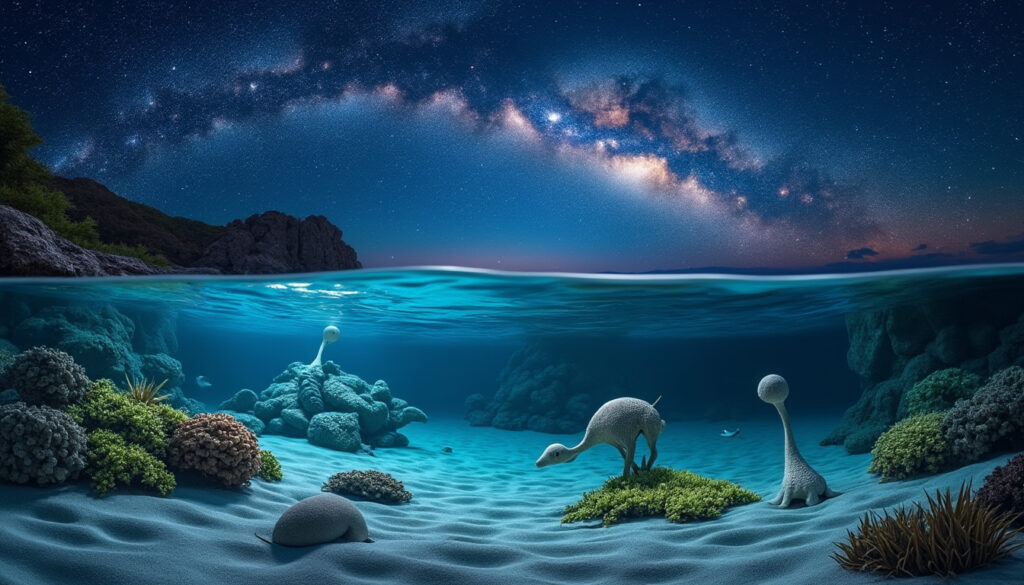
In a cinematic universe where creativity and provocation coexist, Derek Jarman stands out with his iconic film “The Garden of Monsters”. This masterpiece, a true exploration of identity and love through the prism of the queer world, takes us on a mystical dive into the heart of its visual labyrinths. With a bold aesthetic and deeply human themes, Jarman questions our relationship with nature, art, and personal struggle. Enter this captivating universe to discover the richness and complexity of a film that continues to inspire and provoke.
Diving into the Milky Way: A Retrospective of Derek Jarman’s Masterpiece, “The Garden of Monsters”
Through a unique exploration of the iconic work of Derek Jarman, “The Garden of Monsters,” we discover how this film transcends the borders of fear and beauty. By blending a striking visual universe, profound themes, and a bold approach, the director manages to immerse us in a reality where the world of dreams and that of reality intersect. This article offers a retrospective of this foundational work, its aesthetics, and its impact on contemporary cinema.
An Unprecedented Artistic Vision
In “The Garden of Monsters,” Derek Jarman presents himself as a true alchemist of cinema. In this masterpiece, his unique perspective on human interactions and their environment leaves a lasting mark. Through a combination of impressive cinematography and a daring narrative, Jarman succeeds in creating a universe that is both oppressive and poetic. His mastery is such that he draws the viewer into an intense reflection on our relationship with nature and society.
Jarman employs powerful visual metaphors. Nature, the human body, and the ephemeral nature of life are at the heart of his story. The scenes follow one another, rich in colors, often saturated, inviting total immersion. Each shot is a work of art in its own right, where form and color support a discourse on the modern world. In this way, Jarman positions himself as a true pioneer of cinematic aesthetics.
Color as Language
In this film, color transcends simple decor: it becomes a means of expression. Jarman fits into a pictorial tradition where each hue conveys an emotion. This brings him closer to the language of painters, both Impressionists and Expressionists. The choice of vivid hues often evokes complex emotional states. The use of color is never separate from the message he wishes to convey; it is both a reflection and an amplifier.
Moreover, the contrasts between warm and cool tones allow for unveiling the different facets of humanity. These plays of light and shadow reveal the human condition, oscillating between hope and despair. Jarman thus plays with perceptions, allowing everyone to identify. He addresses universal emotions that traverse the human spectrum beyond any boundary.
A Tribute to the Marginalized
Celebrating marginal voices, Jarman creates a deep connection with communities often made invisible in traditional cinema. The protagonists are portrayed with dignity and respect, figures often forgotten by society. Each character thus becomes a symbol, a voice for those weighed down by the burden of social norms. The themes of sexuality, death, and loss resonate throughout the work, evoking deep and often painful experiences.
The film thus becomes a manifesto, a celebration of diversity. Jarman provides a glimpse into a world constantly struggling for recognition. In this struggle, realism mingles with the fantastic, and rebellion is expressed through every image. Through his narrative choices, he raises questions about inclusion, community, and identity. The gaze cast upon the other is both critical and tender, inviting a necessary reflection.
Aesthetics and Forms of Narration
Exploring “The Garden of Monsters,” it is impossible not to mention the formal style that characterizes Jarman’s work. The director plays with narrative structure, daring to break and abandon traditional conventions. This results in a clear discontinuity, where sequences juxtapose often striking images of raw violence and gentle beauty. This stylistic choice is bold, even disconcerting, but enriches the viewer with a unique cinematic experience.
Through choices like editing, the disruption of linear narrative, and bold transitions, Jarman creates a new temporality, a cinematic time where each element dialogues, coordinates, and rebels. He offers a reflection on the perception of time, always moving, sometimes circular. Thus, the work becomes an invitation to see beyond appearances, to delve into what lies behind each captured moment.
Cultural Impact and Legacy
The impact of “The Garden of Monsters” transcends the aesthetic framework. This film has succeeded in marking its time, influencing many directors. The work contributes to the evolution of independent cinema, paving the way for new voices. Jarman has been a forerunner for filmmakers exploring queer themes, marginality, and artistic avant-garde. The way he uses cinema to tackle current issues and social concerns makes it not only a visual masterpiece but also a powerful instrument of change.
There is a poignant beauty in how Jarman invites introspection. By addressing controversial social issues, he shakes public opinion, encouraging it to question itself. Behind the violence of certain scenes, there is a call for understanding, for acceptance of our own monsters. In this, his vision remains strikingly relevant, attesting to struggles that endure today.
“The Garden of Monsters” is not just a film, but a true emotional journey through human suffering, aesthetic beauty, and the acceptance of differences. It reveals the power of cinema as an art form, capable of awakening consciousness and sparking reflection. In an era where representation and identity are crucial subjects, Jarman’s work continues to resonate, like an echo of an era in search of meaning, a call for tolerance.
Diving into the Milky Way: A Retrospective of Derek Jarman’s Masterpiece, “The Garden of Monsters”
The Garden of Monsters, a flagship work of Derek Jarman, is distinguished by its ability to amalgamate diverse narrative and aesthetic forms. Through this film, Jarman does not merely present a linear story; he rather explores the richness and complexity of the human condition while defying the conventions of cinematography. His innovative technique, combining elements of super 8 and 35 mm, gives a poetic dimension to his approach, where each image becomes a canvas, each shot a vibrant tableau of emotions.
Jarman invites us to a dialogue with the past and the present, juxtaposing historical references and provocative social critiques. In an environment of turbulence and change, the film deconstructs preconceived notions about culture, identity, and sexual identity. Through sequences that are both dreamlike and brutal, it forces us to reflect on the shadows that haunt our society while seeking light in moments of unexpected beauty.
Finally, this work embodies Jarman’s artistic genius and his capacity to transcend artistic boundaries. By oscillating between irreverence and nostalgia, he captures the very essence of humanity. This retrospective of Jarman’s masterpiece opens a window into a universe where monstrosity coexists with beauty, urging the viewer to question their own perceptions and appreciate art in its purest and rawest form. The Garden of Monsters thus remains a monument to bold creativity, a call to celebrate authenticity and diversity.


