
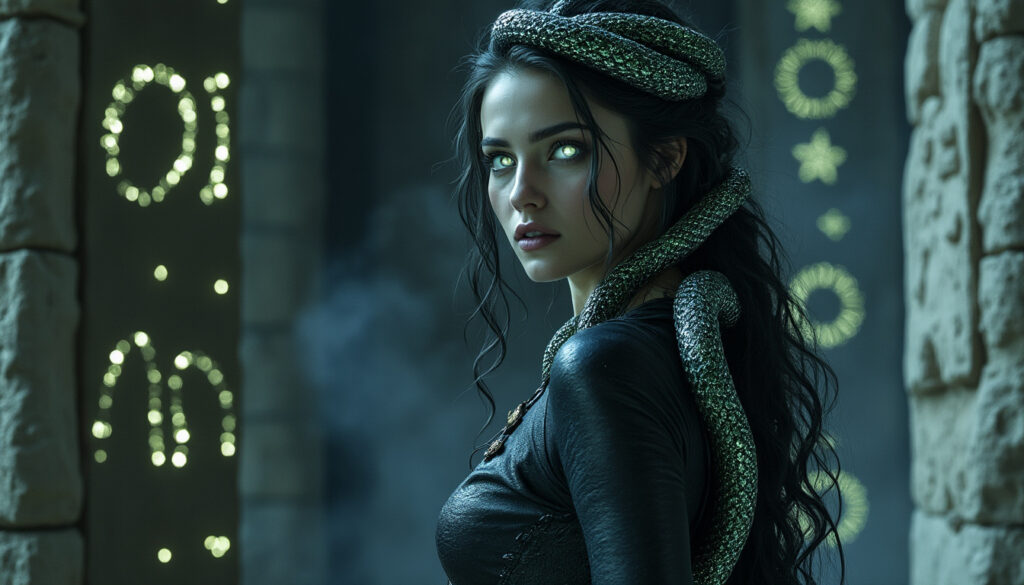
In the contemporary film universe, Evi Kalogiropoulou stands out as a unique and bold voice, notably with her film Gorgonà. This fascinating work is distinguished by its ability to blend mythology, aesthetics, and political reflection, all while plunging the viewer into a post-apocalyptic Greece. Through a powerful and visually captivating narrative, the director reinterprets classical mythological figures, such as the Gorgon, to address contemporary themes like patriarchal violence and environmental crises, all while transforming the perspective one has on the modern world.
In the contemporary cinematic landscape, Evi Kalogiropoulou emerges as a director with a fascinating and unique universe. With her latest film, Gorgonà, she proposes a work of incredible visual and thematic richness. Through a Greece that is both mythological and dystopian, she immerses the viewer into a universe where myth and reality coexist in a troubling manner. This article explores the depth of Gorgonà, highlighting Kalogiropoulou’s singular style, her influences, and the impact of her work on European cinema.
A unique vision of modern cinema
Evi Kalogiropoulou distinguishes herself by her ability to unite different universes, associating mythology with contemporary issues. She has had an impressive journey in the world of short films with works recognized at the Cannes Film Festival. Her first feature film, Gorgonà, is a true continuation of this exploration.
The film presents a particularly critical view of our current society. Here, industrialization stands as a symbol of suffocating patriarchal domination. The themes of domination and emancipation emerge powerfully, embodied by characters who serve as reflections of current conflicts.
In her works, she also highlights the beauty of landscapes, blending urban elements with a melancholic atmosphere that evokes the past. The dreamlike visual rendering is illustrated through scenes where modern architecture rivals ancient ruins, recreating a sensation of suspended time.
A narrative where the myth resurfaces
The choice of the Gorgon as a central figure is not fortuitous. In Gorgonà, Kalogiropoulou revitalizes a mythological heroine while weaving reflections on contemporary violence. Through this character, she questions the female gaze on a world dominated by male power. The Gorgon, far from being a mere monster, becomes a symbol of resistance.
The filmmaker does not seek to pay homage to Greek mythology in a classical way. On the contrary, she subverts its meaning to address today’s issues, particularly those related to ecology and social relations. Ancestors and their narratives thus transform to align with modern realities, offering the viewer a new perspective.
The film does not merely update a legend. It also examines how myths can be powerful tools for discussing society. In this regard, Kalogiropoulou demonstrates that myth can serve as a mirror to our existence, reflecting the tensions and contradictions of our time.
An aesthetics serving the narrative
Gorgonà also stands out for its sublime and audacious aesthetic approach. The visual compositions evoke striking geometric rigor while capturing the grotesque aspect of industrialization. The scenes, often bathed in natural light, ignite emotions and imbue the film with an almost sacred aura.
The quality of the images reinforces the central themes. The staging of characters and industrial installations raises questions about the human body, reimagined as an exploitable installation. The camera, far from remaining neutral, keenly reveals the inner struggles of each protagonist, making visible their solitude in a world that suffocates them.
This narrative conveys the idea of a different temporality. The key moments are not intended to be understood solely in a classic progression, but as instances laden with symbolism. Kalogiropoulou chooses a slowness that, paradoxically, intensifies the viewer’s experience with the challenges posed by Gorgonà.
A powerful echo in European cinema
Through her work, Evi Kalogiropoulou positions herself within a broader dynamic in European cinema. She does not fit into the conventional framework of cinematic narration. Her approach to directing reflects a desire to depict contemporary political struggles without masking them under simplistic narratives.
The film goes beyond a mere critique of power structures. It questions perceptions of the past and identity through the lens of mythology. Gorgonà is not just a reinterpretation; it is a reinvention of the gaze upon the world, in which every image invites the audience to reflect.
In summary, an immersive journey
Gorgonà is, above all, an immersive experience. Evi Kalogiropoulou succeeds in weaving a narrative where visual and narrative power intertwine. Viewers are invited to navigate between eras, feeling both the beauty and the tragedy of human existence.
Through her artistic choices, she expands our understanding of what it means to be at the heart of a constantly evolving world. The tensions that run through her characters resonate deeply, allowing us to pose the right questions about our current society, which is increasingly complex.
Evi Kalogiropoulou’s first feature film, Gorgonà, proves to be a bold and meaningful work. By confronting viewers with a post-apocalyptic Greece, the author weaves a complex tapestry where themes of patriarchal domination and natural resource exploitation intertwine. This film is not merely entertainment but an invitation to reflect on our own society and its systems of power. Kalogiropoulou immerses us in a universe where ancient myths intertwine with contemporary realities, urging a reconsideration of traditional narratives.
Through her work, the filmmaker manages to present myth not merely as a metaphor or cultural heritage but as a contemporary form of thought. By reactivating the figure of the Gorgon, she challenges the power relations that permeate our time. Women, traditionally relegated to passive roles in mythological narratives, become here active protagonists, embodying a force of emancipation. The way Kalogiropoulou films her characters, through exchanges of gazes and interactions, contributes to this inversion of roles and prompts the viewer to reevaluate their own perceptions.
Finally, Gorgonà transcends simple fictional narratives to touch on fundamental questions about our collective existence. Through her unique artistic vision, Evi Kalogiropoulou broadens the horizons of Greek and European cinema, marrying aesthetics and discourse to offer a deeply immersive cinematic experience. Gorgonà is not just a film; it is a visual and emotional reflection on the current world, a call to look beyond the surface of things and to understand the dynamics at play. The magic of Gorgonà lies in its ability to evoke emotions while encouraging critical thought, making this film an essential work of our time.


