
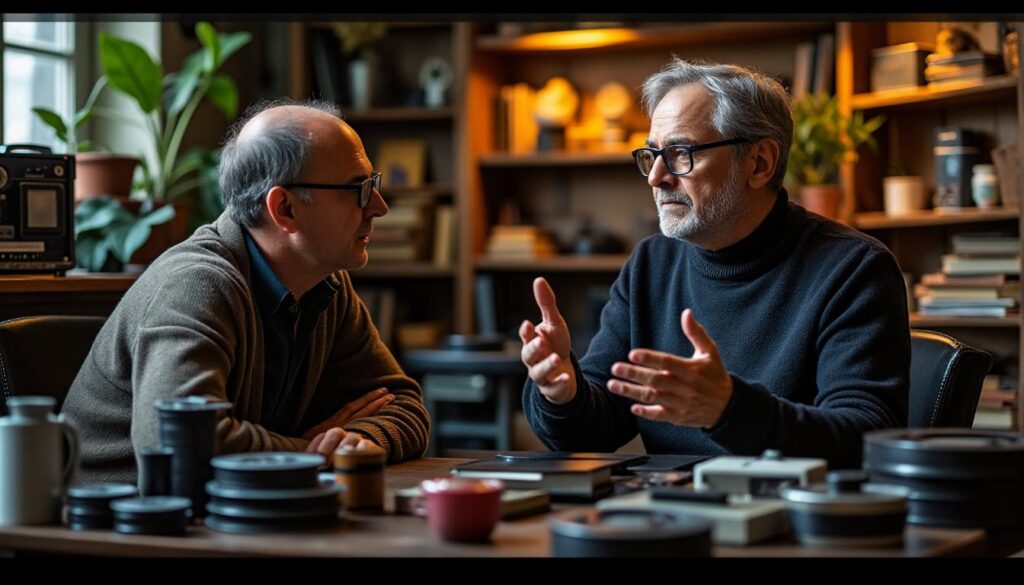
In this captivating interview, João Mario Grilo shares his thoughts on the restoration of his iconic film, The Trial of the King. Through a deep exploration of the documentary gesture and temporal dimensions, he illuminates the issues surrounding the representation of power and majesty in the 17th century. The discussion revolves around the influences of painting and cinematic techniques that transcend mere narrative elements to capture the essence of a complex and fascinating era.
An enlightening encounter with João Mario Grilo
In this fascinating interview, renowned director João Mario Grilo provides a valuable insight into his iconic work, The Trial of the King, recently restored. Through his reflections, he explores not only the documentary gesture that permeates his film but also the temporal dimensions that he addresses with depth. This first paragraph serves as an entryway into a discussion that embeds cinematic art within the spectrum of time and representation.
The documentary gesture in cinematic work
At the heart of Grilo’s reflection lies a fundamental aspect: the documentary gesture. This term evokes not only how historical narratives are captured but also how human emotions intertwine with past events. For him, each scene is a living testimony of intentions and struggles. By attempting to capture the truth, cinema forges connections between the viewer and the filmed subject.
This delicate interplay between fiction and reality becomes a narrative dance. In The Trial of the King, this dance materializes through the staging of dialogues and human interactions. It goes far beyond simple reconstitution; it is a true exploration of the connections that shape our understanding of history.
Grilo highlights a crucial point here: the need to give a soul to his characters. Documentary narratives are truly captivating only when one feels the life pulsating behind each representation. He thus emphasizes that the past can only be grasped through a cross-analysis of emotions and events. Ultimately, this human approach reveals the richness of the work.
The temporal dimensions in the narrative
Grilo has often been praised for his skill in manipulating time in his works. In this perspective, he explains how time becomes a character in its own right in The Trial of the King. The author particularly focuses on the notion of historical time that overlaps with personal and political revelations. This results in a polymorphic temporality where the past illuminates the present.
He also addresses the issue of temporality in relation to the viewer’s perception. The film invites each individual to reflect on the unfolding of events, provoking an inner dialogue about what it means to be a spectator of a collective story.
João Mario Grilo underscores the importance of waiting for the right moment for certain scenes to make complete sense. The strategic use of flashbacks creates a space where the viewer is both active and receptive, enhancing the impact of images and narratives. For example, the majesty of historical figures is reinforced through moments of silence, provoking deeper reflection.
The stakes of restoration
The restoration of a film is a delicate and demanding task. In the case of The Trial of the King, the restoration has brought back to life a work whose visual and narrative richness was in danger of disappearing. Grilo explains that every detail is meticulously examined. This attention is reflected in the care taken with lighting, texture of the image, and compositions. The process requires a deep understanding of technique and a willingness to preserve the film’s original essence.
An interesting aspect of this restoration is that it also opens discussions about cultural identity. Historical films like this offer insights not only into the era they represent but also into the values and questions of contemporary societies. They thus become witnesses to our evolution.
- The restored images create a link between the past and the present.
- A restored film can influence modern perception of historical events.
- Conservation is part of a broader framework of cultural preservation.
Open conclusion: a call for reflection
João Mario Grilo leaves us with a poignant thought on the importance of keeping films alive, sharing them with new generations so they can question their place in history. The Trial of the King, through its restoration, transforms into an open window onto the past, while creating a space for reflection on the present.
His dialogue with history resonates with every viewing, every encounter, and every discussion. This underscores the power of cinema as a medium capable of transcending time and evoking the universal in a language that speaks to all of us.
During our interview with João Mario Grilo, the emphasis was placed on the importance of the documentary gesture in his work, particularly through his iconic film The Trial of the King. Grilo invites us to rethink how cinema represents history, not merely as factual reconstitution, but as a living process where time and space coexist organically. The centerpiece of this reflection lies in its ability to bring forth a narrative through stylistic choices that engage our gaze and perception of reality.
The restoration of The Trial of the King represents an exceptional opportunity to rediscover this timeless depth. With the judicious use of light, set design, and dialogue, Grilo transports us to an era where the representation of power, majesty, and their symbolic implications become tangible. The mastery of time in his film lies not only in its narration but also in the way images float and reveal themselves, allowing each viewer to question their relationship with history and find echoes in their personal experience.
Grilo reminds us that cinema is above all an art of the moment, an art that captures fleeting moments to make them permanent. In our exchange, he also emphasizes the need to reclaim these works through careful restorations, a process that is not limited to technique but engages a broader reflection on cultural memory and the transmission of knowledge. This act of archiving and illuminating films, especially those bearing historical heritage, is fundamental to ensuring their accessibility to new generations and to fostering their understanding in a perpetually evolving world.


