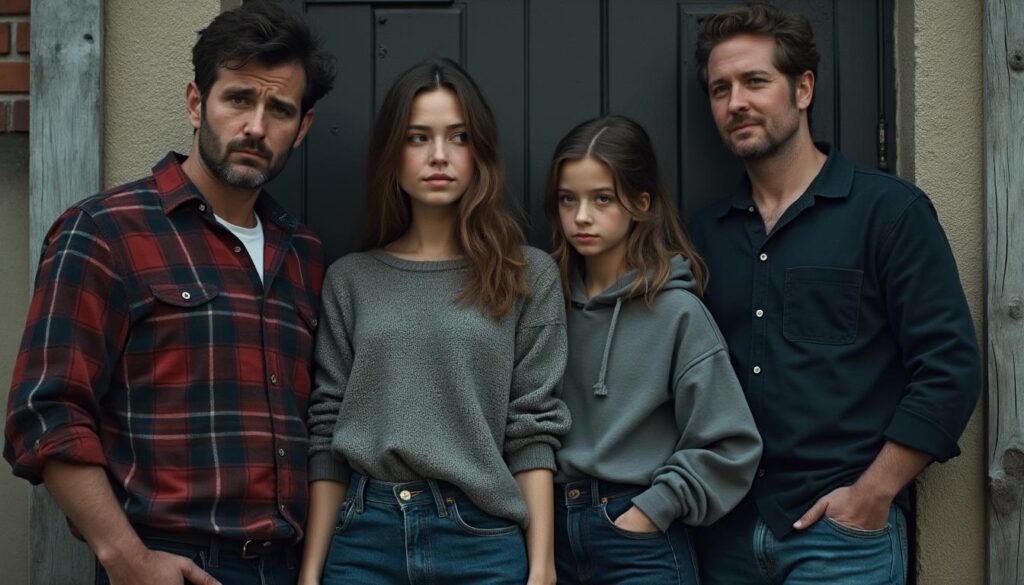
In his latest film, Father, Mother, Sister, Brother, Jim Jarmusch takes us on a family odyssey that intertwines humor, tragedy, and reflections on parental dynamics. Through a trilogy of disconnected narratives, Jarmusch explores the tensions and unspoken truths that haunt relationships among family members. With his mastery of detail and his keen sense of cynical irony, he depicts both the joys and the difficulties of these family ties, inviting us to question our own relationship with our parents and the concept of emotional inheritance.
In Jim Jarmusch’s latest masterpiece, titled “Father, Mother, Sister, Brother”, the director explores the complex and often difficult dynamics of family relationships. Through an interwoven narrative of three distinct stories, he immerses us in a universe where dark humor, irony, and poignant reflection on blood ties converge. Jarmusch, with his usual mastery, addresses themes such as manipulation, silence, and the quest for identity through the lens of human absurdity.
An Offbeat Humor at the Heart of the Narrative
Humor, omnipresent in Jarmusch’s universe, serves as a guiding thread. In “Father, Mother, Sister, Brother”, this is especially evident from the first scenes. Indeed, the author employs an offbeat style that depicts delicate situations with lightness. For example, the character Jeff, played by Adam Driver, perfectly embodies this comic and tragic duality. His relationship with a manipulative father creates moments that are both amusing and emotional.
This humorous facet is also linked to exceptional acting. Tom Waits, as the domineering father, manages to juggle between complicity and authoritarianism. Each line contributes to making the character both appealing and repulsive. The farce he embodies raises disturbing questions about parental relationships. Jeff’s winding path forces him to question his own choices in the face of the blindness of paternal admiration.
Striking Female Characters
The female dynamic in the film deserves special mention. Charlotte Rampling, Vicky Krieps, and Cate Blanchett together create a trio of powerful women who embody both tenderness and tension. The annual “tea time” scene thus becomes a true theatre of emotional confrontations. Jarmusch succeeds here in shattering stereotypes by presenting mothers who, despite their own struggles, often find themselves in disagreement with their children.
As the story unfolds, a heavy silence emerges. It becomes a symbol of an inheritance of rigid upbringings, where the unspoken seems to govern exchanges. The portrayal of the sisters, caught in this emotional void, is disarmingly accurate. The confrontations around the tea table reveal bitter and, at times, hilarious truths. Through this medium, Jarmusch challenges us regarding a woman’s ability to bear invisible sufferings.
The Children’s Quest for Identity
Another fundamental aspect of the film is the quest for identity of the children. As we approach the conclusion, the notion of emancipation takes on a full dimension. The twins, through their figurative shift from childhood to adulthood, reflect a maturation process. Far from parental judgments, they must learn to forge their own identities. Nostalgia is palpable in the scenes within the family apartment emptied of its occupants, a space now tinted with memory.
The reunion between Sister and Brother thus unfolds in a charged context; the death of the parents becomes a catalyst for reflection. Jarmusch offers us a space of delicacy where each glance and each gesture reveals profound mutual understanding. Ultimately, death becomes not only a separation but also a source of restored unity.
A Staging Rich in Symbolism
Finally, Jarmusch’s staging cannot be overlooked. Each shot is carefully crafted, saturated with meanings that go far beyond the dialogues. The artistic direction presents a visual universe that underscores tensions and emotions. The choices of sets are more than mere backgrounds; they become characters in their own right.
- A Parisian apartment that echoes memories
- A tea that we raise to remember with bitterness
- Urban landscapes that transcend the physical proximity of the characters
The sensitivity with which Jarmusch approaches these themes makes him a unique artist. Every image, every cut is a reminder of the fragility of human relationships, a call to feel rather than to judge. One can only note that this family odyssey questions each family member about their role and rightful place within the whole.
Father, Mother, Sister, Brother: A Family Odyssey by Jim Jarmusch
In their latest collaboration, Jim Jarmusch unveils a masterful work titled “Father, Mother, Sister, Brother”, where he explores complex relationships within a family through a lens that is both humorous and tragic. The film is divided into three segments that highlight the often tumultuous ties between members of the same family. Each narrative awakens a sense of empathy and reflection on the nature of family dynamics.
Jarmusch’s genius lies in his ability to blend humor with a deeply critical gaze on universal themes such as love, responsibility, and the quest for identity. The character Jeff, portrayed by Adam Driver, brilliantly exposes the moral dilemmas that children face in relation to manipulative parents. This analysis encourages the viewer to question their own beliefs and ties with their parents, prompting them to see the world through the eyes of their characters.
The depth of emotion that emanates from the performances of the actresses, notably Charlotte Rampling and Cate Blanchett, gives the work an additional weight. The tense scenes and heavy silences illustrate how emotional legacies can shape individuals throughout their lives. Jarmusch does not shy away from addressing delicate subjects such as family representativity and the pain of unspoken words, drawing attention to the necessity of communication.
In summary, “Father, Mother, Sister, Brother” is an invitation to revisit our own family stories, mingling laughter and tears. Jarmusch reminds us that even amidst chaos, there is always a hidden beauty, a lesson to be learned, and a path towards emancipation and understanding.