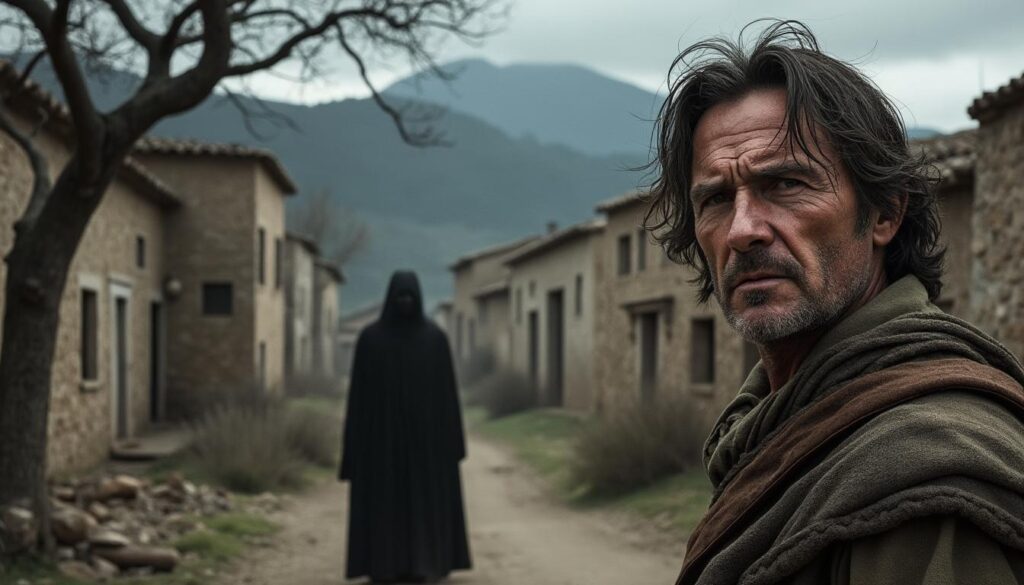
Fred Zinnemann, a renowned director, often remains underestimated in the cinematic landscape, despite memorable works such as From Here to Eternity and The Day of the Jackal. His film Behold a Pale Horse, a daring adaptation of the novel Killing a Mouse on Sunday, immerses us in a Spain ravaged by civil war, addressing complex themes such as morality and redemption. At the heart of this work, the tension between two diametrically opposed characters emerges, illustrating the internal struggles and heartbreaking choices each must face in the face of a tragic past.
Fred Zinnemann’s film ‘Behold a Pale Horse’ is a cinematic work that transcends simple tales of vengeance or redemption. It is a profound reflection on morality, war, and the human complexities that result from them. Through the gripping narrative of a story of exile and sacrifice, Zinnemann reveals the inner struggles of his main characters while exploring universal themes of humanity. This article examines how Zinnemann manages to immerse the viewer in this poignant drama, as well as the emotional and historical implications of his masterpiece.
A career marked by depth
Fred Zinnemann is recognized for his ability to explore deep themes through his films. Although often perceived as a studio director, his art goes far beyond mere conventional productions. In ‘Behold a Pale Horse’, Zinnemann deals with the exile of a man, an former Republican partisan, who returns to his homeland to find his dying mother. This plunges us into an atmosphere of tension, heightened by the constant fear of danger.
The film is also a reflection of past conflicts. The context of the Spanish Civil War, although rarely explored in cinema, is presented here with great authenticity. Through the narrative, Zinnemann uncovers the complexities of loyalty and betrayal while showing how these choices have devastating effects on individual lives.
Deep and nuanced characters
The main characters in the story, Artiguez played by Gregory Peck and Viñolas portrayed by Anthony Quinn, are treated with great precision. Artiguez, the protagonist, represents the struggle for redemption and inner peace. He is forced to face his past, but he is also haunted by his choices. Visibly weary from years of war, he finds himself in a world that has changed during his absence. This evolution shapes him as a character, rendering him as tragic as he is heroic.
Viñolas, the antagonist, is equally if not more complex. At first, he appears to be a simple executioner. But as the story unfolds, his obsession with Artiguez and his desire to understand his enemy become increasingly clear. This raises crucial questions regarding morality and the personal motivations behind each person’s role in the conflict.
A poignant narrative with tragic accents
The narrative of ‘Behold a Pale Horse’ is woven with tragedies. The story arc evolves as Artiguez tries to get closer to his mother. However, each interaction reveals not only the pain of exile but also the fragile links of the past that continue to influence the present. The tension is palpable as he secretly prepares for his visit, a symbolic act of redemption and consolation.
The representation of landscapes, crafted carefully by Zinnemann, becomes almost a character in its own right. The Spanish landscapes, mingled with archival flashbacks, evoke a sense of nostalgia and loss. The black and white used behind the camera by Jean Badal adds to the emotional intensity, highlighting the absence of color in these lives tormented by conflict. This is a very deliberate artistic choice that contributes to the film’s dark atmosphere.
The staging of a historical reality
Beyond pure fiction, ‘Behold a Pale Horse’ is rooted in historical reality. Zinnemann does not hesitate to integrate real historical archives, immersing the viewer in the horrors of war. This underscores the brutality of Franco’s regime, whose impact endures over time. The way the film treats this historical period, creating a palpable atmosphere, sheds significant light on the consequences of power struggles.
These elements give the film a depth that deserves recognition. Thus, Zinnemann addresses not only the barbarity of war, but he also allows for a reflection on reconciliation. The emotional impact of the work is undeniable, as it evokes thoughts about justice, redemption, and humanity in the face of horror.
An invaluable cinematic legacy
Ultimately, the film ‘Behold a Pale Horse’ is a treasure of cinema, a masterpiece that calls for introspection. Zinnemann has managed to capture the nuances of complex morality within a captivating narrative, thus revealing profound truths about human existence. The Blu-Ray edition by Indicator / Powerhouse allows new generations to discover this masterpiece, enriched with numerous supplements, attesting to its place in the cinematic pantheon.
The added interviews and documentaries provide a unique perspective on Zinnemann’s work and the context in which he made this film. It is an ideal opportunity for cinema enthusiasts and lovers of poignant stories to deepen their understanding of this exceptional work and explore themes that continue to resonate today, such as the desire for peace and redemption.
In summary, ‘Behold a Pale Horse’ is not just a simple film. It is an exploration of personal struggles in the face of external conflicts, a struggle that remains universal, always relevant in our contemporary world. This work by Zinnemann stands as a cornerstone of cinema, a reminder that even in darkness, there is always a path to light.
Fred Zinnemann and his masterpiece ‘Behold a Pale Horse’
Fred Zinnemann invites us to delve into the heart of the human soul through his film ‘Behold a Pale Horse’, a work that still resonates today due to its deep exploration of morality and redemption. Set against the backdrop of the Spanish Civil War, this film intricately weaves the themes of vengeance and forgiveness, thus offering a nuanced perspective on human conflicts and the moral choices that arise.
The narrative follows the journey of Artiguez, a former Republican fighter, who returns to his homeland to see his dying mother. This trip, which seems motivated by familial love, quickly transforms into a more complex and dramatic journey when he realizes he has been lured into a trap by Viñolas, his sworn enemy. This personal conflict reflects the larger struggles inherent in the human condition, all shimmering with a palpable tension that underscores the moral dilemma each character faces.
What Zinnemann brilliantly achieves is to transcend the framework of a simple revenge story to create a meditation on forgiveness and the consequences of actions. The characters, notably Manuel and the priest played by Omar Sharif, embody the duality of human nature, oscillating between conforming to the expectations of vengeance and the quest for inner peace. The settings are refined, and the black-and-white photography by Jean Badal highlights the shadows of human emotions. This creative choice amplifies the tragic themes of the film.
‘Behold a Pale Horse’ is not merely a film about war, but a powerful examination of the human condition, the scars left by conflicts, and the internal struggles that ensue. Thus, Zinnemann establishes his film as an essential work, worthy of exploring the moral complexities that traverse our existence.