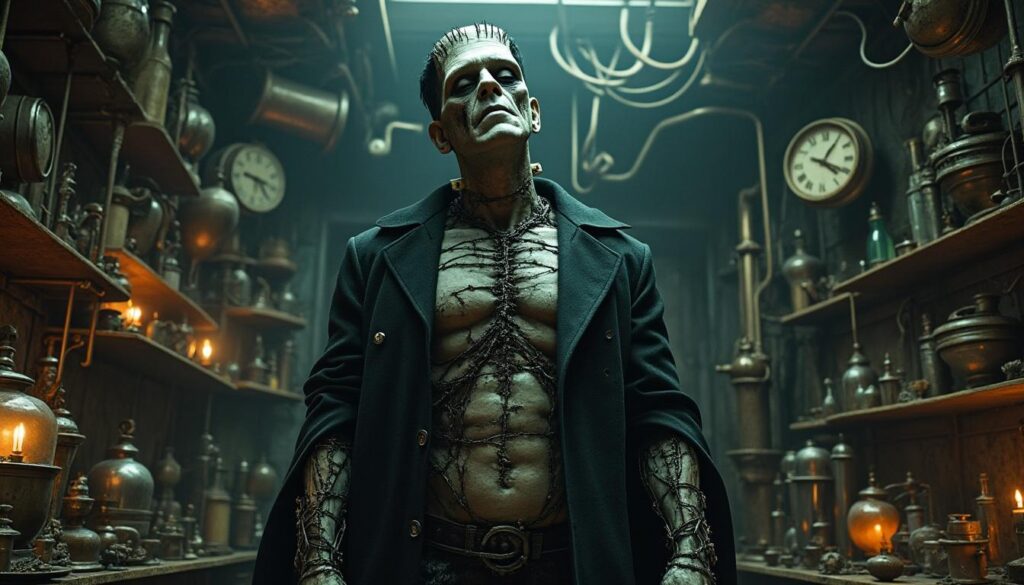
Guillermo Del Toro, the undisputed master of the fantastic, tackles one of the most striking myths in literature and cinema: Frankenstein. With an innovative approach, he revisits Mary Shelley’s masterpiece, infusing it with deep and personal themes. This project, which has long been an aspiration for the director, manages to blend humanity, creativity, and reflections on the human condition, while questioning the notions of creation and parentage. With an impressive visual style and an inheritance influenced by his own experiences, Del Toro promises a captivating adaptation that will resonate with both enthusiasts of the original work and newcomers alike.
Guillermo Del Toro, a famous Mexican director, presents a captivating and original interpretation of “Frankenstein,” the iconic work of Mary Shelley. Through his film, he explores the themes of creation, responsibility, and human nature, while infusing his own artistic vision. His adaptation offers a profound reflection on the very architecture of our existence, inviting viewers to reconsider the notions of monster and creator.
The Journey of Guillermo Del Toro
Guillermo Del Toro has always had a special connection to the myth of Frankenstein. Influenced from childhood by key works, his love for monsters and mythology has shaped his career. His admiration for James Whale’s 1931 adaptation shows how much this story has marked him, from religious concepts to aesthetic and moral reflections.
With a unique vision, he tackles complex themes that question the human condition. His interest in the strange and the fantastic leads him to create universes where humanity intertwines with horror. Each of his films showcases his talent for rendering monsters deeply human, evoking an unexpected empathy in their strangeness.
A Bold Adaptation of Frankenstein
In his adaptation of “Frankenstein,” Del Toro chooses to focus on the duality between the creator and his creature. He exploits the narratives of Victor Frankenstein and his monster within a bipartite narrative structure. Through this approach, he delivers an introspective look at artistic creation and the moral implications of human ambition.
The unfolding events prompt viewers to question the nature of creation. Victor, portrayed by Oscar Isaac, becomes a true ethical dilemma. His obsession with eternal life and his desire to excel make him both a fascinating and tragic character. His creature, played by Jacob Elordi, is a poignant reflection of the internal struggles faced by each individual against their own existence.
The Fundamental Themes of the Work
At the heart of this story are themes such as responsibility, the quest for identity, and the struggle against isolation. The relationship between Victor and his creature highlights the heavy burden of spiritual parenthood. Their interactions raise questions about the role of the artist: how far can one go to realize a work?
Furthermore, this film exposes the pain of abandonment. The monster, created to be loved, finds itself alone, desperately searching for a place in a world that rejects it. In summary, it is a meditation on the human condition, where each character becomes a reflection of a broader conflict within society.
Striking Visual Aesthetics
Aesthetically, Del Toro sparkles with inventiveness. The film is bathed in a gothic ambiance, reinforcing feelings of melancholy and tragedy. The artistic direction and photography superbly orchestrated by Dan Laustsen contribute to creating a unique atmosphere. The dim light, deep shadows, and meticulously designed sets plunge the audience into a universe that is both dark and enchanting.
Each scene reflects the emotions of the protagonists. Moments of suffering and solitude are accentuated by powerful visual choices. For instance, the use of natural elements, such as fire or water, intertwines with themes of rebirth and destruction. These metaphors reinforce the internal dialogue between the creator and its creation.
The Characters at the Center of the Narrative
The iconic characters are skillfully developed. Victor, filled with arrogance and despair, confronts his own demons. His dynamic with the creature reveals hidden aspects of his soul. The choice of Jacob Elordi for this role underscores the underlying humanity of the monster, which seeks nothing more than acceptance and understanding.
The presence of Christoph Waltz in the role of the patron introduces an intriguing character. The viewer perceives the ambiguity of intentions, thus evoking capitalism versus art. This dynamic offers a striking reflection on the contemporary realities faced by content creators in an environment often governed by profits.
A Mixed but Significant Reception
The journey of Guillermo Del Toro provokes both admiration and criticism. Although “Frankenstein” generated high expectations, the film has not always received a warm welcome in theaters. Distribution challenges and competition at the box office have partly hindered its visibility.
Nevertheless, it remains a work of great importance for cinephiles. This film addresses troubling and persistent questions. The strength of the work lies in its ability to tackle timeless subjects while captivating the audience through a magical staging. The questions raised by Del Toro resonate far beyond the film, posing ethical challenges in our own quest for understanding.
To learn more about the film and further explore Guillermo Del Toro’s universe, enthusiasts can turn to various resources. For example, a good read to prepare an appropriate costume can be consulted via a link here.
With his latest adaptation of “Frankenstein,” Guillermo Del Toro provides a personal vision and deeply introspective take on a classic of literature. By navigating between the fascination for the monster and the struggle of its creator, the director manages to question the notions of artist, creation, and responsibility. Victor Frankenstein, brilliantly portrayed by Oscar Isaac, embodies a complex character torn between his desire to transcend death and the consequences of his actions.
The duality of the narrative, shifting from Victor to his creature embodied by Jacob Elordi, enriches the story and allows for a deeper exploration of the themes of father and child, innocence and brutality. The creation of the creature is not merely a scientific act; it becomes a metaphor for the struggles that animate all human existence. In a universe where catholicism and mythology intersect, the film transcends genres, blending horror, drama, and philosophical reflection.
Del Toro boldly injects elements of his own experiences and spirituality, paying homage to the universality of Mary Shelley’s work. This adaptation invites viewers to reflect on timeless questions about human nature, suffering, and love, while maintaining a captivating visual aesthetic that is uniquely his own. Through his staging choices, he imposes a gothic aesthetic that judges the humanity of both its creator and the monster, thus proposing a reflection on the human condition in all its complexity.