
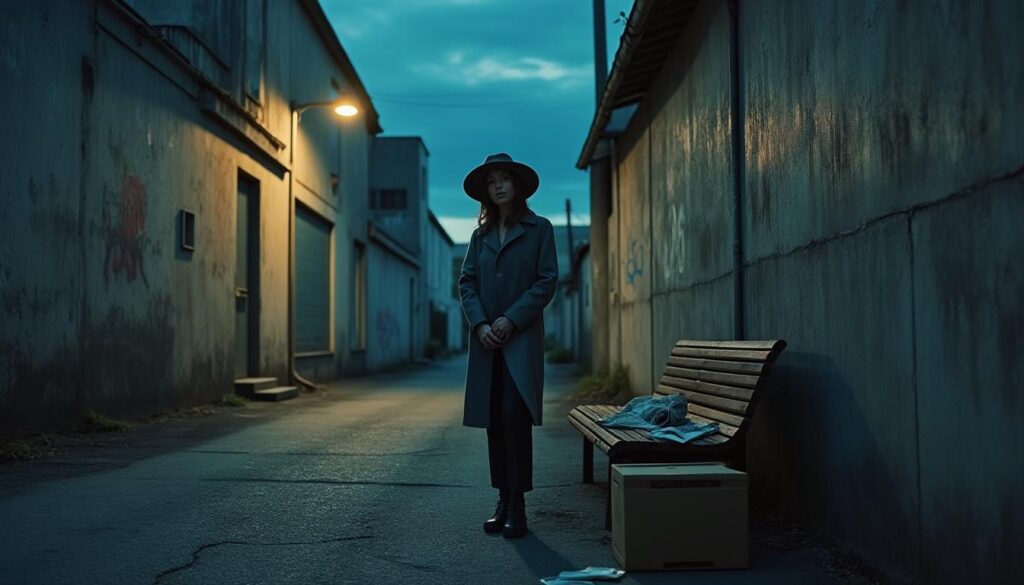
In her latest film, The Mastermind, Kelly Reichardt continues her bold exploration of cinematic genres by tackling the caper movie. Far from the humorous conventions often associated with this genre, she chooses instead to engage in an ambitious deconstruction, revealing the dark and absurd facets of her protagonists’ choices. Through a narrative tinged with despair and political anxiety, Reichardt invites us to reflect on the very essence of cinema, while questioning the myths and clichés that fuel it.
An Introduction to “The Mastermind”
In a cinematic climate where traditional canons are being challenged, Kelly Reichardt stands out with her latest film, titled “The Mastermind”. By deconstructing the genre’s codes, this director offers a narrative that provokes thought. This article analyzes the narrative and visual choices that constitute this intriguing work, while highlighting echoes present in Reichardt’s filmography. Instead of engaging in a heroic saga or incessant twists, the film explores the quest for identity and the consequences of human actions. Far from being mere entertainment, it is a true meditation on fate and failure.
The Bold Choices of the Director
The signature of Kelly Reichardt asserts itself in this film, marked by a clean style. Contrary to the conventions of classic American cinema, she presents characters whose choices are often problematic. Indeed, the deconstruction of the narrative manifests from the very first scenes, where the lack of clarity in the protagonists’ intentions suggests a lack of purpose. The film challenges the codes of the genre, particularly those of the caper movie, by showing the ramifications of failure.
It seems that Reichardt wishes to transcend simple entertainment, inviting the viewer to question. Through bold narrative choices, she sheds light on her characters’ flaws. Their inability to make wise decisions consistently questions the very concept of heroism. By exposing these weaknesses, she offers a new perspective on human nature, an exploration that deserves to be highlighted.
A Subtle and Immersive Setting
The direction of “The Mastermind” also stands out for its visual aspect. Dominated by cinematography inspired by American landscapes, it evokes iconic paintings. The staging, often compared to the works of Charles Burfield and Justine Kurland, establishes a dialogue between the natural setting and the characters’ emotions. Warm autumnal tones saturate the images, creating an atmosphere that is both welcoming and melancholic.
This stylistic choice reinforces the notion of intimacy, as scenes of sex, theft, or simple contemplation are immersed in a peaceful setting. Thus, nature plays an essential role as a reflection of the protagonists’ inner turmoil. Through this striking description, we understand that the environment is not just a backdrop, but a true character in its own right.
Multi-Faceted Characters
The main character, portrayed with finesse by Josh O’Connor, is constructed to symbolize an archetype of the failure. His awkwardness and inability to conform to expectations evoke both empathy and irritation. In other words, he embodies this figure of the anti-hero, whose journey seems inevitably doomed to failure. His evolution, although subtle, is crucial to the plot.
This character finds himself at a crossroads, navigating between the desire for success and profound vulnerability. Interactions with his family and friends reveal the nuances of his character, pulling the strings of emotional drama. His relationships are mirrors reflecting his own flaws, allowing the viewer to witness an authentic exploration of humanity.
A Film with Latent Humor
Although the film may appear devoid of lightness, it contains touches of subtle humor. Reichardt employs absurd comedy to create a distance between the audience and her characters’ adventures. Time and again, situations seem so desperate that they become almost comical. This fragile balance between tragedy and humor is one of the director’s trademarks, leading her to approach the gravity of failures with a more nuanced take.
The presence of this irony adds an additional depth to the film, stopping the viewer in their tracks to reflect on the human condition. In this quest for meaning, it is striking to see how moments of dysfunction can lead to a form of catharsis.
An Open Conclusion
In summary, “The Mastermind” does not leave one indifferent. This film presents Kelly Reichardt in a new light, using unique narrative devices to explore failure. Rather than providing simple answers, it raises questions about the nature of choices, morality, and identity. In an increasingly saturated cinematic landscape, the originality of Reichardt’s project is both a breath of fresh air and a profound reflection on our world.
To discover more information about Kelly Reichardt and “The Mastermind”, you can consult this article on Ype.
With “The Mastermind”, Kelly Reichardt delivers a work characterized by its bold deconstruction of classic codes of American cinema. The director, known for her minimalist approach, confronts one of the most established genres: the caper movie. This challenge, while ambitious, results in an adventure with an atypical narration, where the characters grapple with their own failings rather than conventional dramatic stakes.
As the minutes pass, the viewer is drawn into a universe where the usual humor and tension give way to an anesthetic passage of time, illustrating the absurdity of the protagonists’ choices. While the plot promises narrative turns, the disappointment lies in the fact that every opportunity inevitably transforms into a tangible failure. This unflinching view of failure is, in a way, indicative of an exacerbated fatigue in cinema for Reichardt.
The themes of individualism and despair fully reveal their dimension. At the center of “The Mastermind”, we find a character who, despite his convictions, remains mired in a solitary existence, without awakening to a collective consciousness. Reichardt’s direction, clean and graphic, continues to anchor itself in muted landscapes, but this time, she chooses to empty her narrative of any heroic character, thereby reducing her protagonist to a mere shell, mirroring a world that ends in disappointment.
Thus, “The Mastermind” does not merely redefine the genre, but questions the relationships between action and its consequences, while hinting at a broader reflection on the human condition in the modern era.


