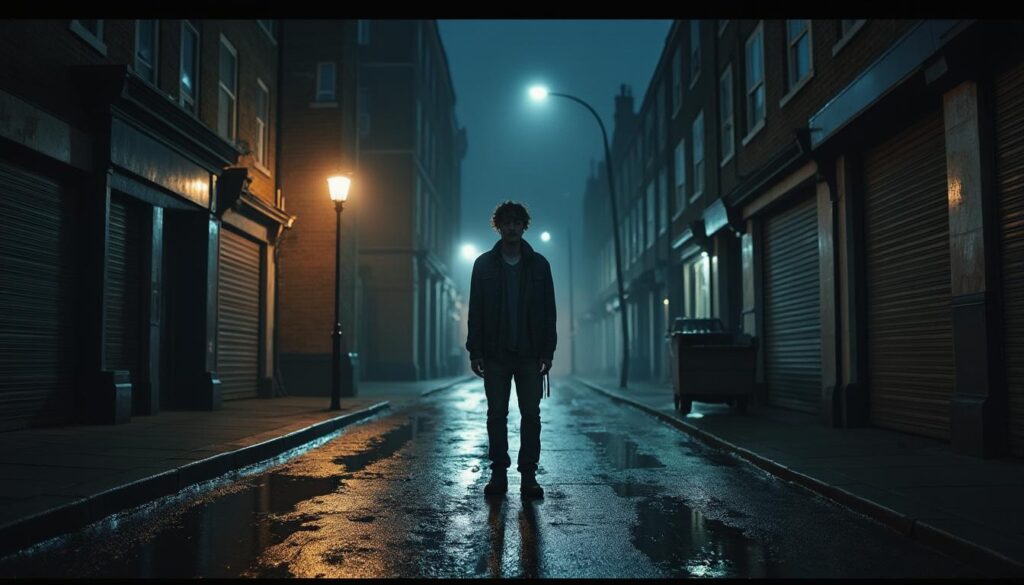
Mike Leigh, an essential figure in British cinema, offers with his film Naked (1993) a striking portrait of the violence and mistrust that inhabit the streets of London. Through the chaotic journey of Johnny, portrayed by a masterful David Thewlis, the director immerses the viewer in a universe where morality falters and where every interaction reveals the cruelty of human existence. Naked thus asserts itself as a work that is both unsettling and rich, pushing the boundaries of conventional storytelling to explore the depths of the human psyche.
In the film Naked, directed by Mike Leigh in 1993, British cinema shines with an unprecedented depth and brutality. Through its central character, Johnny, confronted with a disenchanted world, Leigh explores themes of nihilism, violence, and despair. This cinematic masterpiece provides an incisive look at a fractured British society. The work questions human relationships, loneliness, and the quest for identity in a heavy and sinister atmosphere.
An immersion in urban chaos
The first moments of Naked immediately plunge the viewer into a universe of despair. Johnny, portrayed by David Thewlis, flees to London after committing several offenses. The film begins with a brutal scene that highlights the omnipresent violence in the protagonist’s life. Then, Leigh’s camera takes us through the dark and nightmarish streets, where interactions are often marked by aggression.
The choice of location in Manchester and then London accentuates the feeling of isolation. Johnny’s journey resonates as a metaphor for his troubled mind. As he wanders through the city, he becomes a mirror reflecting the anxieties of a society in crisis. Through his encounters, he reveals the flaws of the characters he meets, while exposing his own decay.
A theatrical and immersive approach
Mike Leigh, drawing on his theatrical experience, collaborates closely with his actors. Each scene is the result of a long improvisation process that reveals the raw emotions and inner thoughts of the protagonists. This method creates an authentic atmosphere, where Johnny’s loss of bearings resonates with the fragility of the other characters.
This dynamic enhances the depth of the dialogue. One can feel a palpable intensity in each verbal exchange, which goes far beyond simple conversations. Here, authenticity is paramount. The magic of Naked lies in the way Mike Leigh is able to frame the unpredictability of human interactions, achieving an unparalleled immersion in the anxious everyday lives of his characters.
A character in despair
Johnny, a harsh and complex figure, symbolizes the despair of lost youth. He oscillates between charm and anger, attracting and repelling those who cross his path. His encounter with Sophie, for example, highlights the tragic beauty of human relationships. He appropriates Sophie’s vulnerability while reflecting his own misery back to her.
Johnny’s resentment towards society drives him to reject all forms of connection. He seems condemned to live his hatred, incapable of accepting, even for a moment, the sweetness of feelings. The scene where he violently questions the faith of passersby well illustrates this verbal aggression and the scathing critique of society. Each retort is like an arrow, leaving wounds where compassion should reign.
A dizzying social critique
Through this character and this narrative structure, Leigh offers a powerful critique of the British social context of the 1990s. By moving away from Manichean discourses, he presents characters that are both detestable and endearing. In this universe, the struggle for survival is not an empty phrase, but a painful reality. From this struggle, a tragic poetry is born.
Ultimately, the work feeds on the absurdity of this era. Johnny’s anger towards inequality manifests in his violence. Throughout the film, the camera captures this intensity and cruelty of human relationships, which Leigh highlights with stunning mastery.
A memorable and unclassifiable work
Mike Leigh leaves an indelible mark with Naked, through his unflinching exploration of human suffering. Through its aesthetic and the brilliant performance of David Thewlis, the film stands as a masterpiece of British cinema. The complexity of the characters, their internal struggles, and the interconnection of their misery result in a captivating narrative that leaves no one indifferent.
The film does not merely depict scenes of violence. It becomes an instrument for understanding a society in decay, grappling with its own contradictions. Consequently, Naked continues to resonate in the cinematic landscape, drawing attention to the social fractures that remain contemporary.
An immersion in the brutality of existence
In “Naked” (1993), Mike Leigh immerses us in a brutal and intense universe, marking a turning point in his filmography. The film stands out for its unflinching representation of the British society of the time, where individualism and despair reign supreme. Through the character of Johnny, brilliantly portrayed by David Thewlis, Leigh exposes the contradictions and pain inherent in human existence, skillfully balancing black humor and tragedy.
The filmmaker enhances the art of improvisation, allowing his actors to take ownership of their roles in an authentic way, thereby increasing the emotional impact of each scene. This aspect reinforces the realism of the narrative, making each interaction both palpable and poignant. The sometimes cutting dialogues reveal a society in decomposition, where everyone seems lost in their own turmoil, seeking a connection while being deeply isolated.
Moreover, Leigh’s direction employs bold visual choices to accentuate the film’s psychological tension. The often frantic camera movements and carefully thought-out compositions underscore the chaos and confusion that inhabit his characters. The duality between the visual beauty and the brutality of the themes tackled creates a disturbing yet profoundly captivating cinematic experience.
In sum, “Naked” remains an essential work of English cinema, combining stunning performance by actors and incisive social reflection. Mike Leigh achieves the feat of capturing the chaotic essence of life, prompting the viewer to question their own values and the human nature while providing a lucid look at a troubling reality.