
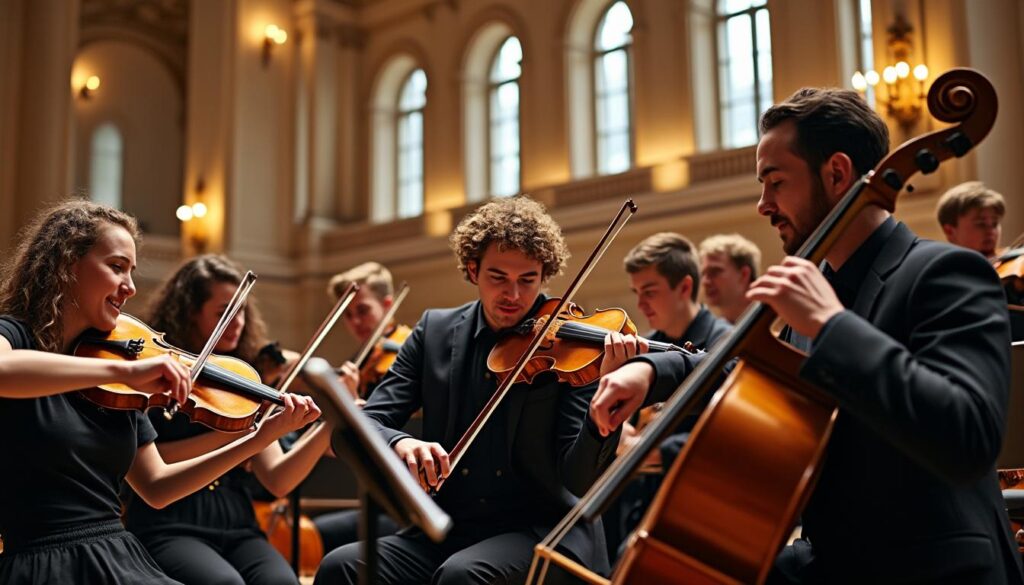
In his latest documentary, Philippe Béziat immerses us in the heart of a captivating adventure with ‘Nous l’orchestre’, where classical music becomes a reflection of a unique human experience. Through the eyes of conductor Klaus Mäkelä and the musicians of the Orchestre de Paris, the film reveals the very essence of a collective in constant interaction. The authentic testimonies of these artists, who juggle their individual aspirations and their common commitment, offer us a unique view of creativity and the dedication necessary to achieve a collective symphony.
The documentary ‘Nous l’orchestre’, directed by Philippe Béziat, plunges us into the fascinating world of symphonic orchestras. Through poignant testimonies and an immersive approach, the film reveals the dynamics of the musical collective and the humanity of the musicians who make up this large family. This work stands out for its way of exploring human relationships and teamwork while highlighting the beauty of music.
An immersion into the world of the orchestra
In the dim light of the Stadium de Vitrolles, we discover Klaus Mäkelä, the talented conductor, leading the Orchestre de Paris. The director masters the art of capturing the precise and charismatic gestures of Mäkelä, making us witnesses to the unique interaction between the conductor and his musicians. It is important to note that this film is not just a representation of concerts, but rather a sensory journey at the heart of the creative process.
Philippe Béziat invites us to perceive music from a new angle. Close-ups of the musicians, exchanges among orchestra members, all contribute to creating a vivid picture of the rehearsals. The diversity of personalities, their varied origins, whether from Portugal or Armenia, enriches the narrative and underscores the collective nature of musical creation.
Authentic testimonies at the heart of the symphony
The filmmaker chooses the approach of liberated speech. He gives a voice to each member of the orchestra, thus allowing us to discover not only the musician but also the individual. These testimonies illustrate the unique journeys of each musician while expressing, in one way or another, their deep passion for music. They share anecdotes about their daily lives, their challenges, and their aspirations.
This we that the director mentions is formed from their individual experiences and morphs into a collective entity. The strength of this approach is to humanize figures often idealized, showing that they are after all normal people, who commute to rehearsals by bike or subway, juggling the realities of their personal lives.
The dynamics of orchestral play
In the film, the idea that each musician contributes to the overall sound of the orchestra is particularly emphasized. Each instrument has a unique voice, but all must work together to create harmony. Béziat, thanks to remarkable sound engineering, immerses us in the auditory experience of each musician during rehearsals. He employs a large number of microphones, capturing the nuances, dynamics, and magic that occur within the orchestra.
In doing so, the director highlights the importance of listening. In a performance, non-verbal communication between musicians is crucial. The interaction between players, their ability to adjust and respond to each other’s playing, thus becomes a metaphor for living together. The magic of ‘Nous l’orchestre’ lies in those moments where music transcends words, where the collective is created through the sensitivity of each member.
A reflection on humanity and relationships
Beyond the music itself, Béziat reminds us that the life of an orchestra is also made of humanity. Tensions, friendships, frustrations, and harmonies all coexist in this musical space. The testimonies of the musicians, sometimes anonymous, expose darker realities: suffering, anxiety, and personal conflicts. By shedding light on these issues, the film manages to capture the complexity of human relationships in a demanding professional setting.
- Work colleagues: The boundary between friendship and responsibility is sometimes blurry.
- Experimentation with art: Musicians constantly go through periods of doubt.
- Essential cooperation: Every rehearsal is a necessity for collective success.
Every rehearsal then becomes a challenge in itself, a place where sharing and accepting one another are paramount. Philippe Béziat succeeds in showing that, despite the tensions, this coexistence can generate astounding results. This is illustrated by the fact that, ultimately, music is the link that unites all these individuals, a kind of universal language.
Time and space serving music
The film skillfully plays with the notion of time. Rehearsals, performances, and even auditions are filmed with a careful eye, taking into account not only the present moment but also the resonances of the past. The memories evoked by the musicians, their nostalgic glances, express a deep attachment to their art. This relationship with time enriches our understanding of their musical practice and the ties that are woven within it.
Moreover, the juxtaposition of images between their daily commitments and the rehearsals shows the reality of the classical musician today. They are artists but also individuals with lives, ambitions, and dreams. This allows the audience to easily identify with these characters while discovering a facet of their world that is often unknown.
In his latest documentary, Philippe Béziat immerses us in a universe where music transcends the mere artistic fact to become a true vector of emotion and human communion. ‘Nous l’orchestre’ is not only an exploration of the backstage of the Orchestre de Paris but a true tribute to the collective richness that emanates from each musician, each note, and each interpretation. Through intimate interviews and moments of rehearsal, Béziat demonstrates how music is built not only in the exchange of sounds but also in that of human experiences.
The film highlights the duality between the I and the we, a tension that reflects in every performance. Each musician, whether a violinist or percussionist, brings their own personality and story, contributing to the harmony of a complex and living whole. Thanks to careful staging and the clever use of sound technology, the director captures moments of truth where emotion is palpable. Viewers are invited to feel the intensity of rehearsals, as well as the shared frustrations and joys within this micro-society where art and friendship intertwine.
‘Nous l’orchestre’ transcends the simple representation of a musical formation to transform into a poignant testimony about humanity and collective work. Philippe Béziat does not just show the beauty of music; he explores the human dimension that accompanies it, reminding us that each symphony is the fruit of a group of individuals who set aside their differences to come together in a single melody. This documentary thus serves as an invitation to celebrate this artistic synergy, where harmony is created not in perfection, but in the vulnerability and personal investment of each.


