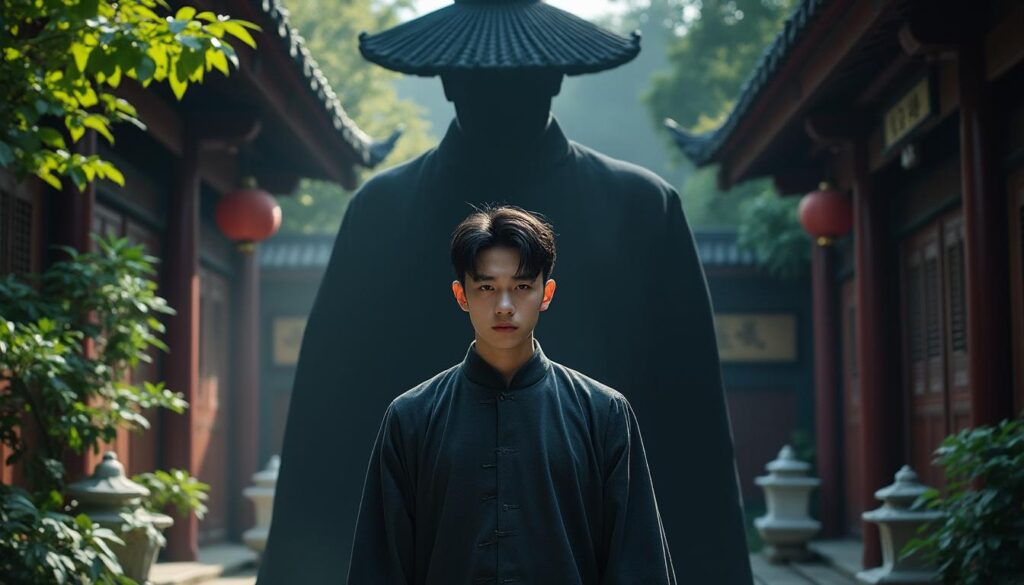
In the work of Qiu Sheng, a delicate exploration of the links between a son and his father unfolds, where the latter’s shadow looms long over his existence. This film offers an introspective look at family relationships, grief, and the quest for personal truth. Through the eyes of Qiao, the protagonist, the author questions the weight of paternal expectations and the process of identity reconstruction, thereby witnessing a profound reflection on the emotional legacy and memories that shape the individual. The duality between memory and reality is at the heart of this poignant work, inviting the viewer to navigate between the past and the present in search of an authentic understanding.
Through his work, Qiu Sheng explores the depths of the relationship between a son and his father, illustrating the echoes of absence and the quest for identity it entails. In his emblematic film, he navigates between memories, regrets, and the realities of a complex relationship. This introspective journey, where technology plays a major role, raises universal questions about memory, grief, and self-discovery. By drawing on personal experiences, Qiu Sheng manages to establish a powerful emotional portrait that resonates well beyond his own story.
A Tumultuous Filial Relationship
The connection between Qiao and his father Jiantang, as narrated by Qiu Sheng, is far from idyllic. From his childhood, Qiao experiences tensions with his father, who seems more concerned with his own vision of success than with his son’s emotional well-being. This imposing father, adhering to rigid values, never truly understands Qiao’s calls for help. An atmosphere of silence, tension, and unspoken words arises, exacerbating the gulf between them.
It is fascinating to see how technology plays a pivotal role in this dynamic. The voice messages left by Jiantang after his death become a bridge between the two worlds. These recordings, akin to echoes from the past, cast a bluish shadow over painful childhood memories. Qiao, now an adult, is able to create a digital version of his father, highlighting the limits of this digital connection. Just how much can one really grasp the essence of someone through pixels?
The Quest for Identity and Truth
Catharsis is at the heart of Qiao’s journey. In seeking to understand his father through his own conflicted memories and the insincere tributes of others, he embarks on a quest to discover *who Jiantang really was*. It is a dive into memory, through insinuations and multiple perceptions. Each recalled memory is tinted with subjectivity, often contradicting itself. This illustrates the flaws of human memory and the inability to grasp the entirety of who another truly is.
The Effects of Memory
- Black holes in memory.
- Shards of light on key moments.
- An inherent subjectivity in every memory.
The intertitles that punctuate the film itself guide the viewer’s reflection. They revisit elements of the funeral tribute while questioning their veracity. What makes a man *considered good*? The legacy he leaves behind or the relationship experienced with his loved ones? This questioning leaves the viewer in a void of certainties, fueling the dissonance that permeates the narrative.
Technology and the Paternal Ghost
The virtual double generated by Qiao through artificial intelligence represents a poignant metaphor for modern relationships and memories. It raises reflections on the immortality of the soul and hope, but also on the limits of technology. The way this double is shaped depends on Qiao’s own perceptions, illustrating how our memories and emotions can be filtered by our expectations.
There is also an irony in the representation of young characters who are surprised by the muffled calm by the riverside. Their carefreeness contrasts with the depth of Qiao’s quest, highlighting the gap between generations in facing life and death. This reflection on alternative reality seamlessly integrates into the themes of the fantastic explored by the director, evoking works as abstract as those of Kiyoshi Kurosawa.
Maintaining the Balance Between Introspection and Narrative
Ultimately, Qiu Sheng manages to maintain a subtle balance between a controlled staging and raw emotions. Although some moments may lack empathy, the strength of the images and narratives plunges us into the meanders of a complex paternal relationship. The juxtaposition between a clinical cinematic atmosphere and the pain of a son in search of authenticity appears as a metaphor for the internal struggles everyone experiences.
Through this work, Qiu Sheng infuses a new voice into a timeless theme, that of the relationship between a father and a son. This meticulous exploration of familial heritage, regardless of its scope, invites everyone to reflect on their own relationships. It is a cinematic journey that resonates with the universal struggle for understanding as well as for reconciliation.
A Son’s Legacy in the Shadow of His Father
In the work of Qiu Sheng, the tension between paternal legacy and the son’s individual identity is palpable. At the heart of this dynamic is a character beset by questions, navigating between the memories of a father both admired and feared. Qiao, in seeking to understand his father’s figure through the prism of modern technology, embodies the generational struggle that transcends time and emotions. This introspective quest questions not only the father-son relationship but also how memories shape our perception of others.
Through innovative narrative devices, Qiu Sheng successfully interrogates the nature of memory and identity. The use of virtual reality and artificial intelligence allows for the exploration of themes as varied as grief, anxiety, and reconciliation. The film ventures into a universe where absence confronts the possibility of digital resurrection, thereby providing a space for reflection on the bond of love and unresolved conflicts. It raises questions about how we communicate with our loved ones, even after their departure.
By adopting a poetic and introspective visual approach, Qiu Sheng immerses us in an atmosphere laden with emotion, where each image serves as a mirror of human complexity. The staging, while sometimes emotionally distant, does not lack intensity. It reflects the feeling of omnipresent imbalance in Qiao’s life, torn between the memory of a father who never knew how to listen and the burning desire to understand his legacy. The work thus becomes an ode to familial rapprochement, offering a chance to rebuild broken bonds, even beyond death.