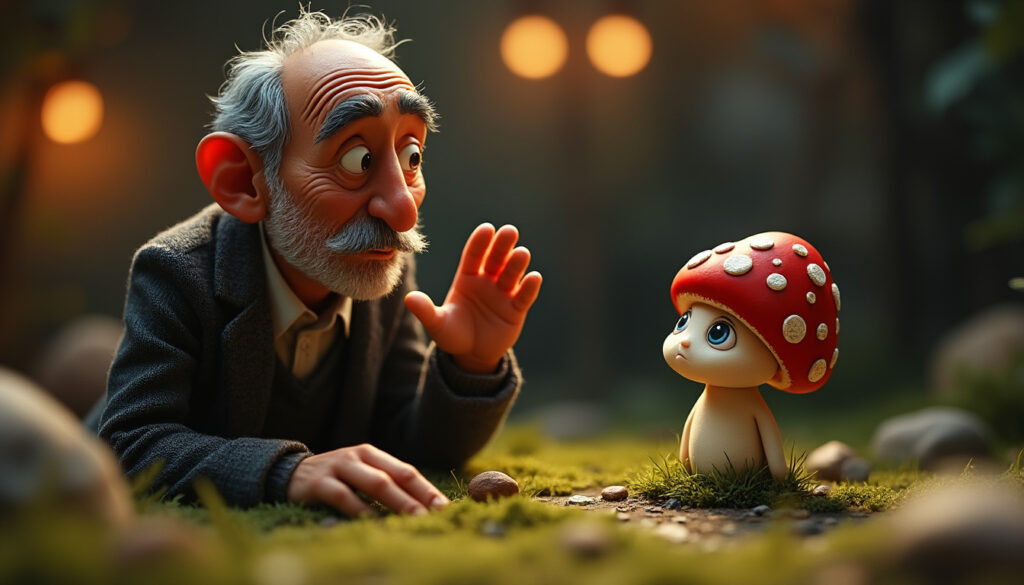
With One Last Hat-Tip, Rodolfo Pastor reunites with Capelito for eight new adventures in modeling clay. Guided by his magic nose, the little mushroom turns mishaps into moments of poetry, humor, and solidarity, in a world where imagination brings every detail to life.
With One Last Hat-Tip, Rodolfo Pastor brings back his little modeling-clay mushroom in a new collection of eight short films. Between gags, inventions, and unexpected encounters, Capelito turns the little mishaps of everyday life into wonderful adventures. This collection unfolds an artisanal world where imagination does not escape reality: it transforms it, with gentleness and mischief.
A new rendezvous with the mushroom in the magic hat
Capelito is back with his familiar appearance and a nose capable of conjuring up all kinds of hats. In this series of brand-new stories, his sociability often puts him at the center of attention, earning admiration from his neighbors, sometimes tinged with jealousy. But his whimsy is about more than entertaining the crowd. When an egg falls from its nest or a friend runs into trouble, he watches, looks for an idea, and puts his talents to work for others. The film thus gives his slapstick antics a generous spirit, without ever turning him into a solemn hero.
The origins of an extraordinary nose
The collection first takes us back to Capelito’s birth, in the episode that reveals the origin of his power. The little mushroom dreams of changing his hat, like the character in his favorite fairy tale. A crocodile appears outside his house, clearly in pain. Capelito is initially afraid of being eaten and sprinkles white spots on his hat to make himself look like a poisonous mushroom.
The ruse soon gives way to compassion, because the crocodile is not dangerous: he is ill. Capelito treats him with whatever he has to hand, despite his imposing size and the blankets that must be piled on him to keep him warm. Once cured, the animal turns out to be a kind fairy. She gives her host a magic nose, and now a simple pinch is enough to change his hat with a joyful honk.
A modeling-clay workshop where anything can change
In Rodolfo Pastor’s world, the forest feels like an open testing ground for every kind of surprise. The hills, houses, and everyday objects seem to be waiting for an idea to transform them. An avalanche can help make a gigantic ice cream. A potion promises to change someone’s hair, while a magnet becomes an unusual weapon against mischievous germs. This imagination is not based on magic alone: it also grows from attention to the shapes and possible uses of things. Capelito looks at his surroundings, spots an opportunity, and comes up with a solution using whatever is nearby.
Solidarity often gives his inventions their purpose. To save an egg that has fallen from its nest, he adapts his hat and turns it into a propeller helmet. When germs make their way into nostrils, he improvises a way to dislodge them. This little magician is not trying to accomplish grand feats. He would rather fix a problem, bring a smile, or help a neighbor. His nose may allow him to change his appearance, but above all it becomes a practical tool, a source of unexpected solutions. Each transformation thus extends an act of care for the living world.
The marvelous also finds its way into the relationships between the characters. A mermaid lives in the pond, and Capelito eventually falls in love with her. Their meeting brings together two worlds that seemed far apart, without the film needing to draw a rigid boundary between them. Elsewhere, turtles can form surprising police convoys, while leaves turn into feathers. These ideas are presented with playful simplicity, as if the world need only be seen differently to reveal its possibilities. The strange does not interrupt ordinary life: it slips into it, colors it, and makes it more expansive.
A poetry of details, sounds, and textures
Capelito’s little house is an essential part of these films’ charm. Glass jars and utensils line the shelves, alongside ceramic jugs that evoke a lived-in home. A green chest of drawers holds a few books, while a bed by the window is covered with a colorful patchwork quilt. These objects are more than simple props. Their textures, colors, and arrangement give the setting a welcoming, almost familiar presence. It is a space where surprises unfold amid everyday routines.
Outside, the landscapes extend this sensitive attention to detail. In the snowy valleys, the trees look like little lampposts topped with pearly leaves. The wind makes them sway, and the light seems to glide over their rounded shapes. The hills offer a sweeping backdrop, yet are made up of painstakingly detailed elements. This union of the vast and the tiny fuels the sense of wonder unique to the series. In a single shot, a forest can seem large enough to hold a thousand adventures and detailed enough to invite us to pause over a single leaf.
Music adds another texture to this animated world. Sound effects accompany Capelito’s movements, and the theme songs set a cheerful tone. Some episodes also feature music played by the characters themselves, like the chanterelle orchestra preparing for a concert. On his birthday, a bear skis through the valleys while humming Verdi. The contrast between the grandeur of a musical score and the comedy of a scene creates gentle humor rather than a mere joke. Sound thus contributes to the personality of each adventure.
In another episode, an excerpt from Also sprach Zarathustra accompanies the opening of Capelito the Henpecked Dad. The solemn reference contrasts with the slapstick situation and plays on the audience’s memory. The orchestra becomes part of the story, just like the gestures, objects, and settings. This musical variety helps make each short film a self-contained little composition. It also highlights the freedom of Pastor’s workshop, where cinema can play with its own conventions without losing its gentle touch. The result remains accessible to children while offering a few knowing nods for adults.
Finally, the modeling-clay animation gives transformation a tangible presence. Objects seem ready to be reshaped at any moment, and the characters inhabit a hand-crafted world. A hat becomes a brand-new accessory; a recipe produces an improbable solution; an element of the landscape lends itself to a new use. This visual malleability makes the impossible believable, because each transformation seems to emerge directly from the material. The viewer is witnessing less a distant miracle than an invention taking shape before their eyes, with a tangible sense of mischief.
Modest adventures, open to infinity
Capelito does not need grand ambitions to get by. He lives in a little forest cabin and pays attention to what is happening nearby. His observant eye notices details, his dreams extend each situation, and his magic nose helps him take action. He does not try to escape reality, but to work with it, embracing its colors, contours, and hidden possibilities. This way of inhabiting the world makes the character endearing: his inventions spring from both imagination and careful observation.
The eggs that recur throughout the collection embody this promise of transformation especially well. They suggest fragility, but also what is preparing to hatch and multiply. Around them, the stories bring forth chicks in the snow, germs in armor, or an owl roused from sleep by the birds’ commotion. The situations shift in scale and tone without losing their playful coherence. Even the smallest scene can open onto a teeming world. The film thus cultivates an attentive sense of wonder, built on surprises rather than grand speeches.
This new rendezvous brings together the ingredients that have shaped the filmmaker’s world: transformation, music, slapstick, and sharing. The title One Last Hat-Tip suggests a farewell, but Capelito’s vitality leaves the door open to further flights of fancy. Eight short films make up this journey, in which the little mushroom’s nose connects appearances, desires, and beings. The conclusion of each adventure opens up a new possibility, as if the material always held some as-yet-unknown shape. The world then seems immense, not despite its smallness, but because of it.
With One Last Hat-Tip, Rodolfo Pastor brings back the little modeling-clay mushroom for eight brand-new adventures, where every detail seems ready to transform. His magic nose, which lets him change hats in an instant, becomes much more than a comic device: it opens paths to the unexpected and helps Capelito respond to the needs of those he meets. Behind the gags and cheerful sound effects, the character remains attentive to others, always curious about what the world might have in store for him.
The collection also reveals the origin of his power. In this first story, a sick crocodile appears outside the mushroom’s house. Capelito first hides his hat beneath white spots, but his wariness quickly gives way to compassion. By taking care of his visitor, he receives the gift that has long fueled his dreams: the ability to transform his hat according to his imagination. This story already sketches out the distinctive balance of Pastor’s world, where the marvelous emerges amid ordinary acts.
The other episodes unfold a teeming world: a mermaid can awaken Capelito’s love, an avalanche can help make a giant ice cream, and an egg fallen from its nest can spark an improvised rescue mission. The forest, the snowy hills, and the hero’s little house create an artisanal setting rich in textures and colors. Familiar objects, musical mushrooms, and fanciful creatures coexist in a world of imagination that is constantly renewed.
Music is an essential part of this atmosphere, from catchy tunes and expressive sound effects to unexpected nods to the classical repertoire. Beneath the apparent simplicity of the animation, Capelito invites us to observe, invent, and care. His hat changes, his nose honks, and the smallest feature of the landscape can become the starting point for a new adventure.