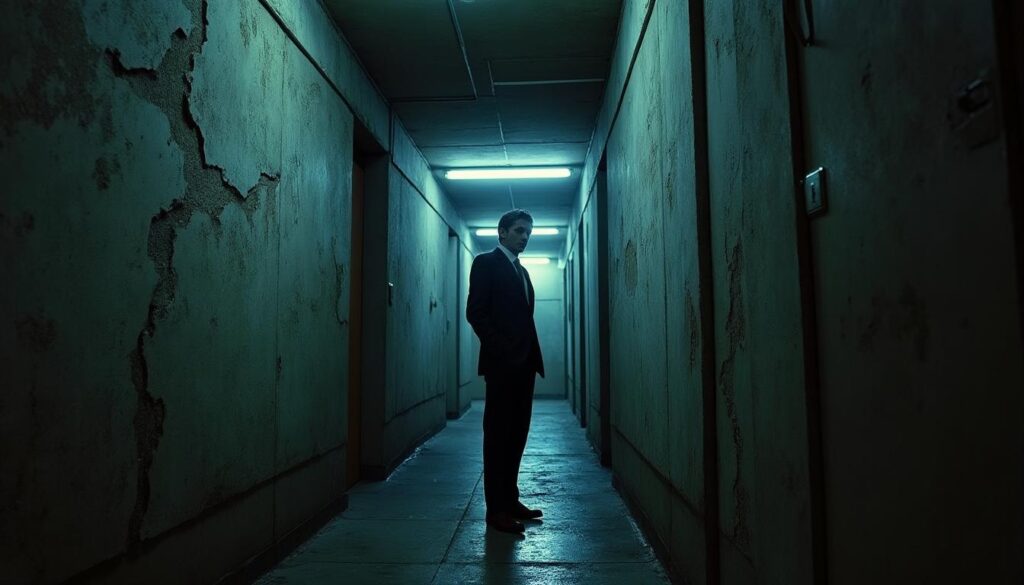
Through the emblematic work of Roman Polanski, “The Tenant” (1976), the viewer is drawn into a universe where reality and paranoia intertwine to create a palpable atmosphere of dread. This psychological thriller explores the depths of isolation and alienation within an oppressive urban setting, where the anonymity of the main character, Trelkovsky, becomes a reflection of a broader social malaise. Based on the story by Roland Topor, Polanski develops a staging of unmatched mastery, playing on the codes of the genre to question the very nature of identity and power. This dive into the troubled mind of the protagonist invites reflection on human anxieties, while keeping the viewer on the edge of their seat until the last minute.
The film The Tenant, directed by Roman Polanski in 1976, represents an emblematic work of the psychological thriller. Inspired by Roland Topor’s novel, this feature film offers a deep and disturbing exploration of the themes of anger, alienation, and paranoia. Polanski reinvents the codes of the genre by inserting a reflection on identity and society, all while creating an oppressive atmosphere. Through the life of its protagonist, Trelkovsky, the viewer is drawn into a disturbing spiral where the boundaries between reality and dream blur.
roman polanski and his influences
Roman Polanski is a filmmaker whose career is marked by intense personal experiences. Born in Poland, he fled war and persecution during his childhood. These events left an indelible mark on his work. The Tenant is not just a film, but also a mirror reflecting the fears and anxieties of the author. In this work, he addresses themes of trauma and solitude, often present in his other films, such as Repulsion and Rosemary’s Baby.
The references to his past and the tragic stories he has lived through add significant depth to this adaptation. This unease present from the very first scenes plunges the viewer into a universe where anxiety becomes palpable. Polanski’s direction of actors, along with his meticulous choice of sets, helps to anchor this tension.
The story of the tenant
At the heart of The Tenant is Trelkovsky, whose journey highlights a growing alienation. This young man, shy and awkward, moves into an apartment in Paris. This place quickly becomes a character in its own right, imbued with mysteries and tensions. Succeeding a previous tenant who committed suicide, Trelkovsky faces the mistrust and hostility of his neighbors. Each interaction exacerbates his feeling of isolation and depersonalization.
Elements of the plot, such as strange noises coming from the walls or the suspicious glances of the neighbors, create a suffocating atmosphere. The apartment, both a refuge and a prison, symbolizes the immense social pressure to which the protagonist is subjected. Polanski uses the camera almost as a voyeuristic character to observe Trelkovsky.
a disturbing visual aesthetic
Polanski’s direction in The Tenant plays a crucial role in creating the oppressive atmosphere. The camera, manipulated by cinematographer Sven Nykvist, is often floating, almost spectral, capturing every gesture of the protagonist with a disturbing intensity. This aesthetic choice reinforces the notion of paranoia that permeates the entire film. The credits, for instance, begin with a mysterious face, a preamble to the unknown and the disturbances that will follow.
Moreover, the sets are meticulously designed, engulfed in a dark ambiance where every object, every reflection, carries meaning. The staging emphasizes emptiness and anxiety, amplifying the feelings of discomfort present in the main character. Each shot can be analyzed as a painting of distress, revealing the psychological depths of a man struggling against his own surroundings.
Themes and interpretation
Beyond the psychological thriller, the film interrogates broader themes such as identity and social acceptance. Trelkovsky, as a character without a first name, symbolizes the loss of identity, often relegated to the status of a mere tenant. This dehumanization is reinforced by the inquisitive gaze of his neighbors. The issues of racism and xenophobia are also present, as Polanski reflects on his own journey. The dialogue of the characters, often filled with suspicion, testifies to a rejection of the other, echoing contemporary society.
- Paranoia: an omnipresent feeling that shapes the narrative.
- Solitude: Trelkovsky is always surrounded, yet profoundly alone.
- Identification: the viewer is invited to engage in Trelkovsky’s journey.
As The Tenant unveils a unique vision of the psychological, it also positions itself as a poignant critique of society. A society where isolation and anxiety take precedence over empathy. Roman Polanski, through this masterpiece, reveals himself as a relentless observer of human flaws.
“The Tenant” stands out as an emblematic work of Roman Polanski, capturing the despair and alienation of an individual facing a hostile society. The story follows Trelkovsky, an ordinary man whose life takes a turn when he moves into an apartment where the former tenant committed suicide. This Parisian urban setting, far from being trivial, becomes a true character in its own right, symbolizing the oppressions and fears that inhabit the protagonist.
Polanski’s manipulation of the direction, through ingenious visual effects and breathtaking camera work, accentuates the psychological tension. The architecture of the building – claustrophobic and labyrinthine – carries the viewer into a universe where reality and nightmare coexist. Each scene is imbued with an anxiety, where everyday elements become sources of threat and dread.
The film is not only an exploration of paranoia; it also depicts cultural rejection and isolation. Trelkovsky, as a Polish immigrant, represents vulnerability against a society that is wary and hostile. This theme, resonating with Polanski’s own history, adds a tragic depth to the work, illustrating the shortcomings of humanity in search of understanding against indifference.
Through “The Tenant”, Polanski offers us a incisive view of the human condition, skillfully blending horror and absurd humor. His ability to immerse the viewer in the unknown, while keeping them on the edge of their seat, attests to his genius as a director. This film, rich in symbolism and imbued with a troubling atmosphere, remains an essential masterpiece of the psychological thriller.