
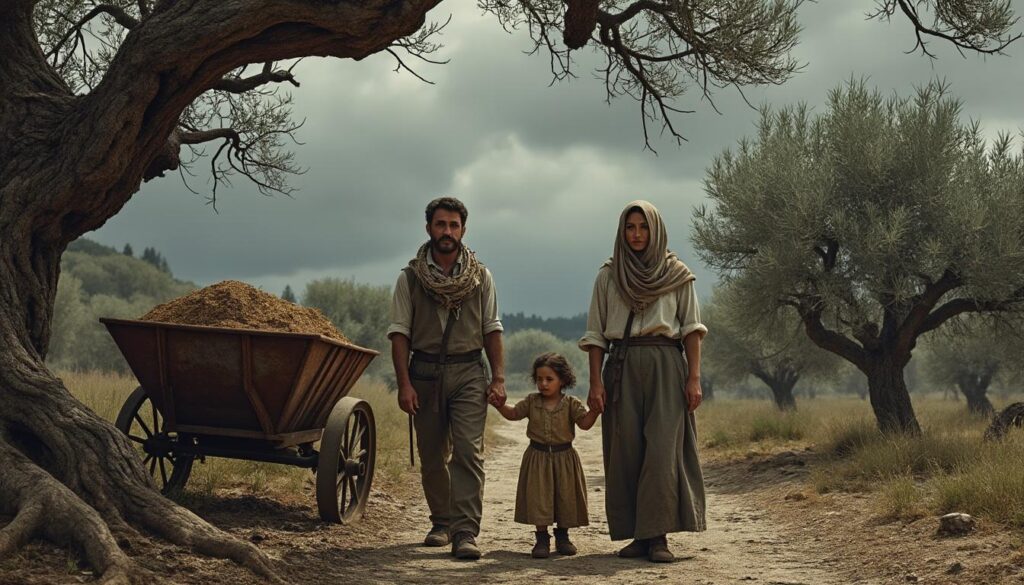
Giuseppe De Santis, an emblematic figure of Italian neorealism, made his mark on his era with bold works that challenge narrative and formal conventions. Among his major accomplishments, Bloody Easter (« Non c’è pace tra gli ulivi »), released in 1950, stands out for its ability to combine elements of drama, melodrama, and western, while exploring the universal themes of justice and social injustice. This film, imbued with humanism and social critique, sheds light on the daily lives of the working class in post-war Italy, offering a poignant reflection on the struggle of the oppressed against an unequal system.
Introduction to Giuseppe De Santis and “Bloody Easter”
Giuseppe De Santis is a director who has profoundly influenced Italian cinema through his commitment and unique style. His emblematic film, “Bloody Easter” (or “Non c’è pace tra gli ulivi”), released in 1950, brilliantly illustrates the social issues of post-war Italy. This work fuses various artistic influences while remaining rooted in the reality of the working class, making it a masterpiece of neorealism.
The artistic journey of Giuseppe De Santis
Giuseppe De Santis, born in 1917, is a prominent craftsman of neorealism. Before taking to the camera, he was a film critic. His career truly took off after his contribution to the film “The Devil’s Lovers” by Luchino Visconti, where he learned the ins and outs of directing. In 1945, he made his debut with “Days of Glory”, but it was truly with “Bitter Rice”, in 1949, that he gained notoriety.
Then, with “Bloody Easter”, he succeeded in redefining cinema as it was known. The film adapts mythological narratives to contemporary realities, blending drama and social criticism, thus creating an emotionally rich work.
The themes of “Bloody Easter”
This feature film addresses fundamental issues such as class struggle and the quest for justice. Through the character of Francesco, a former soldier, the film explores the consequences of the Second World War. He returns to his village to discover that his family has lost their possessions. This tragic scenario resonates with a society torn by injustice and poverty.
- Social injustices: The disappearance of property and the oppression of the weakest are central to the narrative.
- Collective claim: Francesco’s evolution from outcast to leader highlights popular resilience.
- Sense of community: Rural scenes illustrate the solidarity and struggle of the inhabitants against adversity.
A unique and bold aesthetic
Giuseppe De Santis adopts a striking visual approach in “Bloody Easter”. The film stands out for its carefully composed frames and fluid camera movements. An iconic sequence presents a landscape where silhouettes carry umbrellas, creating an almost surreal and poetic image. This desire to give grandeur to the narrative stands in opposition to the naturalistic ideology of neorealism.
Moreover, the director employs non-professional actors, thereby reinforcing the connection to reality. This choice underscores his commitment to an authentic representation of the characters’ emotions and struggles. De Santis does not hesitate to incorporate various genres, such as melodrama and typical elements of western, thus offering a rich and varied cinematic experience.
Contemporary resonance and legacy of the work
The film is not just a simple chronicle of the past. This work questions Italian society and its inequalities in a universal manner. The emblematic phrase “There are those who have something, and those who have nothing” sadly resonates even today. De Santis’s critical gaze on social mores remains relevant, sparking reflections on current inequalities.
Furthermore, “Bloody Easter” paved the way for new currents of thought in European cinema. Its bold blending of styles will continue to influence many directors, demonstrating the power of neorealism in the evolution of the seventh art. The film is now recognized as a classic, available in high definition from Studiocanal.
Giuseppe De Santis and his landmark work: “Bloody Easter”
Giuseppe De Santis represents an emblematic figure of Italian neorealism, a movement that has radically redefined the cinematic landscape of its time. With “Bloody Easter” (« Non c’è pace tra gli ulivi »), released in 1950, he establishes himself as an undisputed master, combining a documentary approach to reality with a deep artistic sensitivity. This film illustrates the struggles of the working class, highlighting the injustices endured by Italian peasants in post-war Italy.
The plot of “Bloody Easter” focuses on the character of Francesco Dominici, a former soldier facing the harshness of his return to civilian life. De Santis explores interpersonal and community conflicts through a narrative that is both realistic and allusive. The staging, marked by the use of non-professional actors, offers a striking authenticity, underscoring the precarious living conditions of these characters. This choice echoes his desire to give voice to those often sidelined by mainstream cinema.
Additionally, the film is characterized by a bold aesthetic, incorporating elements of surrealism and references to classical myths. Francesco’s journey, which symbolically traverses several stages of Christ’s life, bears witness to a powerful syncretism between the religious and the historical, where cinema becomes a vehicle for reflection on social justice. The masterful performance of the actors, especially that of Raf Vallone, enhances the emotional impact of the work, revealing tormented souls long burdened by tragedy.
Thus, “Bloody Easter” is not just a simple film narrative; it is a poignant cry of revolt against inequalities and a call to awareness. Through this film, De Santis not only offers a social critique but reminds us of the importance of humanity and solidarity in the face of adversity.


