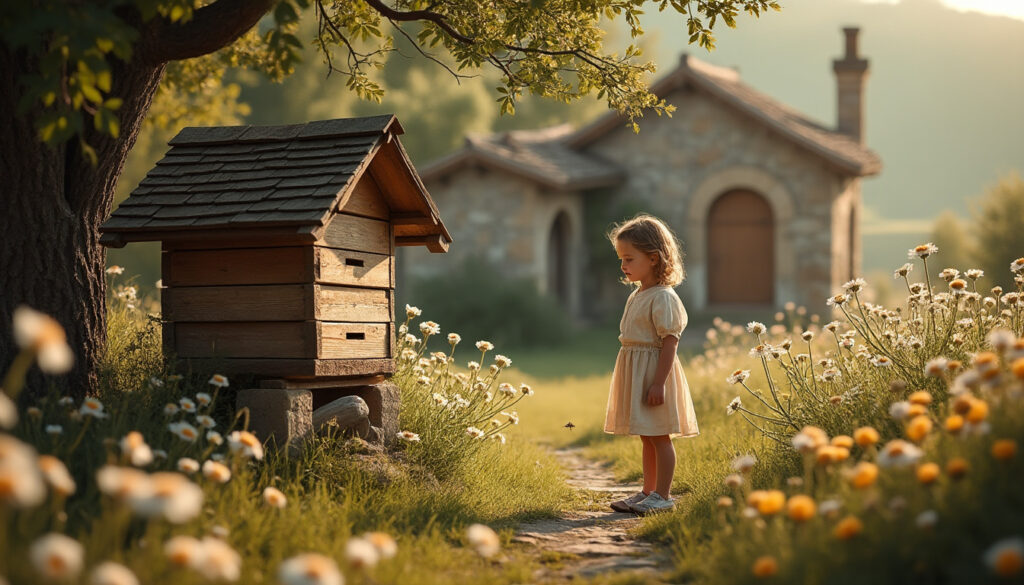
In the landscape of Spanish cinema, Victor Erice stands out for his singular approach, blending realism and poetry. With his masterpiece ‘The Spirit of the Beehive’, shot in the heart of the 1940s in Spain, he explores the themes of childhood, the imaginary, and reality in a context marked by The Franco dictatorship. Through the innocent eyes of two sisters, Ana and Isabel, the film invites reflection on human nature, where enchantment carves a path through a world often austere, creating a cinematic experience of rare intensity.
Victor Erice is a Spanish filmmaker whose work, through the film *The Spirit of the Beehive*, transcends simple cinematic narrative to become a poetic exploration of the themes of childhood, the imaginary, and reality. In this article, we will decode the richness of his film, the emotional impact it generates, and the visual beauty that emanates from it, all within a symbolic historical context. Thus, we will discover how Erice manages to capture the essence of childhood innocence amid the harshness of the world surrounding them.
An enchanting tableau: Erice’s world
The film *The Spirit of the Beehive* takes place in a small isolated village in Castile during the 1940s. This period marks the end of the Spanish Civil War, a time when the social climate is tinged with palpable austerity. The children, however, discover a glimmer of hope with the arrival of a traveling projectionist. This cinematic experience becomes a pivotal moment in their lives, a first encounter with fantastic worlds.
The rhythm of the film, both languorous and enchanting, invites the viewer to experience the naivety and emotions felt by the two sisters, Ana and Isabel. Their fascination with the film *Frankenstein* resonates with their own poignant reality, confronted by familial austerity and a often silent daily life. This contrast creates a particular atmosphere where the fantastic intertwines with an almost tangible world.
The importance of symbols and sound
Erice skillfully employs ellipses in his narrative, allowing the sound of a train arriving to evoke much more than just a simple image. This gives the film a strong symbolic dimension, where symbols rival the narrative content. The children’s gazes and visual compositions create echoes of universal emotions while allowing for personal interpretation.
In Erice’s sequences, every shot is meticulously studied. Often, the intimacy of the characters is revealed through static shots that capture the authenticity of their gazes. In this regard, the children become windows into a fragile world, where their innocent viewpoint reveals the complexity of human emotions.
The film does not merely depict a reality; it emphasizes how innocence can transform pain into poetry. In this context, the original score plays a crucial role in accentuating this duality. The musical compositions, while blending childish tones, create an ambiance that is sometimes peaceful, sometimes disturbing.
The sisters: a deep link between childhood and the imaginary
The two sisters, Ana and Isabel, embody facets of childhood. On one side, Isabel is bolder, seeking to explore the world. On the other, Ana represents a deeper sensitivity and a need for escape. This dichotomy between their characters echoes a collective feeling of wandering. Indeed, they find themselves alone, sailing between the imaginary and reality. With an absent mother and a preoccupied father, their daily lives are marked by a quest for love and comfort.
The experiences they share bring them closer, creating a strong bond that reveals the pain and joy coexisting in their universe. The imaginative games they invent become a mechanism of survival, allowing them to create a protective bubble away from the demands of the adult world. Thus, reality becomes evanescent, a distorted reflection through their innocent eyes.
The child’s gaze: a metamorphosis of the real
Erice explores, through *The Spirit of the Beehive*, the transformation that a child’s gaze can operate on reality. This candid look, capable of playing with shadows and lights, confronts the harshness of life. The themes addressed do not disappear; on the contrary, they come to life through the child’s eye. The film rejects raw realism, opting for a particular sensitivity that allows it to evoke both wonder and melancholy.
This identification process with the characters offers the viewer a unique immersive experience. The fears and fantasies of the little girls, like echoes of our own childhood, manage to evoke an almost hypnotic empathy. It then becomes difficult not to question our own conception of the imaginary, of dreams, and of memories. This emotional journey is one of the great strengths of Erice’s work.
An timeless masterpiece
Across the decades, *The Spirit of the Beehive* has managed to find its place among cult films. Anchored in Spanish history, it is like a rare pearl that continues to inspire filmmakers and critics. The beauty of its shots and the depth of its themes make it a work of incomparable richness. This masterpiece transcends the barrier of time, exploring universal themes that touch the essence of humanity.
Erice’s poetic universe, both through its artistic direction and its ability to touch sensitive chords, continues to resonate. The film reminds everyone of the importance of the imaginary in the face of adversity and the capacity of childhood to dream beyond difficulties. With each viewing, *The Spirit of the Beehive* is rediscovered, opening the way for reflection on how beauty and pain coexist.
Victor Erice: A poetic dive into ‘The Spirit of the Beehive’
In The Spirit of the Beehive, Victor Erice manages to create a work that transcends the simple boundaries of cinema to become a true sensory experience. Far from being just a film, it is an exploration of childhood, dreams, and fears that dwell in young and innocent hearts. Through the eyes of two little girls, Ana and Isabel, Erice captures the very essence of naivety and the imaginary, giving birth to a poetry that is both sweet and disturbing.
The atmosphere of the film, anchored in the historical context of post-war Spain, strengthens the contrast between the innocence of childhood and the harshness of the adult world. The carefully curated photography, with light and shadow play, highlights this duality, where the real and the dreamlike coexist harmoniously. The viewer, swept away by Erice’s delicate mise-en-scène, finds themselves sharing in the characters’ emotions, diving into their universe where every silence and every gaze speaks more than words.
With a unique narrative approach, Erice uses shocking ellipses, allowing sound and atmospheres to transcend simple action, thus creating an almost mystical link between the viewer and the work. The music, rich in nuances, accompanies this emotional depth, amplifying feelings of melancholy and wonder. The characters, imbued with solitude and innocence, open a gateway to a rich and complex inner world, where childlike beliefs mingle with the darkness of reality.
Through this masterpiece, Victor Erice confronts us with the power of the imaginary and its ability to illuminate, even briefly, the pain of the world around us, thus reminding us of the fleeting beauty of childhood and its dreams.