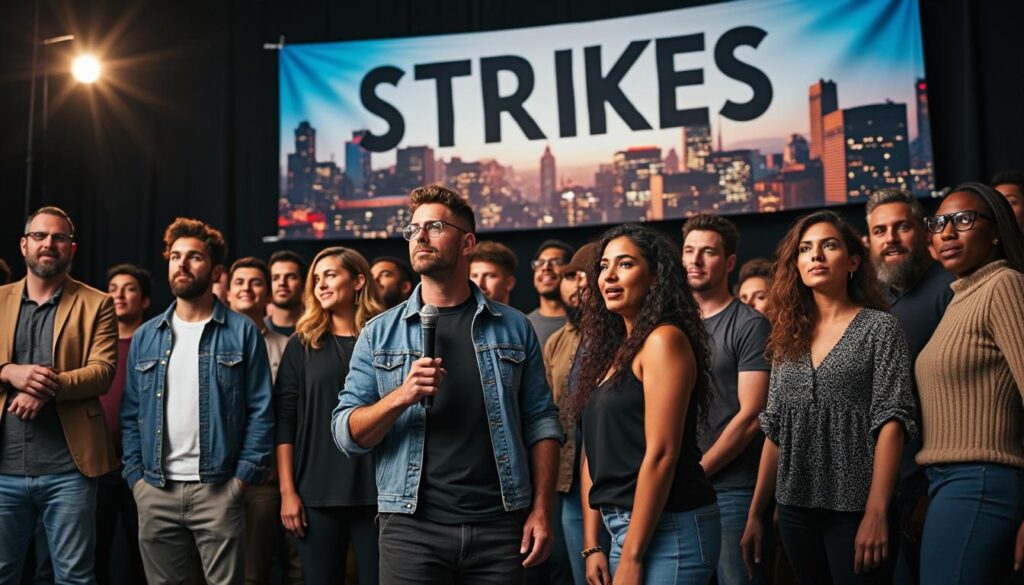
After nearly a year of tensions and battles between voice actors and major publishers, a temporary agreement has just emerged. This struggle, marked by demands for AI-related protections, has finally found a resolution, promising necessary guarantees as the industry adopts tools aimed at reproducing and modifying the performances of actors. The details of this agreement are still being finalized, while discussions continue regarding the terms of the strike suspension.
After a year of intense negotiations and strike, video game voice actors have finally reached a temporary agreement with the major publishers in the industry. This long battle centered on the protection of performances in the face of the growing use of artificial intelligence. Despite ongoing tensions, notable progress has been made, allowing for the establishment of essential safeguards regarding the use of AI.
The main issues of the strike
Since the beginning of this strike, actors have demanded better salary conditions and a safer working environment. Indeed, one of the most controversial points was the potential role of AI in voice recording and performance capture.
Actors have faced the alarming prospect that their works might be copied or modified without their consent, thus threatening their professional future. This fear has intensified recently with examples like AI modeling the voices of famous video game characters, raising concerns among artists.
A temporary agreement with significant advances
The new agreement, which is yet to be ratified by union members, promises essential guarantees regarding the use of AI. Although specific details have not been disclosed, clear advancements are expected. On one hand, the protection of performers must be strengthened, while transparency and the necessity of their consent when using their digital replicas must be ensured.
The ten companies involved in the agreement include giants like Activision, Disney, and Epic Games. These discussions show a shift in perspective within the industry, where employee voices are increasingly recognized. However, it is crucial to remain vigilant, as tensions are not entirely eased.
The role of AI in the future of video games
Actors are increasingly concerned that AI models may replace their voices and movements, rendering their art obsolete. The dissemination of examples of AI replacing certain characters in recent games provokes a mix of fascination and fear.
- Effects of AI on productions
- The struggles for artist protections
- Actors’ reactions to these changes
Examples like Sony’s internal demo, where an AI-controlled Aloy interacted with a player, have faced severe criticism. Voices like that of Ashly Burch, who plays the lead role of Aloy, have raised major concerns about the substitution of human art by an algorithm.
Actors’ reactions and future implications
At the heart of this struggle, various actors have spoken out about the situation. William Salyers, known for his role in Spider-Man 2, talked about the difficulties in being heard without being misunderstood. His comments highlight the growing division within the community, exacerbated by the tensions surrounding the negotiations.
Statements like those of Jennifer Hale, with her experience on Mass Effect, have reinforced the idea that dividing the community will only worsen tensions and delay future agreements. Actors hope that the ratification of this agreement will mark the beginning of a new era of enhanced collaboration between artists and the industry while ensuring that their rights are respected in this digital age.
The impacts of this agreement will extend beyond simple contracts. They could set a precedent for other sectors affected by AI, pointing towards a necessary evolution in artistic work.
Discover the reviews on the horror film Sinners for a glimpse of other brilliant creations in the entertainment field.
It is crucial for content creators to stay in tune with these changes. Meanwhile, explore the reliability of all-inclusive vacations to connect travel and original creations.
A victory after long months of struggles
After 11 months of tensions and negotiations, a new chapter is turning in the world of video games. Voice actors, who have fought tirelessly to protect their performances against artificial intelligence, have finally reached a temporary agreement with the major publishers. This turning point ends a strike that mobilized artists and industry professionals, sparking crucial debates about the future of work in the sector.
The central point of this dispute was how AI could threaten the rights and compensation of voice actors. The recently announced agreement includes guarantees for artists, essential to prevent their performances from being used without their consent or payment. This marks a significant advancement in recognizing the value of artists in an increasingly digital and automated world.
Starting last summer, the strike highlighted the challenges faced by actors in a rapidly changing industry. As technologies progress, the need to establish clear protections has become essential. The support of SAG-AFTRA members has been crucial in ensuring that artists’ voices are heard and respected. Their commitment has not only contributed to the acceleration of discussions but has also fostered a sense of solidarity within the community.
With the imminent approval of this agreement, hope is rekindled for voice artists. This event marks an important milestone, but it remains to be seen how companies will implement these new rules in their daily operations. Actors look forward to their concerns being taken seriously so that their art can be preserved despite technological advancements.