A virtual comedian generated by artificial intelligence attracts millions of viewers with her sketches. But behind the views and subscribers, comedians accuse her of stealing their jokes without permission—turning viral success into a debate about creation and online compensation.
On Instagram, a virtual comedian named Tiffany Sloan quickly catches attention with AI-generated stand-up videos. But behind her impeccably smiling sketches, a comedian claims to recognize jokes and even elements of her outfit. The case raises a very real question: who profits from laughter when the machine seems to borrow the work of artists?
A virtual character gone viral
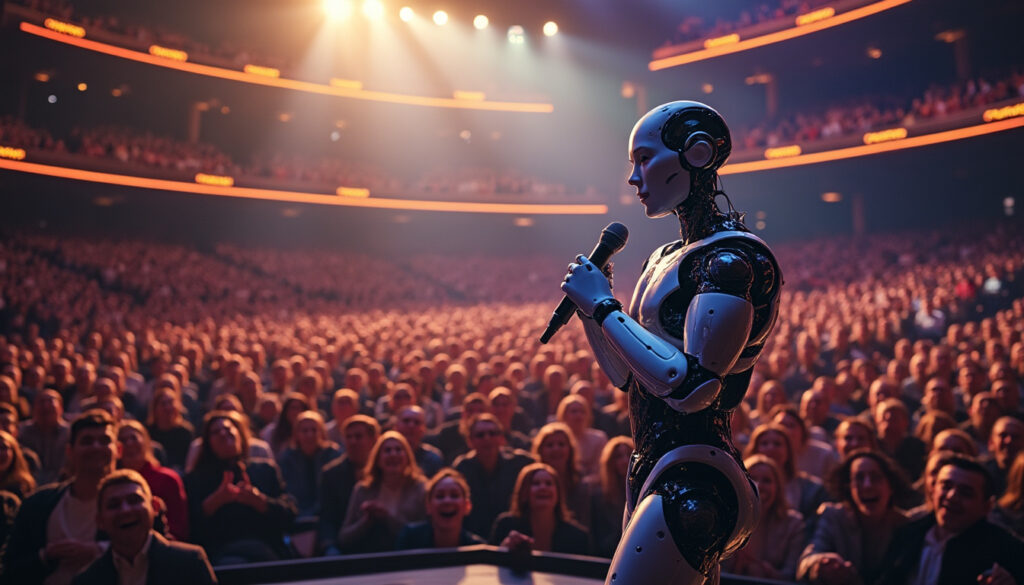
Tiffany Sloan has no stage, no tour, and to date, no known human identity behind the character. She exists as a woman created by AI, seen telling jokes in front of an artificial audience in a series of short videos. The set reproduces the familiar signs of stand-up: a microphone, laughter, and an attentive crowd. The illusion is convincing enough to stop the scroll.
The Instagram account associated with Sloan reportedly started posting on September 11. In less than three weeks, it allegedly surpassed 375,000 subscribers and released about 75 videos, with one of them crossing seven million views in less than two weeks. These figures give a sense of how quickly a synthetic character can establish itself in news feeds. They do not, however, indicate whether viewers always know they are watching an artificial creation.
Resemblances that go beyond mere inspiration
On October 3, comedian George Brett Olson published a comparison between a joke told by Sloan and a snippet from one of his own shows. According to him, the resemblance concerns not only the comedic spring: the outfit worn by the virtual character also evokes his appearance on stage. An isolated coincidence may sometimes be due to chance or a widely shared idea. But when several details align, the question of origin becomes hard to dismiss.
When the joke and staging echo each other
Olson accuses the account of taking his material and suggests that other comedians might also be affected. For now, these statements describe public allegations, not a judicial decision establishing the facts. The distinction matters: it allows artists who claim harm to be taken seriously without turning an accusation into a definitive verdict.
A joke is not always just a string of words. Rhythm, pauses, posture, and costume choice contribute to how it works in front of an audience. Reproducing an idea while retaining these indicators can create the impression of a broader imitation than a simple borrowing of phrases. It is precisely this mix that makes the comparison unsettling.
Doubt remains about the origin of the content
The creator of Tiffany Sloan is not publicly known, according to the elements reported on the account. It remains difficult to know who selects the jokes, what sources are used, or whether the videos are designed by a single person. Without transparency about production, the public cannot easily distinguish original invention from borrowing.
The process could also extend beyond a single character. Olson claims that some jokes are reused through other AI-generated women with different appearances. If this practice is confirmed, the virtual face would merely be an interchangeable wrapper built around already existing comedic materials. The same gag could then circulate under multiple identities and across various accounts.
For comedians, the stakes are real: a video can capture attention and generate revenue while the person behind the joke neither authorized its use nor received credit. Virality alone does not constitute proof of ownership or permission. However, it can make the copy more visible than the original performance, especially when the algorithm widely distributes the most engaging content.
A views machine, crafted to capture attention
Short videos are designed to interrupt scrolling. An immediately understandable joke, an expressive face, and a quick punchline form an effective recipe for gaining views and eliciting comments. Generative tools allow these ingredients to be mass-produced, with variations in settings, clothing, or characters. The result resembles less a constructed show than a succession of tested formats aimed at satisfying the algorithm.
The profitability of circulating content
In this model, engagement—views, reactions, and comments—becomes a currency of exchange. The more a post circulates, the more it can contribute to the revenue or visibility of the account, depending on the platform’s mechanisms and available monetization options. Economic interest then relies as much on volume as on quality or originality. A borrowed idea can continue to yield profits even if its author remains invisible.
The creation of artificial characters also makes testing cheaper and faster. An operator can modify the appearance of the performer, change a few details, and post several versions to observe which one performs best. Sloan has even been integrated into sequences with celebrities, including Kaley Cuoco and Danny DeVito, further blurring the line between manufactured sketch, montage, and real appearance. An account associated with the character would also offer content on OnlyFans, extending the exploitation of this virtual identity beyond just Reels.
The algorithm sometimes prefers quantity over context
Platforms do not always reward what deserves the most attention in the artistic sense. They measure behavior instead: watching to the end, sharing, commenting, or returning. An imitated video can thus benefit from extensive dissemination before its origin is discussed. And when the public later discovers the controversy, its reactions can in turn fuel the reach of the content.
This mechanism incentivizes publishing more, sometimes at the expense of verification and credit due to creators. AI does not make these choices alone: it is people who organize production, choose formats, and utilize tools. But the ease of generation reduces barriers, while recommendation systems can transform an experiment into a continuous flow. In this economy, attention becomes the central product.
The same logics are found in other forms of entertainment, even when human writing remains at the forefront. For another way to celebrate the mechanics of words and play, check out this game show for word enthusiasts, in the spirit of Dropout. The contrast is striking: on one side, the pleasure of a well-crafted idea performed by people; on the other, content whose provenance may remain opaque.
Laughter, between artistic freedom and responsibility
Comedy has always drawn from its surroundings, and its boundaries are not always easy to outline. A premise may circulate, transform, and be told differently by several artists. This does not mean that all resemblances constitute theft. However, the potential appropriation of a specific passage, coupled with similar staging cues, calls for explanations and, if necessary, a serious investigation.
This discussion also touches on the responsibility of platforms. When a network encourages content that generates the most interactions, it helps define what is profitable for creators. Technology enables the production of videos, but the distribution model partly determines why certain ones are mass-produced. The debate around political humor and its limits, addressed in this reflection on Jean-Baptiste Rivoire and the place of gravity, also reminds us that laughter and responsibility can coexist without negating each other.
What automation changes for artists
For a comedian, a joke is often the result of many trials: it is tested in a room, reworked based on reactions, then integrated into a show. A viral copy can obscure this process behind an artificial performance, without the public knowing who shaped the idea. The problem thus goes beyond whether a video is funny. It also concerns the recognition of work and control over its dissemination.
Creators can document their shows, point out resemblances, and ask platforms to review a post. Yet, these steps take time, while clips sometimes continue to circulate. The intellectual property rules applied to jokes and performances can depend on circumstances and jurisdictions. Legal uncertainty should not serve as a pretext for systematically erasing the identities of affected artists.
The public also has a role, albeit limited, in the circulation of content. Sharing a video without verifying its origin can strengthen an account that benefits from a contested borrowing. Conversely, citing the original artist or consulting their performance helps place the joke in its context. This gesture does not replace an investigation or the obligations of platforms, but it makes credit more visible.
Synthetic characters at the heart of our news feeds
Tiffany Sloan illustrates a mutation already perceptible: manufactured characters can acquire a familiar appearance, publish at a rapid pace, and build a considerable audience. They can also borrow the codes of human artists, to the point of blurring the provenance of jokes. This evolution invites us to observe viral content with greater curiosity, without confusing popularity with original creation.
AI can be used to experiment, invent new forms, or support a clearly defined artistic project. The risk appears when the tool facilitates massive production, the origin is concealed, and the gains reward primarily the quantity of interactions. Cinema, too, has been negotiating for a long time with technical transformations and production choices, as demonstrated by the exploration of Steven Soderbergh’s universe and the analog years. The question here is not just whether a machine can tell a joke, but who wrote the punchline and who reaps the benefits.
Controversies surrounding public figures also remind us that laughter can serve to comment, provoke, or denounce, but that context remains essential. This is evident in the case where Tony Benna denounces André, which places the remarks and their impact at the center of the discussion. With virtual comedians, this context sometimes becomes harder to establish: the performer appears present, while the author and sources may remain in the shadows.
And while these characters gain subscribers, platforms continue to refine their recommendations, creators test new formats, and viewers encounter increasing amounts of generated or altered content. The journey itself is now told in instant clips, between landscapes, tips, and images that circulate at high speed; to prepare for an escape away from the screen, here are must-dos to discover in Montreal. But in the daily feed, Sloan’s next sketch may appear before one has understood where the previous one came from.
When the algorithm takes the stage
An AI-generated character can now attract millions of eyes without ever facing an audience, waiting for laughter, or writing a joke behind the scenes of a comedy club. Tiffany Sloan’s videos illustrate this strange metamorphosis: a digital woman, a manufactured show set, and jokes circulating rapidly in news feeds. The success is very real, even if the identity of the creator remains unknown.
But behind the synthetic smile, a question grates: who owns the jokes? Comedian George Brett Olson claims to have recognized in one of the videos a passage close to his own routine, including some details of his outfit. Other artists have also noted resemblances. These accusations remind us that AI does not create in a vacuum: it can rely on works, voices, and styles shaped by real people. When a gag is reused without permission, the comedian risks losing both recognition for their work and revenue related to its dissemination.
The platform model complicates the scene further. Views, reactions, and subscriptions become immediate rewards, while generative tools allow for rapid production of many variants. A joke, several avatars, different costumes: the algorithm can choose the most eye-catching version, like a show programmer who only looks at audience numbers. In this race, originality and content provenance can take a back seat.
The question remains which rules will allow for distinguishing inspiration from copying and protecting comedians without stifling creative uses of AI. Platforms could make artificially generated content more visible, clarify their remuneration mechanisms, and offer artists simple means to report presumed appropriation. For now, each new view fuels a system where the line between creation, imitation, and profitability continues to shift.