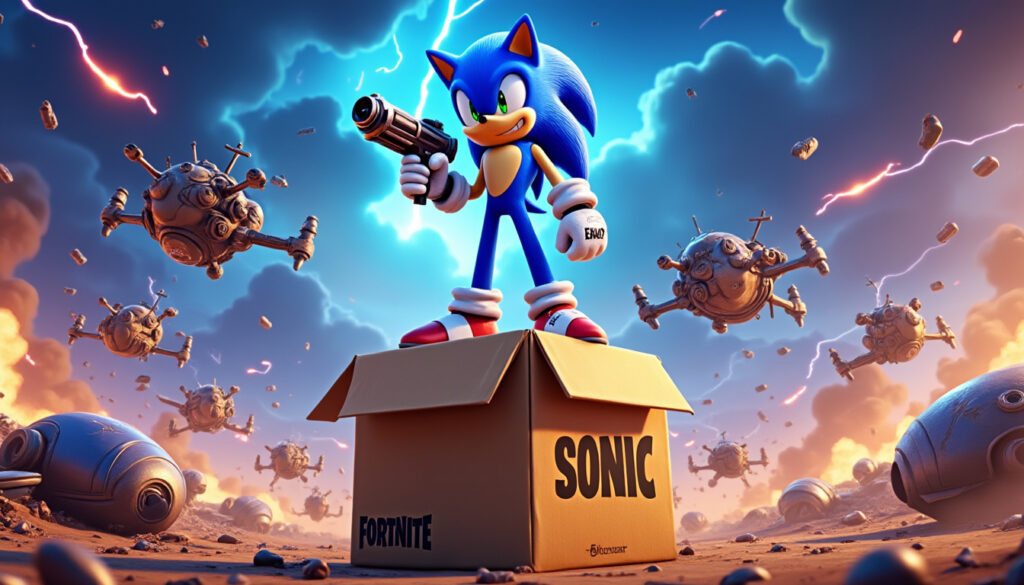
Sonic armed in Fortnite: the encounter between the blue hedgehog and the battle royale from Epic Games has made waves. From the very first weekend, players collected over 1.5 billion rings and eliminated Dr. Eggman more than 14 million times.
Seeing Sonic running and fighting in Fortnite can surprise players used to his family-friendly image. However, this collaboration between Sega and Epic Games quickly found its audience: from the very first weekend, participants collected over 1.5 billion rings and defeated Dr. Eggman more than 14 million times. Behind these spectacular numbers lies a carefully thought-out collaboration, discussions about the identity of the blue hedgehog, and a vision of gaming where previously separate universes can finally cross over. In the world of Fortnite, iconic characters can wield weapons and engage in frantic battles. Sonic, on the other hand, is generally associated with speed, rings, and adventures accessible to the whole family. Finding him in a battle royale game with a gun in hand creates a contrast that is as unexpected as it is memorable. Sega explained this disparity by clarifying that the character present in Fortnite is not the original Sonic, but an android designed in his image. This idea provides a narrative justification for his behavior and prevents directly transplanting the classic hero into a context that doesn’t quite fit his usual games. A comic book accompanies this approach, explaining why this version exists in this world. For Sega, it wasn’t enough to simply add the blue hedgehog to the roster of available appearances. The teams wanted his presence to be meaningful, while respecting the expectations of Fortnite fans as well as those of Sega’s mascot admirers. The collaboration thus required both in-game design work and the creation of a context capable of making this encounter believable. Integrating Sonic into a game already governed by its own visual and mechanical rules necessitated several attempts. His appearance had to fit among the other characters without losing the traits that make him instantly recognizable. The proportions of his head relative to the rest of his body notably sparked discussions at Sega. Shuji Utsumi, president and COO of Sega, recounted that the company wanted to avoid a collaboration that gave the impression Sonic was merely added as a request. They needed to find a meeting point between Sonic’s universe and Fortnite’s, and then ensure that the proposal was convincing on both sides. Several versions were examined before a satisfactory result emerged. Exchanges also focused on how to preserve the character’s identity amid a game where battles are a part of daily life. Epic and Sega were not just looking to produce a spectacular appearance or grab attention for a few days. They wanted the character to fit within the game’s framework without giving fans the feeling that his story had been forgotten. This adaptation illustrates a common challenge for holders of major licenses: how to let a hero evolve in a new environment without diluting what defines him? In Sonic’s case, the answer lies in the idea of the android and a distinct narrative, rather than a silent modification of the traditional character. This precaution allows Fortnite to maintain its tonal freedom while Sega keeps a clear separation between its different incarnations of the hedgehog. The collaboration also reflects a mutual trust between the two companies. According to Utsumi and Takayuki Kawasaki, general manager of Epic Games Japan, respect for the respective universes facilitated dialogue. Tim Sweeney, president of Epic Games and a great Sonic fan, also reportedly contributed to opening the door for the project. The initial results confirmed that this encounter piqued the curiosity of the community. During the weekend following its launch, players worldwide collected over 1.5 billion rings. At the same time, Dr. Eggman was defeated more than 14 million times, a total that gives an idea of the scale of participation. Takayuki Kawasaki described the player response as very positive and pointed out that the total number of participants in Fortnite during the period was higher than that recorded during the same time the previous year. This data alone does not allow for attributing the entire increase to Sonic. However, they demonstrate the energy generated by this season focused on video games and the arrival of such a well-known figure. The fate of Sonic’s famous adversary also made the representatives of both companies smile. Kawasaki joked about the enthusiasm shown by players to battle an antagonist like Eggman. In this world of virtual battles, participants evidently had no hesitation in taking on the mad scientist, transforming the confrontations into a huge nod to the historical rivalry between the two characters. The potential benefit goes beyond the statistics of the season. Fortnite introduces Sonic to players who may have never shown interest in his solo adventures, while the appearance of the hedgehog can encourage his fans to try Epic’s game. The collaboration works both ways: it attracts attention, but it can also serve as a gateway to previously less familiar universes. This flow between communities is one of the attractions of major video game encounters. An appearance can spark initial curiosity, then lead to exploring the games, characters, and stories that inspired it. For Sega, presenting Sonic in a different setting is thus an opportunity to reach a new generation without relinquishing its own productions. For Kawasaki, the arrival of characters from different universes aligns with an idea long championed by Tim Sweeney: in a shared digital space, the boundaries preventing heroes from meeting should not be taken for granted. He compares this vision to childhood games where figurines freely intermingle, even when they hail from different franchises. Fortnite gives concrete form to this possibility, allowing crossovers once restricted to imagination. The principle does not eliminate questions of rights or the specific requirements of each license. It rather necessitates a thorough dialogue: each company must decide which characters it wishes to entrust to this shared space, under what conditions, and with what narrative. The experience with Sonic shows that creating a coherent justification can be as important as appearance or equipment. Utsumi described this collaboration as a learning opportunity for Sega. The company had to think about how to protect Sonic’s uniqueness while accepting that he evolves in a world shaped by other intellectual properties. These discussions have helped Sega better define its position facing a metaverse where encounters between licenses could become more common. The result is a win-win alliance, according to the two executives: Epic enriches its game with an immediately recognizable figure, and Sega places its hero in front of a broader audience. Amid battles, rings, and confrontations with Eggman, the collaboration proves that a universe can open up to new grounds without erasing all its rules. The blue hedgehog did not simply appear in Fortnite: he arrived with a tailored identity, a dedicated story, and a reception measured in billions of rings and millions of defeats for his sworn enemy.A tailored version, rather than a simple cameo
Meticulous adjustments to bring the blue hedgehog into the battle royale
A compromise between fidelity and gameplay freedom
Impressive numbers and an enthusiastic response from players
A bridge between the audiences of Sega and Epic
Fortnite, a meeting ground for major licenses
Sonic armed in Fortnite: a hit that exceeds expectations
Seeing Sonic the Hedgehog arrive in Fortnite, gun in hand, was surprising for fans accustomed to his family-friendly universe and speed-filled adventures. To make this appearance coherent, Sega and Epic Games worked on his appearance, proportions, and especially on the reason for his presence in this world. The idea was to avoid a mere promotional appearance: the character needed to find his place in the game universe while remaining recognizable for fans of the blue hedgehog.
This attention to detail did not prevent the collaboration from taking on spectacular proportions. During the first weekend, players collected over 1.5 billion rings and eliminated Dr. Eggman more than 14 million times. These figures illustrate the enthusiasm generated by the event and give a new dimension to the rivalry between Sonic and his famous enemy. In Fortnite, Eggman clearly did not catch a break.
This success is also part of a broader dynamic: Fortnite brings together universes and characters that would rarely have shared the same playground in the past. For Sega, this experience required thinking about how to preserve Sonic’s identity while integrating him into a digital world open to unexpected crossovers. For Epic Games, the character’s arrival brought an extra dose of novelty and energy to the season.
The encounter also benefits both communities. Fortnite players discover more of Sonic’s universe, while fans of the hedgehog may be tempted to explore the adventures that shaped his reputation. Between rings to collect, confrontations against Eggman, and nods to different franchises, the event transforms a collaboration into a true shared playground.