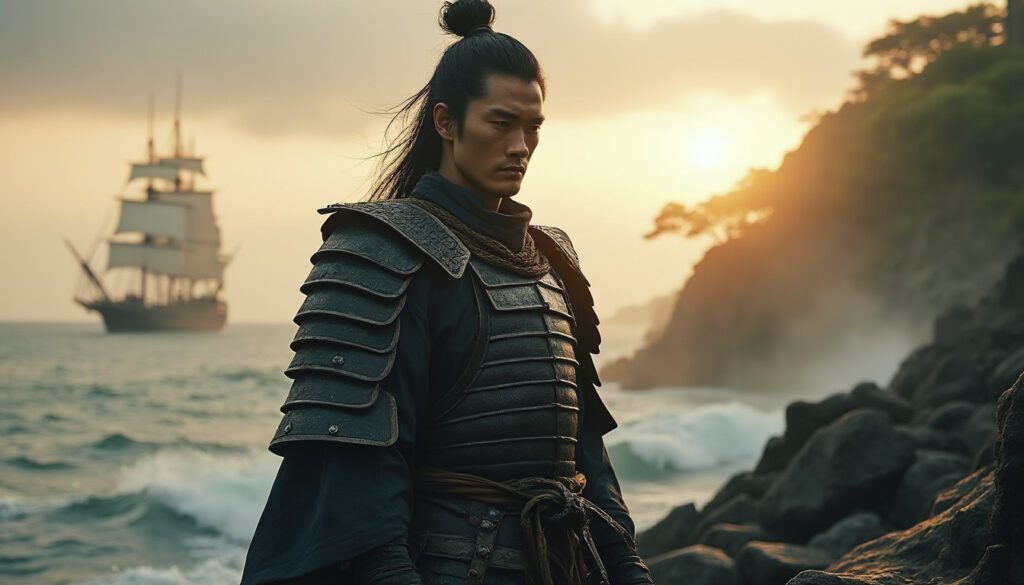
The first samurai epic by Kiyoshi Kurosawa takes place in a universe where alternative philosophy unfolds in the face of the odyssey of a doomed journey. Through the trials of the characters, Kurosawa explores the nuances of honor and power, redefining fundamental notions at the heart of the historical narrative. By distancing himself from the classic tropes of the tragic hero, he offers a vision where morality and personal choices prevail over epic expectations, thus creating a fascinating dialogue between tradition and modernity.
In a cinematic universe often saturated by traditional representations of warrior heroes, the first samurai epic directed by Kiyoshi Kurosawa stands out with a disenchanted perspective. This film depicts inner struggles, a reflection on honor, and above all, a more nuanced social critique than the classic odyssey. By confronting two emblematic figures, Odysseus and Lord Murashige, Kurosawa invites us to question the values that underpin the traditional heroic narrative.
An inner journey rather than an outer one
In Homer’s Odyssey, the protagonist crosses tumultuous seas, seeking a path back to his homeland. This journey is filled with adventures, trials, and commitments. In contrast, Murashige, the central character of Kurosawa, is faced with ethical dilemmas that push him to reflect on his inner self rather than a physical journey. Far from the storms, he navigates moral conflicts, questioning his legitimacy and the nature of his power. This contrast offers a new dimension to the idea of quest.
It is clear that Murashige’s trials are not battles against mythical monsters, but rather confrontations with his own unconscious. His reflection on forgiveness and clemency places his narrative against the typical brutality, thus creating a twisted path. This inner journey often appears more daunting to him than the wars fought against Oda Nobunaga.
An underlying social critique
Kurosawa also addresses contemporary themes, such as power and morality. Murashige’s acts of compassion towards his enemies, peace rather than vengeance, challenge the viewer to reflect on our own choices. In a world where violence is often glorified, this message seems strangely desirable. Indeed, it is not only honor that is at stake, but also our understanding of what it truly means to be a leader.
- The theme of honor translated through acts of clemency.
- A challenge to the conventions of the modern samurai.
- The duality of human nature highlighted in Murashige’s choices.
For Murashige, the race for victory does not hold the same allure. By deciding not to kill his prisoners, he questions the feudal code, giving rise to a new sense of governance. The reflection develops around a notion of humanity that may seem obsolete in an era where idealism is often sacrificed for the sake of conquest.
Drama as the driving force of the story
What makes Kurosawa’s work particularly poignant is his ability to create an atmosphere charged with tension. From the very first moments of the film, suspense settles in, and revelations follow with a disturbing skill. Each character becomes an intriguing thread, connecting individual stories into a collective narrative. As the plot progresses, the motives and intentions of the protagonists become increasingly unclear, reminding the viewer that truth can be an inaccessible luxury.
With the shadow of death looming, the choices Murashige makes are tinged with inevitable gravity. Each decision resonates, as if the echo of a declining empire gave rise to the hero’s nostalgia. Kurosawa brilliantly employs temporal ellipsis, allowing his protagonist to transcend time and space while remaining trapped in his own contradictions.
In summary, Kurosawa’s first samurai epic opens a discussion on a narrative that is not only about a heroic journey but rather highlights the human complexities that accompany it. Thus, by opposing historical figures to contemporary questions, the film takes a bold turn, offering a reflection that resonates across the ages.
An alternative philosophy to the epic of the doomed odyssey
Kiyoshi Kurosawa’s first samurai epic proves to be a captivating journey beyond mere battles and political intrigues, inviting viewers to explore an alternative philosophy that stands in stark contrast to the idea of a doomed odyssey. Through the eyes of Murashige, the samurai lord, we are confronted with a multitude of ethical and moral questions that interrogate the very meaning of war and power.
In this work, Kurosawa portrays a world where the respect for human life and personal integrity collides with the demands of politics and the expectations of society. Far from the traditional heroic approach often found in epic tales, Murashige questions his own nature and principles, as he finds himself trapped between loyalty to his clan and his refusal to assume the role of the torturer. This dichotomy offers viewers a reflection on the value of humanity in the face of the brutality of war.
Kurosawa thus encourages the audience to consider a profound reflection on the nature of glory and sacrifice. In a world where ancient traditions are crumbling, he questions the legacy we leave behind. Through this epic, he creates characters that embody the internal struggles of being a just leader in a time when choices are uncompromising and painful.
The narrative strength of this film lies not only in its action but also in its ability to make us contemplate the consequences of our choices and to redefine what it truly means to be a hero in a changing world.