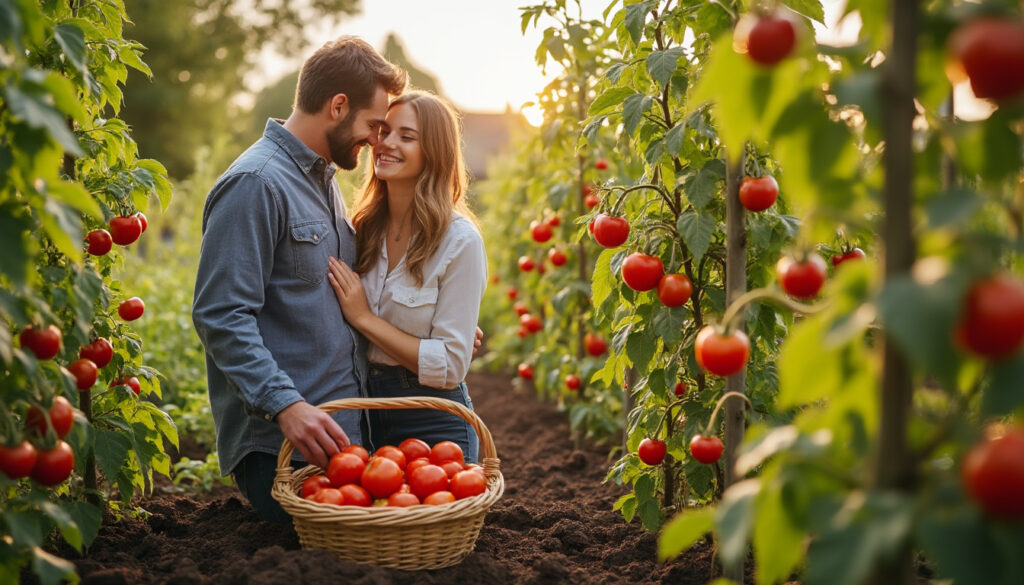
There are treasures that no credit card can truly offer: true love and the first bite of a homegrown tomato, sun-ripened, juicy, and full of flavor. When faced with such happiness, money doesn’t measure up.
There are only two things that money cannot buy: true love and homegrown tomatoes
You can buy ingredients, utensils, and even carefully prepared vegetable baskets, but nothing guarantees the magic of a tomato picked ripe near your home. Like true love, its flavor depends on something that cannot be commanded: time, attention, and the connection with what grows. Between the pleasure of harvest, discoveries in the kitchen, and nostalgia for sunny days, these red fruits tell a deliciously simple story.
There are only two things that money cannot buy: true love and homegrown tomatoes
Every spring, I reserve a share of the harvest from a small local farm. The sum paid in advance helps the producers prepare for the season, then comes the weekly appointment with a box full of surprises. You don’t always choose what it contains: that’s precisely what makes the experience lively. The vegetables arrive at the pace of the fields, with their dirt, their sometimes quirky shapes, and that freshness that’s impossible to reproduce in a neon-lit aisle.
A seasonal box, a thousand cooking ideas
Receiving vegetables you wouldn’t have bought spontaneously is accepting a little culinary adventure. A bouquet of unknown leaves becomes a soup, a squash slips into a stew, and a forgotten fruit can end up as an improvised snack. Gradually, you learn to cook differently, guided less by a fixed recipe than by the contents of the basket.
Seasonality also changes the way we taste. An apple picked at the right time can be incredibly fragrant, while a vegetable picked nearby seems to retain a special energy. Even the leafy greens, which I used to greet with a persistent mistrust, have finally gained a place in my meals. Kale, however, has not yet won the battle.
When the garden tomato becomes a revelation
For a long time, the tomato was not among my favorite foods. I found it to have a watery texture, an uncertain flavor, sometimes too acidic and sometimes sadly bland. In a salad, it often seemed to decorate more than it delighted. I sometimes avoided it without hesitation, except when it disappeared into a well-prepared sauce. Then local harvests turned this verdict upside down.
A ripe tomato picked just a few kilometers from the kitchen offers a completely different experience. Its flesh is juicy, its sweetness balances with a hint of acidity, and an almost flavorful depth reveals itself with the first bite. Some are heavy and meaty, perfect for a thick slice on a burger. Others, tiny like grape seeds, can be eaten whole, without a knife or ceremony.
And then there’s the one you pick warm from the sun. You barely rinse it, bite into it over the sink, and the juice runs down your fingers. This moment is nothing sophisticated, but it stays in memory. You then understand that a tomato is not just an ingredient: it’s also a season, a place, and a long-awaited reward.
The simple pleasure of sun-ripened harvests
In the kitchen, the possibilities follow the mood of the day. I can cut the tomatoes into thick slices, place them in a cast iron skillet, and let them brown with a pinch of salt. Their juice concentrates, their edges lightly caramelize, and the aroma that rises makes you want to take out a plate even before cooking is finished.
A slice slipped into a grilled cheese sandwich brings just the right amount of freshness and acidity. In a large box, the ripest fruits can be slow-cooked to make a deep sauce, perfect over pasta. Others go into the oven with a drizzle of olive oil, then get crushed with peppers to improvise a salsa. Nothing goes to waste: each variety finds its way to shine.
I do not claim that all tomatoes are miraculous, nor that big retailers have no pleasant surprises. But the taste often depends on details that are invisible at first glance: the variety, the timing of the harvest, the journey to the plate, and the care taken in the cultivation. A fruit picked before it is ripe to endure transport does not tell the same story as a fruit left on the vine until the right day. Proximity changes much more than distance.
This abundance also has its little downside: it doesn’t last. At the end of summer, the baskets contain less, then a week arrives without a single tomato. The last fruit kept at the back of the kitchen suddenly takes on disproportionate importance. You hesitate to slice it, consider several recipes, then remember that the best way to enjoy it is sometimes the simplest. It’s a delicious way to discover that waiting can add flavor.
One morning, a song heard on the radio put words to this affection. Its chorus celebrated garden tomatoes with the quiet fervor of a folk anthem: you could slip them into a salad, serve them with eggs, or turn them into juice. I smiled when I discovered that a songwriter had dedicated an entire song to this garden happiness. I, who willingly listen to melancholic melodies about departures and distant loves, did not expect to be enchanted by such a joyful tribute to a fruit. Some choruses simply remind us what matters.
The comparison with true love is not so extravagant. Both require patience, attention, and a certain ability to welcome what doesn’t always follow our plans. You can’t buy a perfect harvest in a few minutes, just as you can’t order sincere affection off the menu. However, you can prepare the ground, care for what grows, and savor the precious moments when they arrive. When the season returns, there may be a new box, a few still warm fruits, and a first bite that makes you forget the long weeks of winter.
Two treasures that cannot be bought
There are riches that fit neither into a wallet nor behind the glass of a shop window. True love is one of them: it cannot be ordered, negotiated, or earned through gifts. It grows at its own pace, like a plant that we tend without being able to dictate the season. It is recognized in a faithful presence, a shared laugh, a hand extended at the right moment. Its value is not measured by its cost, but by all that it helps to grow.
And then there are homegrown tomatoes. A few seeds, a patch of earth or a pot in the sun, weeks of patience… and there appears a red, warm fruit, imperfect, fragrant, ready to transform an ordinary meal into a tiny celebration. You can buy tomatoes all year round, but not necessarily that flavor: that of a fruit picked ripe, still filled with light, that you bring to the kitchen with the pride of having participated in its story.
These two treasures share something in common: they require time and attention. You can’t rush them. You must water, listen, care, accept the less generous days. Sometimes a tomato cracks before it is ripe; sometimes love goes through a period of silence or doubt. This does not make these things less precious. On the contrary, their fragility teaches us to welcome them without taking them for granted.
So, when the beautiful days return, we replant some seeds. We keep a place at the table for those we love. And we find ourselves waiting, with an almost childlike joy, for the moment when the sun will warm the first tomato of the season — while a familiar voice, right next to us, simply asks if we will share a slice.