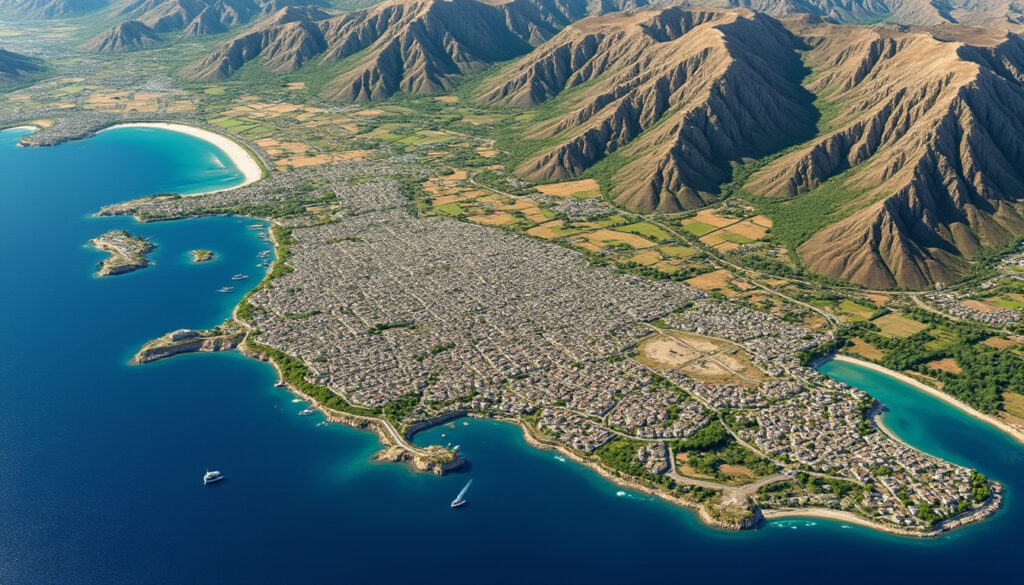
Crete, this island of enchanting landscapes and rich history, raises many questions regarding its administrative status. Travelers and curious individuals often ask, “What is the capital of Crete?” This question seems simple, but it conceals a more complex reality. Indeed, understanding the distinction between regional capital and administrative region is essential for navigating the specifics of Crete’s administrative organization, where Heraklion stands out as the capital of the region.
Crete, this iconic island of Greece, regularly prompts questions regarding its status. Is it simply an island, a region, or a capital? Beyond common perceptions lies a complex reality. This article explores the subtleties of Crete’s administrative situation, highlighting its capital, Heraklion, as well as its regional organization. A better understanding of terms such as region, periphery, and capital is essential for grasping this reality.
Crete and its regional organization
Crete is part of the 13 peripheries of Greece, a system that helps structure local administrations. Each periphery plays a crucial role in regional development, infrastructure management, and public policies. The particularities of Crete lie in its unique culture and rich history, but administratively, it is of paramount importance.
In this context, the term periphery refers to a regional administrative entity that includes several regional units. Crete, while being an autonomous island, is now organized into several administrative units due to the Kallikratis reform. Indeed, this reform, introduced between 2010 and 2011, clarified responsibilities within local governments, thereby making the administrative system more efficient.
Heraklion: the capital of Crete
Heraklion, often referred to as the administrative capital of Crete, is the largest city on the island. This dynamic city concentrates many public, economic, and cultural services. But why label it as the capital? This designation is justified by the presence of regional administrations that operate there, such as the regional council and various administrative offices. This makes it a nerve center for regional affairs.
The designation of Heraklion as “capital” can be confusing. Indeed, it is important to understand that this term can have multiple meanings. Having such a city as a capital implies that it oversees the proper functioning of public services in the region. In this sense, referring to Heraklion as the “capital of Crete” is common, but less precise than stating that it is the “capital of the region of Crete.”
The historical distinctions and their consequences
It is essential to remember that the names of cities can vary depending on the epoch. In antiquity, Gortyn was considered an important political center. This historical distinction must not be confused with the current administrative status of Heraklion. Thus, the island has evolved over time, and so has its administrative organization.
The practical consequences of this distinction are manifold. On one hand, for the general public, the notions of economic and cultural capital are often associated with Heraklion, regarded as a hub for commercial and tourist activities. On the other hand, it is strongly recommended to use precise vocabulary during conversations related to administration, as it greatly facilitates procedures.
In summary, whether you are a traveler in search of discovery or an entrepreneur, understanding the distinctions between capital and chief-town will significantly help you in your administrative interactions and processes.
Glossary of important administrative terms
To better understand the concepts related to the administrative organization of Crete, here is a handy glossary. It can facilitate comprehension of the regional structure.
- Periphery: regional administrative area at the regional level in Greece.
- Capital: city that serves as the seat of a regional administration.
- Deme: local municipality, representing the smallest administrative unit.
- Kallikratis: administrative reform of 2010-2011 reorganizing local governments.
Understanding the status of Crete in relation to its administrative organization allows for better navigation in this island rich in history. The combination of strategic terms and their administrative context forms a complex yet fascinating web. Thus, every traveler or resident can leverage this knowledge to optimize their interactions, whether in informal conversations or official procedures.
Understanding the status of Crete: between capital and region
Crete, this beautiful Greek island, often causes confusion regarding its administrative organization. Although it may seem to be both a capital and a region, it is essential to understand that its official status classifies it as an administrative region, or periphery, within Greece. Indeed, Crete is part of the 13 peripheries of the country, managing development projects and public policies at a regional level.
At the heart of this organization, Heraklion plays a vital role. As the capital, it is the nerve center where regional bodies operate, such as the regional council and various administrative offices. This means that the city is where important decisions regarding the development and infrastructure of all Crete are made. Saying that “Heraklion is the capital of Crete” may commonly be heard, but it is more accurate to emphasize that it is an administrative capital, a term which highlights its role without confusing it with a historical capital.
The Kallikratis reform, implemented in 2010-2011, restructured local governments in Greece and reinforced this status of Heraklion as the capital of Crete. This reform has allowed for a clarification of responsibilities among different administrative entities, thereby making Heraklion’s role even more crucial for residents and travelers alike.
For visitors, understanding this distinction enriches their experience on the island. Knowing that Heraklion is both an administrative center and a vibrant place where economic and cultural activities converge facilitates navigation and discovery of Crete. Thus, the city embodies the bridge between history, culture, and the modern organization of the region.