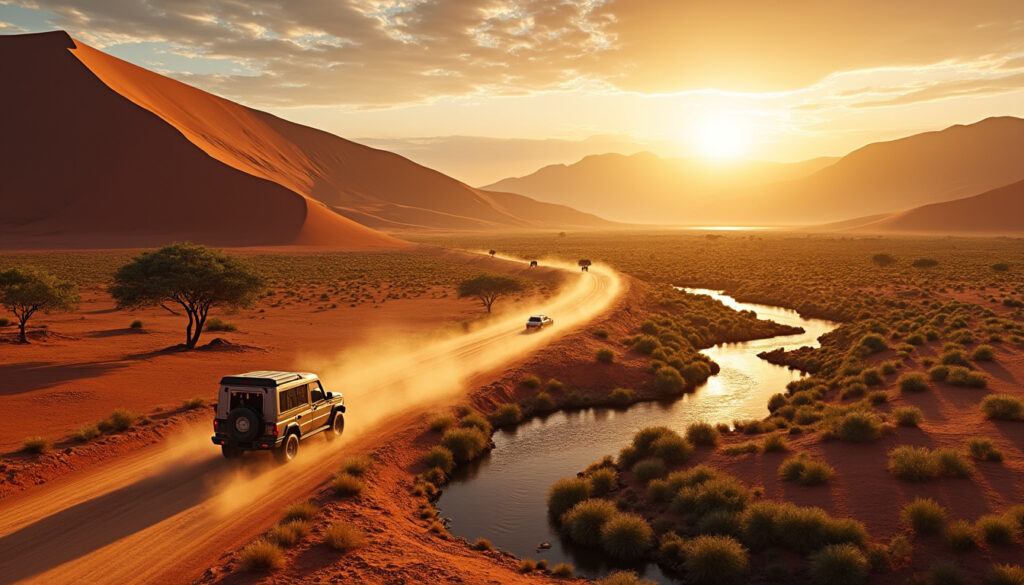
Discover a one-month itinerary in Namibia and Botswana, between the dunes of Sossusvlei, the safaris of Etosha and Chobe, and the aquatic landscapes of the Okavango Delta. This 4×4 road trip alternates between long tracks, camping nights, and lodge stops: an immersive adventure that requires anticipating distances, reservations, and road conditions.
A month in Namibia and Botswana allows you to traverse vast deserts, follow wildlife-rich rivers, and linger in some of the most remarkable parks in Southern Africa. This circular itinerary, designed for a trip in a 4×4 with a roof tent, connects Windhoek, the Okavango Delta, Chobe, Etosha, and the Namib dunes. The distances, tracks, and reservations require serious preparation, but the changing landscapes and animal encounters give each stage a different atmosphere. This route covers approximately 4,500 to 6,000 kilometers, depending on detours and chosen excursions. It takes three to four weeks, but a duration close to a month allows for rest days and unforeseen events. The travel times indicated are realistic estimates: on the tracks, the average speed often remains modest. The first two days in Windhoek serve to recover from the flight, discover the city center, and get acquainted with the vehicle. It’s also a good time to do shopping, check the camping equipment, and buy enough water. The capital serves as a useful transition before the long roads of the country. The drive to Gobabis, about 250 kilometers, offers a first glimpse of the open Kalahari landscapes. After a night in this region, the road continues to Ghanzi in Botswana, nearly 330 kilometers away, with a border crossing to consider. Animals may already appear near the road: careful driving is necessary, especially at dawn and dusk. From Ghanzi, expect about five hours of driving to reach Maun, the gateway to the Okavango Delta. The town allows for provisioning and organizing a trip on the water, particularly by mokoro, a traditional canoe that glides between the reeds. This slow excursion complements the hours spent driving and offers another way to observe birds and wetland landscapes. The road between Maun and Gweta then crosses drier areas, heading towards the Makgadikgadi pans. These vast saline expanses change appearance with the light and can seem almost motionless. In Gweta, the giant baobabs provide a striking contrast and invite you to slow down before hitting the road again. From Gweta, reach Kasane with a stage of about 410 kilometers, or nearly five and a half hours without stops. Situated close to the Chobe River, the town is an excellent starting point for boat safaris, early in the morning or late in the afternoon. Elephants, hippos, and crocodiles are frequently observed on the banks, while the heat imposes a slower rhythm during the midday hours. An additional day allows for a visit to Victoria Falls in Zimbabwe from Kasane. It’s usually convenient to leave the 4×4 on site and reach the falls with local transport, considering the border crossing and entry formalities. The walkways shrouded in mist and the roar of the Zambezi strongly contrast with the silence of the desert tracks. Back in Kasane, continue towards Kongola in Namibia, crossing the Caprivi Strip. This green region, crisscrossed with rivers and wetlands, contrasts with the arid landscapes encountered so far. An evening boat trip offers the chance to observe birds and enjoy a stage less focused on driving. The route can then pass through Shakawe in Botswana, before returning to Namibia via Mohembo to reach Bagani and the Mahango Reserve. The successive borders require a bit of organization, especially regarding vehicle papers and the formalities applicable to each traveler. Distances are sometimes short, but controls and stops can lengthen the day. From Bagani, the crossing to Grootfontein represents about 500 kilometers and may require six hours of driving. This transition stage brings you closer to Etosha National Park, but it deserves regular breaks to limit fatigue. Ensure you have fuel, water, and snacks before leaving the best-equipped areas. Dedicate three days to Etosha, where the tracks link watering points and vast open plains. The outings are particularly interesting early in the morning and at the end of the day when temperatures are more pleasant. By taking the time to stay near the watering points, it is possible to catch glimpses of elephants, lions, giraffes, zebras, and antelopes. After Etosha, head to Kamanjab to discover a more mineral region and, if conditions allow, meet Himba people in a respectful setting. The visit should be organized with a local contact and based on the consent of the individuals encountered. This stage adds a cultural dimension to the journey, beyond landscapes and safaris. The road to Palmwag crosses Damaraland, an area of red reliefs and arid valleys capable of sheltering desert-adapted animals. Nearby, Twyfelfontein is known for its ancient rock engravings, which can be explored on foot with a guide. The heat can be intense: leave early, carry water, and plan effective sun protection. As you reach the coast, stop at Cape Cross to observe a significant colony of fur seals. Swakopmund, about 120 kilometers further south, then offers a welcome break with its restaurants, paved roads, and seaside atmosphere. An excursion to Sandwich Harbour allows you to see the Namib dunes meet the Atlantic Ocean directly. From Swakopmund, the road to Solitaire covers about 265 kilometers through desert spaces. This isolated stop is known for its unique atmosphere and serves as a useful refueling point. The Spreetshoogte Pass, accessible via a short stage afterward, reveals large panoramas of the surrounding plains. Plan two days around Sesriem to explore Sossusvlei and Deadvlei. Depart early to enter the park at dawn and enjoy cooler temperatures. Climbing the dunes requires real effort in the sand, but the views over the red expanses and white pans are remarkable. To break the return journey, a night in the Mariental region allows you to reconnect with the colors of the Kalahari. Reaching Windhoek the next day represents about 300 kilometers, or nearly four hours depending on conditions. If the schedule permits, keep an extra day in the capital to return the vehicle without rush and prepare for the flight. A 4×4 equipped with a roof tent is suitable for this itinerary, especially for the tracks and some sandier areas of Botswana. Check the condition of the tires, the spare wheel, the cooking equipment, and safety gear before departure. A refrigerator, chairs, and water reserves facilitate autonomy, while campgrounds allow for cooking and resting in good conditions. Namibian roads include many gravel tracks, often straight and isolated. Even when the distance shows 300 kilometers, the stage can take several hours due to the surface, breaks, and animal encounters. In Botswana, some sections require slower driving, or even adjusting tire pressure based on terrain and rental company recommendations. Fuel up as soon as the opportunity arises and don’t leave without a sufficient water reserve. Gas stations are sometimes far apart, mobile networks are irregular, and signs are few. An offline map, a reliable GPS, and a detailed travel diary complement the navigation usefully. For three weeks, budget generally around 2,600 to 3,800 euros per person, excluding flights, depending on the vehicle, accommodations, and selected activities. For a trip of about 27 days including mostly camping nights, lodges, several excursions, and the rental of a 4×4, a budget close to 3,900 euros per person excluding flights serves as a realistic benchmark. International flights can add about 900 euros, with variations depending on the season and booking. The dry season, from May to October, favors wildlife observation: vegetation is less dense, and animals concentrate more near watering points. May, June, and October often offer a good compromise between weather conditions and crowds. From November to April, landscapes become greener, and birds are abundant, but the heat rises and some tracks may be more challenging. Book campgrounds in the parks and accommodations in high-demand areas well in advance. Available spots can be limited, and changing the order of stages on-site isn’t always straightforward. You can also draw inspiration from this account for a road trip in Namibia and Botswana with a roof tent, or explore other ideas through this trip to Southern Africa and this notebook dedicated to the exploration of the region.Discover a one-month itinerary to explore Namibia and Botswana
Discover a one-month itinerary to explore Namibia and Botswana
The first days, from Windhoek to Maun
From the Okavango Delta to the banks of Chobe
A detour to Victoria Falls and returning to Namibia
Etosha, Damaraland, and coast landscapes
The Namib dunes before returning to Windhoek
Preparing the vehicle, the budget, and the right season
One month to explore Namibia and Botswana
A month on the roads of Namibia and Botswana allows for the discovery of two countries with contrasting landscapes, without reducing each stage to a mere crossing. From Windhoek, the itinerary leads to the expanses of the Kalahari, then to the wetlands of Botswana. As the kilometers pass, desert tracks give way to rivers, salt plains, and territories where wildlife is particularly present.
The first stages lead towards Ghanzi and Maun, the gateway to the Okavango Delta. A mokoro excursion then offers a different perspective, at the slow pace of the canals and reeds. Further north, Kasane and Chobe National Park allow for the observation of animals around the river, particularly during a boat safari. A day at Victoria Falls can complete this part of the journey, before resuming the road back to Namibia via the Caprivi Strip.
The route continues between rivers, reserves, and long connection stages. After the lush landscapes of the northeast, Etosha provides several days dedicated to safari, with organized observations around the watering points. Damaraland, Twyfelfontein, and the Skeleton Coast then reveal a more mineral Namibia, where rock formations, ancient engravings, and seal colonies punctuate the way.
As you approach Swakopmund, the ocean and the dunes of Sandwich Harbour create a new contrast. The journey ends in the Namib Desert, around Sesriem, Sossusvlei, and Deadvlei, before returning to Windhoek. Allowing approximately four weeks provides the time to alternate driving, resting, and activities while considering the long distances. A 4×4, advance reservations, and a buffer in the schedule facilitate organization, particularly for campgrounds located in parks and remote areas.