
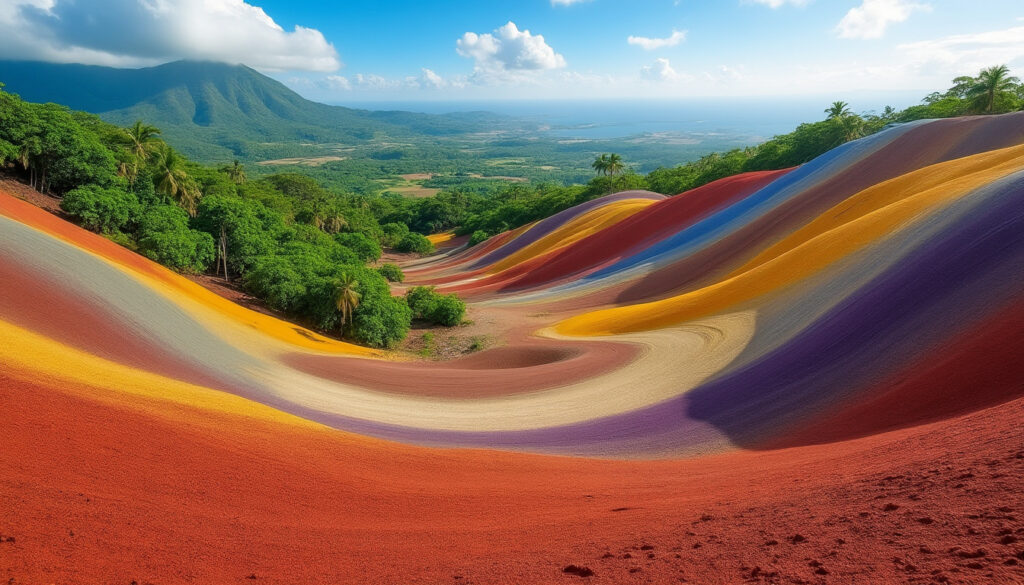
In the heart of the southwest of Mauritius, the Seven Colored Earths of Chamarel reveal mineral undulations in shades of ochre, red, brown, and violet. This stunning volcanic landscape offers a spectacle of colors that seems almost unreal.
Discover the fascinating Seven Colored Earths of Chamarel on the island of Mauritius
In the southwest of Mauritius, the Seven Colored Earths of Chamarel reveal a wavy relief with surprisingly varied hues. This volcanic site, known for its shades of ochre, red, violet, and brown, can be explored along a developed path amidst tropical vegetation. Here’s how to understand this phenomenon, enjoy the visit, and explore the landscapes surrounding it.
A mineral landscape with surprising colors
The first impression is that of a small painted decoration in the Mauritian landscape. Dunes with gentle curves alternate with colorful bands, sometimes very contrasting, sometimes more discreet depending on the light. The colors seem to respond to each other, while the green of the nearby trees and hills highlights their strangeness. From the designated observation areas, the gaze follows the undulations without needing to cross the ground.
Why does the earth present so many shades?
The reliefs of Chamarel are related to the volcanic history of the island. The rocks resulting from ancient lava flows have weathered over time due to the climate and erosion. This transformation has left mineral materials whose hues vary according to their composition. The result forms a natural palette that distinguishes the site from the surrounding tropical landscapes.
Visible colors include notably red, brown, violet, yellow, and ochre tones, with variations that can suggest several other shades. Iron oxides contribute to some reddish or brownish hues, while other mineral components partake in the diversity of colors. The name Seven Colored Earths therefore denotes a remarkable palette rather than a set of seven bands always perfectly separated. Depending on the time of day, the weather, and the state of the soil, contrasts may appear more or less pronounced.
Prepare your visit to the Seven Colored Earths
The site is generally visited on foot, along paths and platforms that allow observation of the reliefs without trampling them. This organization facilitates discovery while protecting fragile terrain. Taking the time to look at the shapes from several viewpoints helps distinguish the nuances and the undulations. A leisurely visit also allows one to enjoy the peaceful atmosphere of the area.
The light significantly alters the appearance of the landscape. In the morning or late afternoon, shadows can accentuate the relief and bring out warm tones. In full sun, colors sometimes seem sharper, but the heat is more palpable. It is advisable to bring water, sun protection, and comfortable shoes, especially if the visit is part of a day of exploration of the island.
Access rules and practical conditions may change: schedules, rates, or available services are not necessarily the same from one season to another. Before leaving, it is therefore better to check recent information with tourism organizations or on site. Respecting marked areas helps preserve the reliefs, whose surface should not be moved or degraded. Caution is also advised on wet paths, which can become slippery after rain.
Photographing the reliefs without altering them
A camera or a phone is enough to capture the contrasts, but images do not always faithfully render the variety of hues. Light, framing, and settings can transform perceived colors. Favoring an unobstructed view allows one to show the undulations and their environment rather than solely seeking a close-up. The platforms provided for this purpose offer several interesting angles.
The early hours of the day and the end of the afternoon are often favorable for photos, as shadows reveal more the curves of the terrain. When a slightly cloudy sky softens the light, details can emerge without overly harsh contrasts. It is preferable to keep natural settings: overly saturated colors give an artificial impression and distance the image from the real landscape. A few shots taken at different distances tell the visit better than a series of identical views.
Respecting the place is part of the experience. One should not descend the slopes to get a close-up photograph, nor pick up soil as a souvenir. The developed paths provide access to representative perspectives while limiting erosion. Observing without touching allows for the preservation of this fragile decor for visitors who will come afterward.
A volcanic curiosity in the heart of a tropical environment
The contrast between the mineral dunes and the surrounding vegetation greatly contributes to the charm of Chamarel. The colors of the earth seem almost arid, while the island is known for its forests, waterfalls, and lush valleys. This proximity of different landscapes makes the visit particularly immersive. In just a few moments, the gaze shifts from glowing soils to relief covered with tropical plants.
The site is often associated with the Chamarel Waterfall, located nearby in the same tourist area. This waterfall descends amidst a green setting and offers a spectacle quite different from that of the colored earths. Discovering them in one outing reveals two complementary facets of the island: the power of volcanic reliefs and the abundance of water in tropical landscapes. However, it is useful to allocate enough time to avoid turning the discovery into a mere photographic stop.
Chamarel is situated in a region that invites slowing down and appreciating the transitions in the landscape. Roads wind through hills, plantations, and wooded areas, with viewpoints changing along the route. The weather can also modify the ambiance: after a shower, the sky, vegetation, and colors of the ground create a different scene. This diversity makes the visit an interesting stop for those wishing to discover something other than the Mauritian beaches.
The colored relief is not vast, and the walk on site remains relatively accessible to visitors capable of walking on developed terrain. It is not a difficult hike, but the route is primarily on foot and may involve sections exposed to the sun. Families should keep an eye on children near observation areas and respect the displayed instructions. An attentive, unhurried visit allows for a better appreciation of the geological details.
Around Chamarel: extending the discovery
The region offers several ways to complete a day dedicated to the colored reliefs. Visitors can combine natural viewpoints with a discovery of rural landscapes and winding roads of southwest Mauritius. Depending on the time available, a stop in the vicinity also allows for observing local vegetation and the reliefs framing the village. It is advisable to plan movements, as trips on mountain roads sometimes take longer than expected.
Nature enthusiasts may be interested in the forests, trails, and panoramas of the region, respecting authorized accesses. The tropical climate leads to rapid changes: heat, humidity, and showers can occur throughout the day. Lightweight clothing, rain protection, and good shoes make movements more enjoyable. For walks in natural surroundings, it is advisable to follow local advice and avoid closed paths.
The discovery also benefits from a curiosity for the island’s geology. Mauritius owes much of its relief to past volcanic activity, remnants of which can be seen in the rocks, valleys, and soils. The earth of Chamarel illustrates how time, water, and mineral elements transform volcanic material. It thus offers an aesthetic landscape, but also a concrete insight into the island’s natural evolution.
On site, the interest lies not only in the diversity of colors. The rounded shapes, the scale of the reliefs, and their integration into a green environment create a unique ensemble. By slightly changing the point of observation, one notices new play of shadows and texture variations in the ground. The visit invites close observation, without expecting a vast panorama or an adventurous route.
Chamarel attracts many visitors, particularly during peak tourist periods. Arriving early can make observation more peaceful and provide more time to explore the surroundings. As with any developed natural space, it is better to follow the guidelines, leave nothing behind, and limit actions that could damage the soil. This attention helps maintain the beauty of the reliefs and the quality of the experience.
The Seven Colored Earths, a geological curiosity in Chamarel
In the southwest of Mauritius, the Seven Colored Earths of Chamarel make up a surprising mineral landscape. On a small hilly area, the ground reveals shades of ochre, red, brown, and violet. The colorful undulations succeed each other like layers drawn in the earth, giving the site an almost unreal appearance, especially when the light highlights the contrasts.
These hues are linked to the volcanic origin of the soils and their mineral composition. After the alteration of rocks, different elements have concentrated in the earth, contributing to the variety of observed colors. The relief forms gentle bumps, the lines of which change in intensity depending on the time and lighting conditions. Despite its spectacular appearance, the site remains modest in size: the visit allows for observing its shapes and hues from arrangements designed to protect the terrain.
The path is generally short and easy to integrate into a discovery of the region. Observation points allow contemplation of the colors without walking directly on the formations. The proximity of the Chamarel Waterfall offers another remarkable stop, amidst a tropical environment where the vegetation contrasts with the warm tones of the ground. This association of landscapes makes the area particularly interesting for an excursion into the interior of the island.
Very frequented, the Seven Colored Earths are also one of the best-known sites in Mauritius. Tourist facilities facilitate access and observation while reminding the importance of preserving this fragile terrain. To fully appreciate its variations, daylight plays an essential role: colors appear more or less pronounced depending on the sky and the time of the visit. Chamarel thus reveals a unique facet of the island, where the volcanic history is directly read in the shapes and hues of the landscape.


