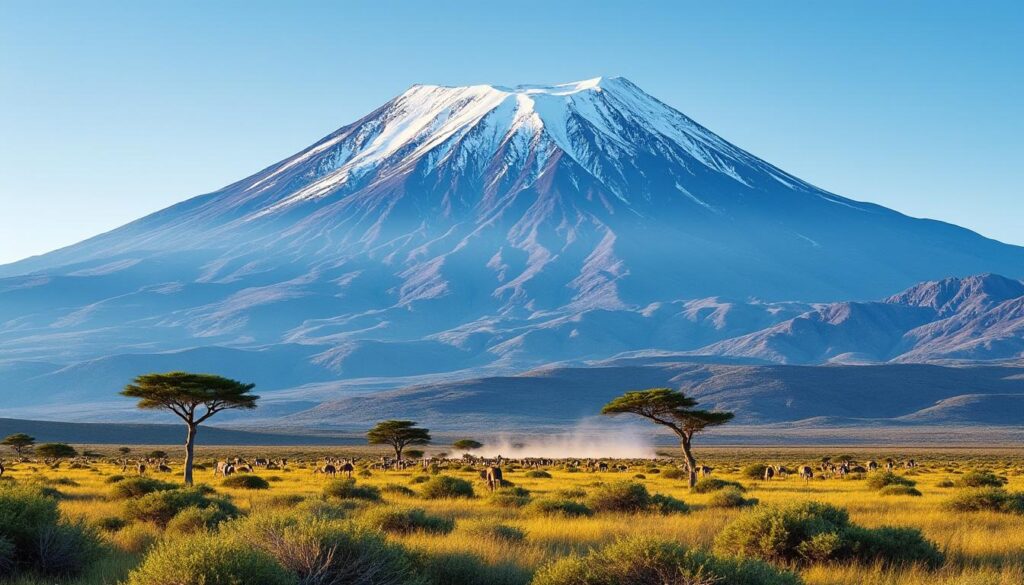
The Kilimanjaro, a true emblem of Tanzania, rises majestically, culminating at an altitude of 5,895 meters. This volcanic massif, which attracts adventurers from around the world, is not only the highest peak in Africa but also a symbol of the wild beauty of nature. Enriched with unique biodiversity and surrounded by breathtaking panoramas, Kilimanjaro remains a must-see for those in search of memorable adventures.
Kilimanjaro, a true symbol of Africa, stands majestically in the Tanzanian sky, attracting adventurers from around the world every year. With its three iconic volcanoes and stunning landscapes, this mountain is not only the highest on the continent but also a rich ecosystem filled with biodiversity. This article will take you on a journey to discover natural wonders, the challenges of the ascent, and the national park that surrounds it.
The Grandeur of Kilimanjaro
At an impressive altitude of 5,895 meters, Kilimanjaro is the highest peak in Africa and the fourth highest in the world. Emerged in the chain of African mountains, it offers an exceptional panoramic view of the surrounding savannah. Dominated by its famous eternal snows, Kilimanjaro represents a true challenge for climbers and an iconic image of untouched nature. The volcanic massif consists of three main peaks: Shira, Mawenzi, and Kibo. Each is unique and contributes to the diversity of landscapes.
The name “Kilimanjaro” comes from the Swahili term “Kilima Njaro,” meaning “Mountain of Light.” This nomenclature captures the essence of this majestic place, whose summit is often crowned with clouds and spectacular lights. Overlooking the savannah, Kilimanjaro offers a striking tableau, a perfect blend of wild nature and alpine challenge.
The Kilimanjaro National Park
Inscribed as a UNESCO World Heritage site, the Kilimanjaro National Park spans nearly 75,575 hectares. This park is home to a multitude of wildlife, including some endangered species. The vegetation is breathtaking, ranging from lush tropical forests to open grasslands and high-altitude zones. This diversity makes it a privileged place for explorers and nature lovers, as well as for those in search of a challenge.
The park is particularly known for its five distinct vegetation zones, which vary according to altitude. Each zone offers a unique panorama and a singular ecosystem, allowing visitors to discover a wide range of African fauna and flora. Among the inhabitants are elephants, buffalos, and many species of birds, making any adventure here even more fascinating.
The Ascent of Kilimanjaro
For adventurers wishing to reach the summit, several routes are available. Each route presents different characteristics, from the difficulty to the duration of the hike. For example, the Marangu route, often dubbed “Coca-Cola,” is popular among beginners due to its ease and its duration of six days.
- Machame Route: spectacular with a duration of six to seven days.
- Umbwe Route: impressive but difficult, with steep slopes.
- Lemosho Route: less frequented and scenic, requiring between six and eight days.
The ascents require between five and nine days depending on the chosen route and acclimatization. These days are not only a physical challenge but also an unforgettable spiritual experience. Each stage offers the possibility to admire breathtaking landscapes while traveling through different climates and environments.
Unforgettable Views from Kenya
A common question among travelers is where to get the best view of this iconic mountain. Many agree that Amboseli National Park in Kenya offers an unparalleled view. With a herd of elephants or zebras in the foreground, Kilimanjaro reveals itself in all its splendor. This panorama is ideal for photographers and lovers of natural landscapes.
At sunrise, the view is particularly stunning, the plateau gradually illuminating as the clouds dissipate. However, weather conditions can change rapidly, sometimes making the ascent to the summit more complex. Balloon tours also provide a unique perspective on Kilimanjaro, combining exploration of the savannah with an exceptional moment of awe.
The Geographical Situation and Ecological Importance
The Kilimanjaro is located in the northeastern part of Tanzania, very close to the Kenyan border. This volcanic massif is the result of powerful geological forces that have shaped the landscape over millions of years. The significance of this mountain goes beyond its height; it also plays a crucial role in regulating the climate of the region.
However, the glacier cap of Kilimanjaro is rapidly declining, a concerning phenomenon attributed to global warming. The ice that crowns the mountain has significantly decreased since the early 20th century, and studies predict total disappearance by 2050. Preserving this unique environment is therefore essential, not only for the mountain itself but for the entire surrounding ecosystem.
Discover the Majestic Kilimanjaro
The Kilimanjaro, proudly rising to 5,895 meters above sea level, is recognized not only as the highest peak in Africa but also as a powerful symbol of adventure and challenge. This unique volcanic massif, consisting of three distinct volcanoes, Shira, Mawenzi, and Kibo, majestically stands, offering a spectacular panoramic view of the vast plains of the surrounding savannah. Its breathtaking beauty and incredible biodiversity make it a must-see for nature lovers and adventurers.
The ascent to its summit is both a physical and spiritual experience, attracting thousands of hikers from all backgrounds each year. The various routes, each with its own characteristics, allow hikers to choose the option that best suits their fitness level and experience. Whether it’s the Marangu route, ideal for beginners, or the Umbwe route, reserved for experienced climbers, each path leads to the discovery of breathtaking landscapes and varied wildlife.
Besides its imposing appearance, the Kilimanjaro is at the heart of serious environmental issues, particularly the regression of its glacier cap, an alarming phenomenon due to global warming. It is therefore essential to encourage responsible and sustainable tourism to preserve this fragile ecosystem. The creation of the Kilimanjaro National Park and its designation as a UNESCO World Heritage site highlight the importance of protecting this heritage for future generations.
In summary, Kilimanjaro is not only a dream destination for adventurers seeking ascent but also a site of invaluable natural wealth, leaving visitors with indelible memories with every summit reached.