
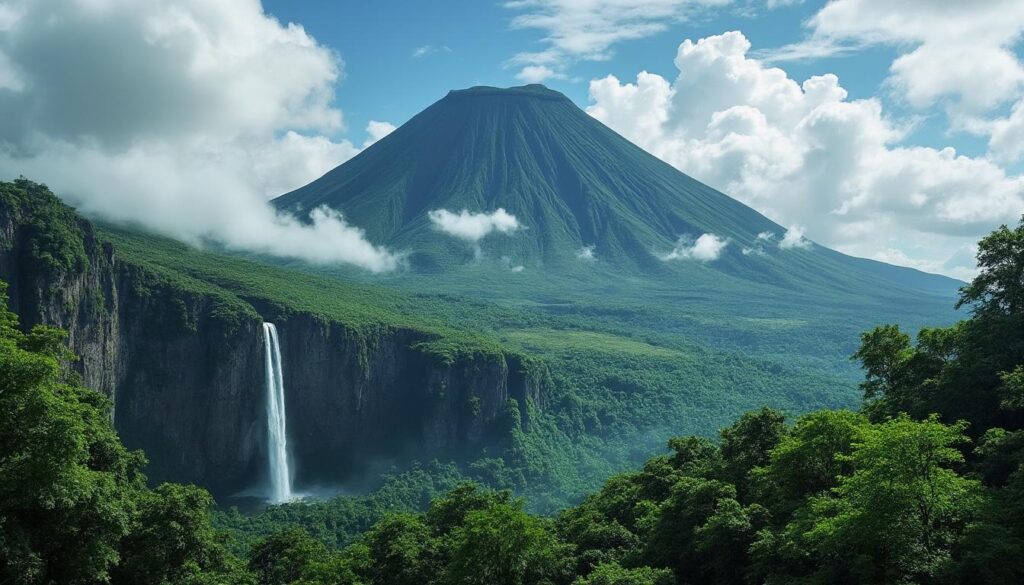
Because at the top of the clouds, Mount Roraima rises majestically at the crossroads of the borders of Venezuela, Brazil, and Guyana. Known for its breathtaking landscapes and its sacred history for the Piaroa Indians, this tepuy is part of Canaima National Park, classified as a world heritage site by UNESCO. With its steep cliffs and unique ecosystem, Mount Roraima attracts adventurers from around the world who wish to explore its wild and mystical beauty.
Dominating the South American landscape, Mount Roraima is a fascinating natural wonder, located at the crossroads of Venezuela, Brazil, and Guyana. Its majestic silhouette, often lost in the clouds, attracts adventurers and nature enthusiasts from around the globe. Experiencing the ascent of this iconic mountain is a unique adventure, discovering a rich ecosystem and deep cultural significance. This article invites you to explore the mysteries and beauty of this iconic site.
A Fascinating Geography
Mount Roraima, a tepuy of the Sierra de Pakaraima mountain range, rises over 1200 meters above sea level. With its steep cliffs and vertical walls, it is surrounded by dense jungle, creating a striking contrast with its plateau. These geological formations date back billions of years, containing a rich fossil heritage. This monolith is often shrouded in fog, a phenomenon that enhances its mystical aura and makes it even more impressive.
As a point of convergence between three countries, its location makes it a place of strategic and symbolic importance. On this plateau, the climate can be extremely changeable, with frequent rains and strong winds. These climatic conditions contribute to an extremely unique and diverse ecosystem, where endemic species adapted to the harsh conditions can be found, such as the famous Roraima black frog.
A Memorable Ascent
To reach the summit of Mount Roraima, hikers begin their adventure in Santa Elena de Uairén, a colorful and welcoming town. This picturesque location is the ideal starting point for an expedition through the Gran Sabana. The ascent takes several days, with an average of 2 to 3 days of hiking required. The path to the summit is dotted with varied landscapes, ranging from dense forests to open plains.
Experienced hikers often prefer to be accompanied by a local guide, particularly one whose culture is deeply rooted in the region, such as the Pemón Indians. These guides possess unparalleled knowledge of the trails, as well as an understanding of the surrounding conditions. They help navigate this complex terrain while sharing local stories and legends that enrich the adventurers’ experience.
A Deep Cultural Significance
For indigenous peoples, Mount Roraima is not just a mountain, but a sacred place. The Pemón culture places great importance on it, considering it the “great green house of spirits.” According to their legends, the mountain is the trunk of an immense tree, carrying the fruits and seeds of the earth. This spirituality is reflected in the way local communities interact with their environment.
Within Canaima National Park, a UNESCO World Heritage site, Mount Roraima also attracts those wishing to admire wonders such as Angel Falls, the highest waterfall in the world. These breathtaking landscapes and unique biodiversity attract the attention of researchers and nature lovers, who come to explore and study this ecosystem. The fact that this region is preserved and protected underscores the importance of its conservation for future generations.
Endemic Flora and Fauna
The biodiversity thriving on Mount Roraima is both fascinating and remarkable. The flora, often poorly adapted to nutrient-poor soils, is home to carnivorous plants, showcasing nature’s ingenuity. These unique species have adapted to the mountain’s climate and challenging conditions. Among them are fascinating plants such as Drosera and Brocchinia, which are among the rare survivors of this complex ecosystem.
The fauna, for its part, is equally captivating. Exotic birds, colorful insects, and mammals thrive in this enchanting natural setting. Hikers and explorers have the opportunity to spot endangered species, highlighting the importance of preserving their habitat. The richness of this biodiversity makes Mount Roraima a true natural treasure, both to discover and to protect.
Mount Roraima: An Unforgettable Journey into Nature
Mount Roraima is undoubtedly one of the most iconic sites in Venezuela, a true treasure of nature in South America. Dominating the landscape with its steep walls and summit often hidden by clouds, this mountain offers a breathtaking panorama that invites exploration and adventure. With an elevation of 1200 meters, visitors are offered a unique perspective of the city of Angel Falls, the highest waterfall in the world, as well as an exceptional biodiversity, making this place a natural heritage to preserve.
The sacred nature of Mount Roraima is deeply rooted in the culture of the Piaroa Indians, for whom this mountain symbolizes their history and legend. The beauty of the landscapes, ranging from lush tropical forests to barren plateaus, captivates those who take the time to discover this unique environment. Endemic species, such as the Roraima black frog and carnivorous plants, testify to the extraordinary adaptation of life to particularly harsh conditions.
For those eager to experience this adventure, hiking to its summit is an unforgettable experience. It requires a certain commitment, but the view that awaits at the top is unparalleled. Engaging a local guide is not only advisable but enriching, as they are happy to share their knowledge of the trails and the cultural history of the region. Whether on foot or from the air, a journey to Mount Roraima leaves no one indifferent and is a true call to escape, adventure, and discover the wonders of our planet.


