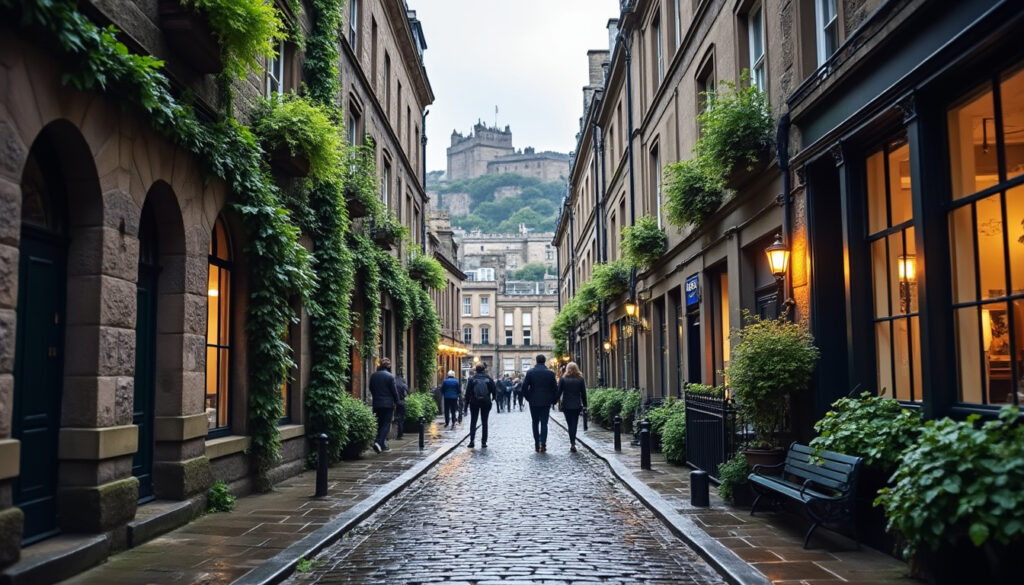
In three days in Edinburgh, travel from the medieval alleys of the Old Town to the elegant avenues of the New Town, before ascending its volcanic hills. An itinerary blending history, architecture, and stunning panoramas to discover all the magic of the Scottish capital.
Edinburgh unfolds like a novel, with each district changing the scenery: medieval alleys, Georgian squares, and volcanic hills compose a surprising capital. In three days, it is possible to explore its iconic sites, take the time to stroll, and enjoy an escape into the great outdoors. Here’s an itinerary to transition from the ancient stones of the Old Town to the elegant avenues of the New Town, without forgetting the panoramas that make Scotland unforgettable.
Three Days in Edinburgh: from the historical alleys of the Old Town to the elegant avenues of the New Town
Built on volcanic reliefs, the Scottish capital plays with perspectives. A street can suddenly open onto a perched castle, a lush garden, or a row of orderly facades. This proximity between nature and history gives the city its unique character.
For a first visit, three well-paced days allow you to explore the main districts without turning every walk into a race against time. The program alternates between monuments, strolls, and breaks, with enough freedom to linger in a museum or step into a pub. However, be sure to wear comfortable shoes: cobblestones, stairs, and slopes are part of the journey.
Day 1: exploring the legends of the Old Town
Start with the Old Town, the historical heart of Edinburgh and one of the UNESCO World Heritage sites. Here, narrow alleys weave between tall buildings, while hidden passages seem to preserve stories whispered in half-voices. Take the time to look up as much as to watch where you place your feet.
From the castle to the Royal Mile
The Edinburgh Castle dominates the city from its rocky promontory. Its ramparts offer an excellent starting point to understand the relief, with the rooftops of the Old Town below and gardens stretching to the north. Keep at least two or three hours to visit the site without rushing.
Inside, discover notably the Scottish Crown Jewels and the Stone of Destiny, linked to the royal history of the country. The palace rooms and military installations tell different facets of the fortress. Even without visiting everything, the view from the esplanade deserves a pause.
As you leave the castle, descend the Royal Mile, the historical axis that connects the fortress to the Palace of Holyroodhouse. The route crosses several streets with changing atmospheres, lined with ancient facades, shops, and small courtyards. Don’t just stick to the main artery: the “closes,” those narrow side passages, often hold the most evocative discoveries.
The secret passages and ancient stones
Mary King’s Close and Lady Stair’s Close provide a glimpse into the urban maze that characterizes this area. Some passages are dark and narrow, almost theatrical, as if they lead to another era. Explore them with curiosity while respecting private spaces and historical sites.
Further on, St. Giles’ Cathedral stands out with its crown-shaped spire. Inside, the sculpted details and play of light invite you to slow down. The Royal Mile then leads to the Scottish Parliament, whose contemporary architecture contrasts with the neighboring buildings.
At the end of the day, head to Grassmarket, an old marketplace lined with restaurants and pubs. The area is lively but retains a strong historical presence, especially with views of the castle. It’s a pleasant place to dine and discover some local specialties.
Day 2: Changing eras in the New Town
On the second day, cross to the New Town, where Georgian order succeeds the more irregular contours of the Old Town. This district, designed in the 18th century to accommodate the city’s expansion, unfolds wide streets and neoclassical facades. The change of scenery is striking, even after just a few minutes of walking.
Gardens, monuments, and Georgian elegance
The gardens of Princes Street form a green breath between the two historic districts. Once occupied by Nor Loch, the area has been transformed into a park, now appreciated for both its paths and its views of the castle. On clear days, the fortress seems to float above the lawns.
In the gardens, spot the Scott Monument, a Gothic tower erected in honor of writer Walter Scott. Visitors who wish to climb its narrow stairs can enjoy a panorama of the rooftops and avenues. The ascent requires a bit of energy, but it offers a different viewpoint than that of the castle.
Then continue towards George Street and Rose Street, two axes that reveal the more regular face of the city. Ornate doors, symmetrical facades, and peaceful squares testify to the Georgian urban planning project. Charlotte Square is worth a detour for its architectural harmony and its cozy atmosphere.
Calton Hill at sunset
In the late afternoon, head to Calton Hill, accessible by a relatively short ascent. The hill gathers several monuments, including the National Monument, whose unfinished columns evoke the Parthenon of Athens. This singular silhouette has helped associate Edinburgh with the nickname “Athens of the North.”
At the top, the view embraces the lines of the New Town, the reliefs of the Old Town, and, in the distance, the Forth estuary. The evening light highlights the contrasts between light stone, dark roofs, and hills. Stay for a moment to watch the city change colors before heading back down.
Day 3: gaining height and keeping up with the cultural rhythm
The last day is ideal for discovering the wild side of the capital. Just steps away from the busy streets, the trails rise into a landscape of rocks and moors. Bring a windbreaker and water, even if the sky looks clear at the outset.
Arthur’s Seat, an escape above the rooftops
In Holyrood Park, Arthur’s Seat rises to 251 meters and strongly marks the horizon. This ancient volcanic hill gives the impression of leaving the city without really distancing yourself. From the Palace of Holyroodhouse, the ascent typically takes about an hour, depending on the chosen route and your pace.
The paths traverse grassy slopes and rocky outcrops, with panoramas widening as you gain altitude. At the summit, the reward is vast: the neighborhoods of Edinburgh, the coastline, and the Pentland hills unfold in several directions. Choose a path suitable for your physical condition, as some sections can be steep or slippery.
For the descent, you can pass near the cliffs of Salisbury Crags and enjoy another angle on the city. The contrast between natural paths and urban streets is particularly striking here. Take a break before continuing to explore museums or the central neighborhoods.
Museums, shows, and summer animation
If the Scottish weather turns fickle, spend the afternoon at the National Museum of Scotland, which offers varied collections and a visit accessible to different ages. The free national museums allow for a cultural outing without straining your budget. However, be sure to check the hours and any temporary exhibitions before your visit.
In August, Edinburgh changes its tempo with the Fringe Festival, a vast event dedicated to the performing arts. Comedians, musicians, and artists take over both the venues and the streets, and the Royal Mile becomes a lively stage. The Royal Edinburgh Military Tattoo adds another dimension to the evenings with its performances by bands on the castle esplanade.
Off-season, the city maintains a rich cultural life, even if the atmosphere is less bustling. Theaters, galleries, and concert halls offer many options to extend the day. Also, let yourself be guided by the posters and small venues: spontaneous discoveries often make for the best memories.
Where to stay to fully enjoy the city
For a three-day stay, choose accommodation well located between the Old Town and the New Town. This central position facilitates walking around and allows for quick access to the main monuments. It also avoids dependence on transport for every outing.
Princes Street serves as a convenient landmark, close to the gardens, shops, and Waverley Station. The Mount Royal hotel, part of The Unlimited Collection by The Ascott Limited, is located on this thoroughfare and faces the gardens as well as the castle. Tram stops connecting to the airport are also within walking distance from the area.
Beyond the location, compare amenities, arrival times, and cancellation policies before booking. Prices may vary according to the season, particularly during summer festivals. An early booking generally offers more choices in the central neighborhoods.
Practical tips before you go
Edinburgh is very walkable, but its slopes and cobblestones require stamina. Wear suitable shoes and bring a waterproof layer, as wind and showers can occur even in summer. A small bag allows you to keep a jacket, water, and a few snacks handy.
The currency used is the pound sterling, and credit cards are accepted in most shops and restaurants. It’s still useful to verify your bank’s payment conditions before departure. For paid monuments, reserving tickets in advance can help you organize your schedule, especially during peak periods.
Finally, keep some flexibility in your schedule. A picturesque street, an unexpected clear spell, or a welcoming café can easily extend a stop meant to last just a few minutes. It’s also by leaving room for the unexpected that you best discover the multiple faces of the Scottish capital.
Three Days in Edinburgh: a journey between history and vast horizons
In three days, Edinburgh reveals several faces, as if each district opens a new page of its history. In the Old Town, the dark facades, narrow passages, and cobblestones of the Royal Mile invite you to slow down to better imagine the eras that shaped the city. From the castle perched on its rock to the discreet alleys, the centuries seem to blend into everyday life, giving each walk a touch of mystery.
Step a little further, and the scenery changes. The New Town unfolds its orderly avenues, elegant Georgian facades, and peaceful squares. Between the Princes Street Gardens and the bright streets of New Town, the stroll takes on a different, more open rhythm, always keeping the spectacular relief of the capital in sight. From Calton Hill, the rooftops, monuments, and hills compose a panorama that encapsulates Edinburgh’s contrasts.
The third day reminds us that this capital is not limited to its stones and museums. The ascent of Arthur’s Seat leads to almost wild landscapes, with the city, coastline, and hills in the background. Then, back on the streets, one finds the cultural energy that animates Edinburgh all year round, particularly vibrant during the summer festivals.
This condensed stay does not claim to unveil everything, and that is also what makes its charm: it leaves room for detours, improvised pauses, and unexpected discoveries. With comfortable shoes, a jacket ready to face the whims of the weather, and well-located accommodation, each day becomes easy to organize. Edinburgh is best discovered on foot, moving from a medieval alley to an elegant avenue, then from an urban panorama to a wind-swept hill. Three days are enough to grasp its soul — and leave with the desire to return.