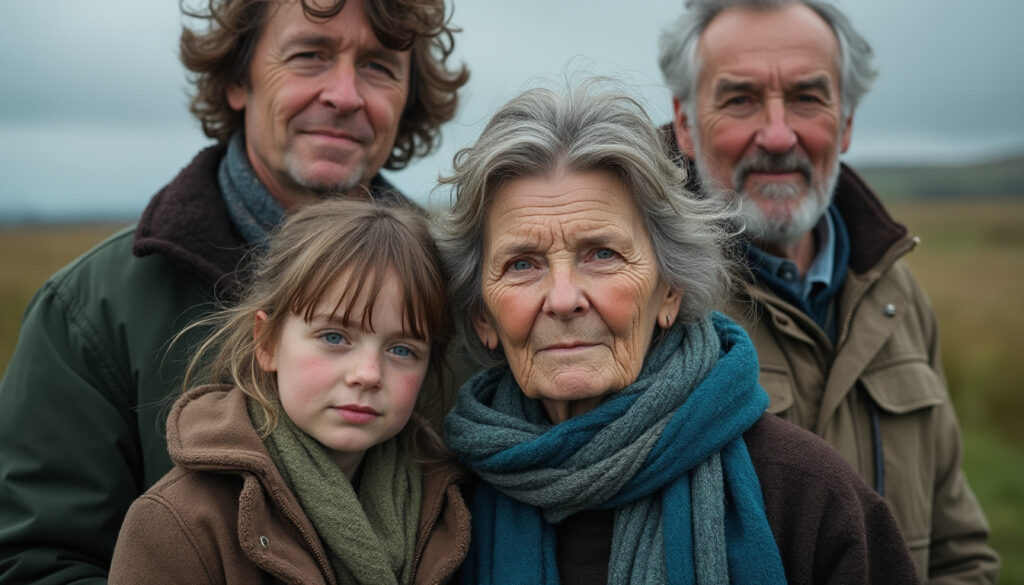
In “Irish Travellers”, Alexander Murphy films the daily life of the O’Reilly family for six years, in the heart of County Tipperary. Amid play, tenderness, and precariousness, this intimate portrait outlines the tensions of an Irish itinerant community confronted with the gradual disappearance of its way of life.
In “Irish Travellers”, director Alexander Murphy gets as close as possible to the O’Reillys, a family of Irish travellers living together in a dilapidated mobile home in County Tipperary. Filmed over six years, their daily life reveals a rich childhood full of play and affection, but also the fragilities of a precarious existence. Without commentary or heavy explanation, the documentary composes a sensitive portrait of an unfamiliar community caught between freedom, ostracism, and social changes.
The film begins with a static shot, at the side of a road. Set to Schubert’s music, the door of a mobile home opens, allowing a succession of children to come out; they go in and out, crossing paths in such a lively manner that one eventually loses count. This opening establishes the tone of a narrative where space is tight, but the energy of the residents seems limitless.
The O’Reilly family consists of twelve individuals, gathered in a large, tired-looking caravan held down by cinder blocks. The shelter appears mobile by name only: the equipment is aging, repairs are piling up, and the housing shows signs of long-term precariousness. Yet, Alexander Murphy does not reduce its occupants to their material difficulties; he also observes their habits, complicities, and small rituals that shape their days.
A camera at the heart of family life
Murphy spent six years with this family from County Tipperary. The length of the filming allows the children to grow up in front of the camera, while the camera gradually becomes a familiar presence, almost an additional member of the household. They play with it, approach it, and sometimes seem to forget they are being filmed.
This proximity nourishes a form of cinema that is both intimate and composed. The scenes often appear carefully organized, like the tableaux of a family album, rather than captured in the urgency of purely spontaneous observation. The film thus combines staged moments with a sense of familiarity, without claiming to reveal everything about the lives of the O’Reillys.
The seasons structure the narrative, but they hardly transform the landscape surrounding the mobile home. Spring itself seems to retain something of winter: the earth, the surroundings of the dwelling, and living conditions remain marked by a form of harshness. Inside, however, the children move with a freedom that defies the sensation of confinement.
A confined space permeated by the children’s momentum
Most scenes take place in the mobile home or in the vast field surrounding it. School remains off-screen, as do several aspects of daily life that the director chooses not to explain. This limited perimeter, however, does not give the film a stifling atmosphere: the activities, games, and exchanges constantly reshape the boundaries of the frame.
Amid this agitation, the father sometimes appears motionless, almost isolated in compositions that visually separate him from others. The shallow depth of field and certain framed shots give his presence a particular weight. Without explicitly detailing what weakens him, the film hints at a muted threat, as if the children’s carefree nature could not last indefinitely.
The sequences where the frame opens then take on a singular value. A game of hide-and-seek in a rolling field evokes the landscapes of a western and briefly suspends daily life. The rides in a sulky offer further escapes: the camera follows the movement, and the film suddenly gains in breadth and lightness.
The music sometimes underscores this euphoria insistently, drawing on recognizable classical pieces. But the momentum of the horses also tells of an erosion. The livestock, once associated with a segment of the Irish nomadic population, is losing its significance, as unemployment and increasing sedentary living progress. The freest outings thus take on the contours of a threatened way of life.
Tradition and modernity under the same roof
The documentary rarely opposes two worldviews explicitly. Instead, it allows them to coexist in gestures and conversations, leaving it to the viewer to perceive the tensions between heritage and change. This choice prevents turning the family into an illustration of an overly simple social debate.
A visit to a showhome crystallizes these contradictions with humor. The children enjoy ringing the doorbell, while their own habitat lacks electricity; the parents, meanwhile, sit around a table attempting to engage with domestic decor. The experience of this orderly home reveals possible desires but also a profound anxiety at the thought of living in a fixed space, exposed to the gaze of neighbors.
The family does not only reject comfort or modern amenities. They also fear what a sedentary home could impose: less freedom for the children, dogs, and horses, and a life that is more monitored. The film does not make a definitive choice between these options; it instead shows why a material improvement can feel like a loss of autonomy.
Sean’s journey, the eldest son, makes these changes more personal. His fiancée appears almost without transition, as if the film skipped over the time of meeting and seduction. This ellipsis hints at a sudden transition from childhood to adulthood, a crucial time that seems little visible in the experience presented on screen.
His move into a caravan close to his parents’ signifies a form of independence, but it remains limited. In a comedic exchange, his mother imagines her future wife as a homemaker, while Sean tries to defend a more modern relationship. Their dialogue is amusing while revealing the weight of family roles and the difficulty of breaking free from them.
Filming without folklore or overarching explanation
Alexander Murphy does not resort to a voice-over or commentary intended to guide judgments. Some questions remain open: the film does not clarify why the father has been in prison nor does it outline the exact causes of his depression. These silences do not constitute puzzles to solve; they simply remind us that the people filmed are not reducible to what can be narrated or shown.
This restraint protects the narrative from a folkloric gaze. The Irish Travellers are not presented as frozen representatives of a picturesque tradition, but as a family facing ordinary choices and particular constraints. The viewer discovers gestures, disagreements, and moments of tenderness without receiving a definitive portrait of this community.
The film also leaves room for ambivalence. One can question the rejection of comfort that seems likely to soften daily life while understanding the attachment to a freedom that has been hard-won. This tension prevents any complacent interpretation: precariousness remains real, but it neither erases joys nor the reasons underlying the family’s choices.
The form of the narrative helps maintain this balance. The scenes of play and musical sequences bring a lyrical dimension, while the details of the dwelling and moments of fatigue remind us of the fragility of material conditions. The camera stays close without pretending to render the lives of the O’Reillys entirely transparent.
Presented at the Critics’ Week in Cannes, “Irish Travellers” serves as both a family portrait and a social observation. With a runtime of 106 minutes and distributed by Dulac Distribution, the documentary focuses on individuals whose trajectories rarely occupy the center of cinematic narratives. Its patiently constructed perspective reveals, behind stereotypes, a unique experience made of freedom, constraints, and attachments.
The camera at the heart of daily life
In “Irish Travellers”, Alexander Murphy chooses to stay as close to the O’Reilly family as possible. For six years, his camera shares the space of the mobile home and the surrounding field, observing games, disputes, habits, and departures. This tight frame does not reduce the film to a stifling chronicle: the children move freely, transforming every corner into an adventure ground and gradually welcoming the lens as a family member. The camera thus becomes a familiar presence, attentive to both ordinary gestures and moments of excitement.
The narrative progresses with the rhythm of the seasons, without voice-over or heavy explanation. This form allows for an important place for silences and ellipses. Some realities remain off-screen, whether it be the reasons for the father’s incarceration or his depressive state. Murphy does not claim to clarify everything: he films rather the consequences of these absences and the tensions that run through the household. The immobile figure of the father contrasts with the children’s restlessness, while the outings in a sulky occasionally open up the frame and lend movement an almost euphoric force.
Through these scenes, the film reveals the fragility of a way of life caught between tradition and modernity. The horses, caravans, and open spaces are part of a daily life that the O’Reillys remain attached to, despite precariousness and the hostile gaze from the outside. The visit to a showhome particularly highlights this gap: the comfort of a sedentary dwelling is attractive, but its walls also seem to limit the family’s freedom. The portrait thus avoids both the picturesque and judgment. It lingers on the bonds, habits, and choices, revealing both the tenderness of the home and the uncertainty of its future.