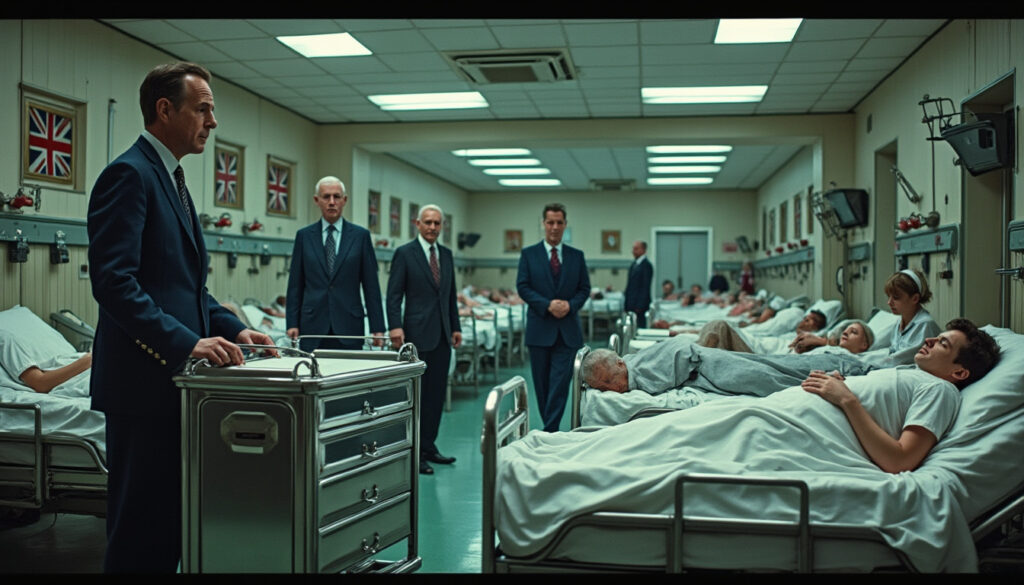
In Britannia Hospital, Lindsay Anderson transforms a hospital into a miniaturized and grim caricature of British society. Amidst privileges, strikes, and excessive medical ambitions, this political satire blends black humor and chaos to scratch at institutions and power relations.
In Britannia Hospital, Lindsay Anderson transforms a medical establishment into an explosive miniature of British society. As the royal family prepares to inaugurate a new service, strikes, privileges, and insane scientific ambitions collide in a chaos that is as comedic as it is troubling. Behind the farce, the film deciphers power relations and creates a portrait of a society that seems to be rushing towards its own catastrophe.
Released in 1982, the film is part of Lindsay Anderson’s political journey, a filmmaker who here prefers furious caricature over social realism. His hospital is a closed space, but it contains an entire country: the notables, the workers, the institutions, the representatives of the monarchy, and those who contest the established order. This concentration gives the story the appearance of a real-life experiment, where each group reveals its interests and contradictions.
Britannia celebrates its anniversary and prepares an official ceremony, an ideal opportunity to gather the powerful under one roof. Outside, the strikers block access; inside, the staff is divided, and the privileged patients demand the services they think they are entitled to. The hospital then becomes a theater of confrontations, and the celebration of its history takes on the air of a prelude to collapse.
A facility that concentrates the tensions of the country
The royal visit serves as a backdrop to an organization already on the brink of breakdown. The kitchens cease preparing luxurious meals for wealthy patients, while an African leader and his entourage benefit from exceptional treatment. Every decision, even seemingly trivial, highlights the inequality of positions and the fragility of the rules meant to maintain order.
Anderson does not seek to establish a clear boundary between the responsible and the victims. The unions, strikers, doctors, and administrators form distinct blocks, but none emerge unscathed from this black comedy. The film observes their strategies, compromises, and blind spots with an irony that spares no one.
This fragmented community recalls the structure of If…, where groups from an English college already embodied opposing camps. In Britannia Hospital, the movement is reversed: the dominant retreat into the facility, while anger threatens from outside. The building becomes a besieged fortress, and the entire country seems to be trapped within it.
Two-tier medicine and the logic of privilege
The film’s first target is a healthcare system hierarchized by wealth and influence. Wealthy patients occupy the spaces almost like hotel guests, enjoying comfort and refined meals without showing any particular urgency. The appearance of a modest dish is enough to provoke their indignation: the announced end of privileges seems more unbearable to them than the illness.
At the other end of the spectrum, ordinary patients risk becoming mere subjects for experimentation. Surgeons treat them with chilling casualness, as if their bodies had value only as research material. The film pushes this violence to the absurd, exposing a medicine where the language of progress may mask contempt.
The human body reduced to a resource
The star surgeon of the story prepares a spectacular invention, intended to advance humanity. Behind his reputation lies a megalomaniac scientist, more concerned with media attention than with the fate of his patients. His project involves creating an idealized human, endowed with a brain presented as superior and freed from the weaknesses of the body.
The sequence around the head prepared for the operation shifts horror into the burlesque. The doctor discovers that his precious element is unusable and immediately considers replacing it with that of another patient. The individual becomes interchangeable, in a logic where scientific ambition and ethics have ceased to intersect.
This macabre fantasy provides the film with one of its most striking images while questioning the idea of perfection. Wanting to eliminate human limits does not necessarily make humanity wiser; it may instead amplify its desire for control. The monster promised by the laboratory ultimately turns out to be merely the extension of appetites already visible in the hospital’s corridors.
Black farce as a political instrument
The staging relies on a turbulent energy, far removed from a social drama treated in a naturalistic mode. Anderson accumulates incidents, tonal shifts, and excessive situations, until the establishment becomes a machine for producing disorder. Laughter often arises from discomfort, leaving behind an impression of anger.
The opening scene immediately sets the tone. An old man is dying in the hall, while emergencies and strikes complicate his arrival; the nurses, on the other hand, have gone to take their break. The absurdity is brutal, but it already reveals a system where daily rules seem to survive compassion.
A satire without moral refuge
Unlike a work that clearly opposes the people to the powerful, the film is wary of simple solutions. The various groups defend their interests, but dissent can also be co-opted or neutralized by convenient arrangements. A promise of a favored position is sometimes enough to calm demands, leaving the mechanisms of domination almost intact.
This vision gives the work a profoundly nihilistic tone. Anderson seems less convinced by the possibility of a collective victory than by the power’s ability to absorb oppositions. Humor then becomes a form of resistance, not because it predicts a happy ending, but because it refuses to render violence respectable.
The narrative ultimately loses all stability: intrigues disperse, events escalate, and the hospital resembles a world no longer obeying any common rules. This disorderly construction accompanies the political crisis rather than resolving it. The confusion is not a mere stylistic effect; it evokes the erosion of an order that claimed to be solid.
Malcolm McDowell and the faces of a society in crisis
Malcolm McDowell reunites with Lindsay Anderson after If… and O Lucky Man!, where he already portrayed Mick Travis. This is not a trilogy designed as the continuous sequel of the same adventure, but a recurring character traversing different universes. Through him, the filmmaker can observe the mutations of a society without confining his hero to a traditional biography.
His role in this third film seems sometimes secondary; however, his presence acts as an anchor amidst the tumult. Promotional images showed him half-naked, his body marked and surrounded by doctors, a grotesque silhouette reminiscent of the Frankenstein creature. This iconography also recalls, through its biting gesture, the universe of A Clockwork Orange, to which viewers might have been tempted to compare the film.
A cast filled with recognizable figures
Surrounding McDowell, several British actors give life to this gallery of authoritarian, opportunistic, or outdated characters. Graham Crowden plays the professor whose research takes a monstrous turn, while Leonard Rossiter, Jill Bennett, Joan Plowright, and Peter Jeffrey contribute to the density of the tableau. Their characters sometimes seem drawn as emblems, but their interpreters bring a unique presence to them.
Mark Hamill’s participation creates an unexpected counterpoint to his image associated with Star Wars. Here, he is far from space heroism: seated in a surveillance vehicle, he appears inattentive to his mission. This mismatch contributes to the film’s fantasy and reminds that observing chaos does not spare those who claim to control it.
Each face seems to belong to a social category, but the characters are not merely reduced to simple illustrations. Their agitation helps give the institution its carnival-like aspect, where official functions become theatrical roles. The credits themselves extend this idea by distributing the performers according to the groups that compose the world of Britannia.
A work that overflows towards the apocalypse
The film begins with a satire of the hospital, but its anger soon extends to the state, institutions, and economic order. The Britannia is a microcosm where the same power relations repeat at different scales. Its long history, celebrated with pomp, contrasts with the violence of the conflicts that currently run through it.
The final part pushes this logic toward an apocalyptic vision, as if political failure had ultimately contaminated humanity itself. Laughter does not completely disappear, but it intertwines with a sense of the end of the world. This is one of the most troubling aspects of the work: its comic energy does not necessarily open onto hope.
A mirror that is still difficult to turn away from
The satire of the film retains a special resonance in a world where inequalities remain at the heart of debates. The privileges of wealthy patients, the exploitation of the most vulnerable, and the media staging of progress compose an easily recognizable mechanism. Anderson exaggerates the features, but this exaggeration makes the structures more visible rather than distancing them from reality.
The filmmaker’s political anger resonates with that of works that interrogate spectacle, power, and the society of control. To extend this reflection on the universes where individuals become the actors of a political device, one can also discover this dive into the universe of Running Man by Edgar Wright. The approaches differ, but both invite viewers to look at what lies behind entertainment and the staging of power.
The satire also retains its bite thanks to the precision of its images, ruptures, and excesses. It refuses to transform revolt into an edifying spectacle, preferring to show a world where each camp risks being caught in the same machine. This bitter lucidity makes Britannia Hospital much more than a political curiosity from the 1980s.
Rediscovering the film in video edition
Blu-ray editions allow viewers to enjoy the film under optimal conditions, notably thanks to a carefully crafted high-definition master. Some publications also offer French subtitles and supplements that shed light on the making of the work. The choice of bonuses varies according to the publishers, making it useful to distinguish their contents before deciding.
Archives and testimonies to extend the screening
A Powerhouse edition includes a long archival conversation with Lindsay Anderson, recorded in 1991 as part of a project dedicated to the history of British entertainment. More recent interviews feature Robin Askwith and Brian Pettifer discussing the filming and their relationship with the filmmaker. The editor Michael Ellis revisits the choices and steps of the editing work.
Trailers complement these documents, while an extensive booklet gathers analyses, interviews, diary excerpts, and testimony from the screenwriter David Sherwin. Together, these provide multiple perspectives on the film, from its conception to its critical reception. These supplements help illuminate a work where the chaotic form sometimes seems as bold as the ideas it defends.
The StudioCanal Classics collection offers a more focused approach, with a presentation made by Première and the short documentary O Dreamland, filmed by Anderson in 1953. This film wanders through the Dreamland amusement park in Margate, observing rides, games, automata, and visitors. A booklet also accompanies the edition, providing another entry point into the director’s universe.
Britannia Hospital, a biting satire of British society
In Britannia Hospital, Lindsay Anderson transforms a hospital into a grim miniaturization of Great Britain. On the occasion of an official ceremony, tensions build behind closed doors: strikers block access, the privileges of wealthy patients are contested, and staff continue their work amidst disorder. Inside and outside, everyone defends their place and their interests. The hospital, meant to heal, thus reveals a deeply divided society.
The satire equally fiercely targets the powerful, the institutions, and individual ambitions. Wealthy patients are treated like luxury guests, while the more vulnerable become subjects of experimentation for physicians eager to advance their careers. The extravagant project of a surgeon, who dreams of creating the ideal human being, pushes this logic to the point of horror. Anderson blends the grotesque with the fantastic, without seeking quiet realism: the exaggeration and black humor make the critique even harsher. The presence of Malcolm McDowell, in the role of Mick Travis, connects the film to the filmmaker’s dissenting universe.
This comedy of chaos does not propose a heroic revolt or easy appeasement. Groups clash, negotiate, and manipulate each other, while tumult seems to seep into every corner of the building. The laughter provoked by absurd situations gradually takes on a hue of concern: behind the farce lies a world where money and power outweigh solidarity. Made in the early 1980s, the film maintains a singular force through its way of turning Britannia Hospital into a theater of social confrontations. Its feverish directing and unfiltered anger give this British satire both jubilant and dark energy.