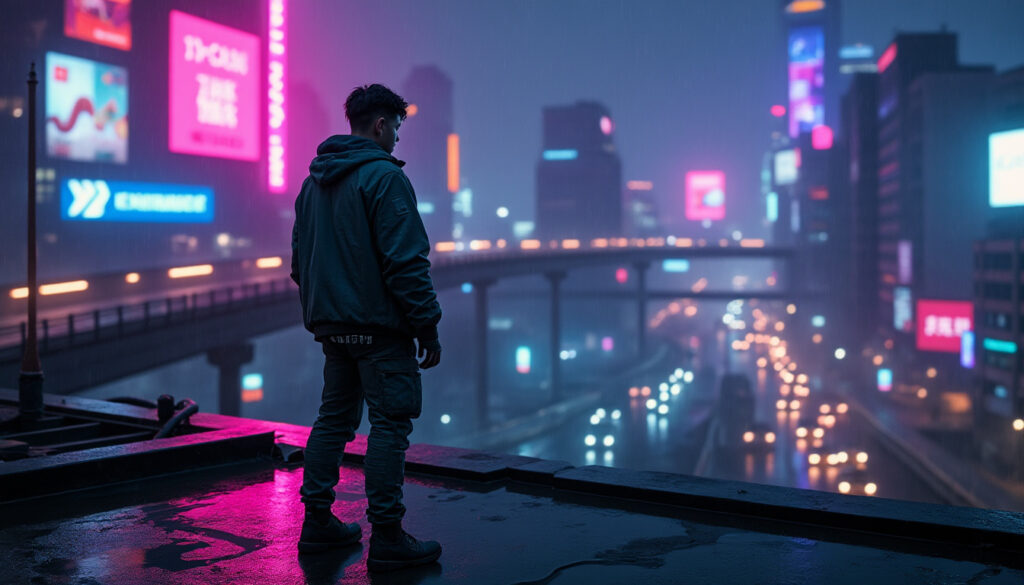
With Cyberpunk: Edgerunners II, Night City welcomes new destinies, amid cyberware, gangs, and battered dreams. Despite the electrifying animation by Studio Trigger, this choral season sometimes struggles to connect its plots and recapture the emotional charge of the first dive into the megacity.
With Cyberpunk: Edgerunners II, Night City welcomes new destinies, augmented bodies, and dreams that unravel under the neon lights. The series maintains the visual energy of Studio Trigger, but struggles to transform its scattered plots into a true common tapestry. This new trip to the metropolis is often captivating to watch, though it does not always rediscover the emotional accuracy that marked the first season.
The first season advanced like a tragedy where each detail seemed to announce the next shock. A few seconds of animation were enough to make David’s mourning for Maine’s fall palpable, while Lucy’s lunar dream found a heartbreaking resonance in its conclusion. These images struck not only through their intensity: they seemed to naturally emerge from everything that preceded them. The sequel also seeks its great moments, but prepares them with less precision and necessity.
A spectacular animation, but more uneven emotions
The know-how of Studio Trigger remains immediately recognizable. Bodies deform, colors burst, and confrontations take on nightmarish electric overtones. The violence is sometimes so excessive that it becomes almost choreographic. Yet, the visual impact does not always suffice to give weight to the events. Where the first season made every outburst a step in David’s tragedy, this new salvo sometimes lets its fiery images resonate alone.
The problem is therefore not the absence of strong scenes, but how they fit into the whole. Some bloody sequences capture attention, and the editing still knows how to accelerate to make the action almost suffocating. However, the stakes sometimes evolve without the narrative giving us the time to attach to the consequences. An injury worsens, a threat changes appearance, a revelation seems to upend everything. Then the story moves on. The series wants to keep the tension rising continuously, but the emotions do not always have the necessary space to settle.
Different destinies seeking their point of convergence
This time, the narration unfolds around several characters without clearly designating a center of gravity. Roman prefers to observe the horror of the city through an old analog camera rather than experience it through clandestine simulations. Talia, a teenager estranged from her parents, has replaced much of her body with implants. Her mother then calls on Weak, a former companion turned edgerunner, to find her and protect her from the Maelström. Added to these journeys is that of D, a nomad driven by a revenge whose true roots he still does not know. Each character opens a different window onto the city, but these windows primarily overlook districts that seem far apart from one another.
A choral narration can indeed work wonders in such a vast universe. The city is precisely made up of lives that intersect without resembling each other: precarious individuals, fabulously wealthy celebrities, mercenaries, and ordinary families share the same backdrop, even when they could never meet otherwise. In the game Cyberpunk 2077, the player’s journeys connect these worlds and give the metropolis a lived coherence. Here, the paths of Roman, Talia, and D remain largely juxtaposed. They inhabit the same universe, but their convergence rarely produces an attraction strong enough for one to feel the city pulling them together.
When the threads finally connect, some links seem too fragile to support the narrative promise. Revelations meant to illuminate the whole sometimes lack depth, while the stakes seem to change shape along the way. Talia’s deteriorating health brings a tangible urgency, but it intertwines with a revenge plot that occasionally adopts a somewhat unconvincing moralizing tone in a world where almost no one has clean hands. The characters then speak as if a simple answer could emerge from a system built on exploitation. This contradiction could have fueled an exciting conflict. It rather remains on the surface, and the series seems to hesitate between denouncing the surrounding brutality and using it as an exhilarating spectacle.
Night City as a backdrop rather than a character
Night City should be much more than a luminous backdrop. Its overwhelming architecture, class relations, and omnipresent technologies could connect destinies and shape their choices. In this season, the city sometimes appears surprisingly interchangeable: its distinctive signs are recognizable, but it feels less like an acting force. The characters traverse a dangerous megacity without each of their movements seeming to reveal a new facet of its functioning. The feeling of living at the heart of a vast organism, capable of engulfing those who try to resist it, weakens. Some lore elements enrich the world, but others are presented with such insistence that one expects them to disrupt the story. Their influence remains limited, however. This dissonance diminishes the impact of discoveries and leaves some plot lines hanging in the audience’s mind.
The series is not devoid of qualities: its voice cast serves many sometimes contradictory characters well, and its artistic direction retains a powerful identity. However, the whole often gives the impression of hesitating between several autonomous narratives. One glimpses a story about augmented adolescence, another about memory and image, then a path of retaliation linked to D’s nomadic past. Each could carry a stand-alone anime. Their reunion would have required more organic connections, less visible in their seams. In striving to find a convergence, the plot sometimes gives the impression of forcing pieces that do not quite fit together. Some scenes then become mere necessary steps rather than inevitable consequences.
This lack of cohesion does not erase the sequences capable of leaving a lasting impression. It simply makes their brilliance more isolated. The first season converged its threads towards images where the emotion seemed to have been patiently constructed, frame by frame. Here, dramatic peaks emerge, but detach more easily from the path that precedes them. Moments of cruelty impress, without always deepening what violence means for those it crushes. Personal conflicts unfold in a deeply ill society, but their connections to this society sometimes remain too light. The staging continues to find striking gestures, wavering gazes, and moments of silence amid the noise. It is in these details that the anime most often regains its sensitivity, before the narrative shifts back to a new tension line.
Cyberpunk: Edgerunners II — a less striking dive into Night City
With Cyberpunk: Edgerunners II, Night City opens its doors to new destinies, but this second season struggles to give them a real point of convergence. Roman observes the city’s violence through his analog camera, Talia descends into a rebellion marked by implants, while D pursues a revenge whose contours he still does not know. These trajectories promise a rich choral tapestry without immediately creating a common dynamic.
The main divergence from the first season lies in how each story fitted into a single movement. Here, the narrative threads remain distanced from one another for a long time before the series tries to connect them through sometimes fragile revelations. The stakes seem to change shape throughout the episodes, and some connections feel more imposed than naturally constructed. The narrative could have gained tension with fewer intrigues developed more solidly.
The violence still holds a central place, and Studio Trigger delivers spectacular, tense, and often cruel animated sequences. But the visual impact does not always suffice to confer the emotional or thematic resonance of the impactful moments from the first season to the confrontations. Night City, although essential to the universe, also feels less present: its social contrasts and unique identity remain more in the background, even though they could bind the told destinies together.
The season is not without its strengths. Its array of characters offers interesting perspectives on the inhabitants of the metropolis, and the voice cast effectively accompanies its most intense moments. However, amidst scattered narrative promises, sometimes shifting stakes, and less memorable strong scenes, Edgerunners II primarily leaves the impression of a potential that does not always find its form. Its streets remain full of possible stories, and this season sketches several without offering them all the same depth.