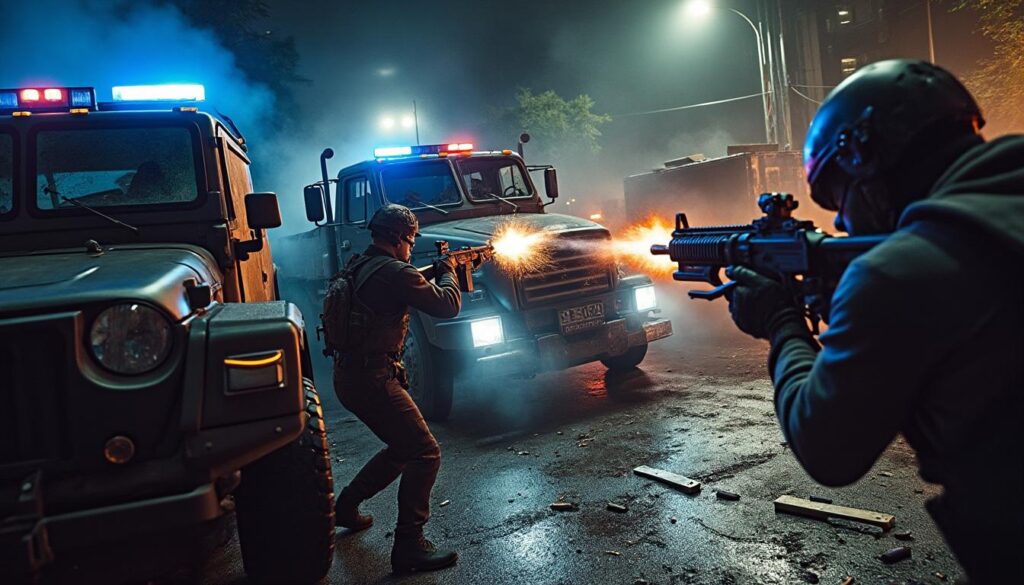
Bruce Beresford immerses us in a ruthless universe with his film ‘The Great Standoff, a significant work that challenges the conventions of traditional crime films. Released in 1986, this bold feature unveils an unfamiliar Australia, where the corruption and duplicity of the characters echo the realities of a degraded social system. Through creative staging and a complex narrative, Beresford invites us to explore the brutality of human relationships in a world in decay.
The film The Great Standoff, directed by Bruce Beresford, offers a fascinating immersion into a story where tension and brutality intertwine. Far from the more conventional image one might have of Beresford, this feature presents a violent and disturbing universe. Here, the key lies in how the director depicts corruption and duplicity through an intense narrative. This article will delve into the main themes of this film, as well as the impact it has had on the landscape of Australian cinema.
A director in search of authenticity
Bruce Beresford is often recognized for his talent, but The Great Standoff showcases a different angle from his previous works. This film, his sixth feature, is both the result of collaborative work and a reflection of a personal vision. The choice of a dark narration demonstrates his desire to explore the most unsettling facets of human nature. This production, made of brutal realism, reveals an Australia that few are accustomed to seeing.
Beresford does not merely deliver a simple heist tale. On the contrary, he injects emotional intensity into his direction. The main characters, initially difficult to identify, are carefully sketched to reveal the complexity of their motivations. This approach makes the film demanding, yet of certain interest. With an atmosphere of darkness, the director opens the doors to a dehumanized world.
The narrative: an omnipresent tension
The attack on an armored car serves as the starting point for a thrilling plot. The flow of suspense is quickly established when the protagonists find themselves caught in a fatal mechanism. This film does not boast a simple narrative; it plays with the viewer’s perception, blurring the boundaries between good and evil. This creates an atmosphere of constant distrust. Each character, from the unionist to the policeman, seems to have their own interests, and this duality is highlighted throughout the narrative.
Being a spectator of the film’s subtle and insinuated violence is no trivial matter. This tension increases as the film progresses and reaches its peak in a shocking final sequence. The editing plays a crucial role, alternating perspectives and making the experience even more immersive. Each scene becomes a dive into despair, confronting the audience with a frightening reality.
A sharp critique of society
Beyond its status as a crime film, The Great Standoff stands out as a social critique of capitalism. This is manifested in the depiction of a society eroded by corruption. The film, through its dialogues and staging, evokes the cynicism inherent in a world where only the strongest survive. The motivations of the characters, often stemming from a violent struggle for money, are depicted with striking acuity.
We see how masculinism imposes itself at the heart of each interaction, endowing the protagonists with a disturbing depth. Beresford does not seek to flatter the viewer but rather to offer a raw reflection of the world. A reality where humanity is progressively sidelined, making way for a struggle for survival. This choice of narration leads to questioning: who are we when survival is at stake?
Captivating aesthetics and staging
Beresford’s direction showcases remarkable aesthetic mastery. His choice of harsh lighting and clinical sets amplifies the dehumanizing nature of the story. The varied atmospheres between urban exteriors and frozen interiors create a sense of oppression. The viewer is thus caught up in this ballet of violence, torn between the desire to move forward and the fear of the unknown. A true visual whirlwind!
By playing with a quasi-televisual aesthetic, Beresford avoids the traditional glamour often associated with the genre, favoring a more direct approach. This choice is wise. The reality is thus brought to the forefront, without artifice. This realism bursts forth especially in the bold narrative choices and plot twists. Each scene is arranged to reinforce the urgency of the situation while maintaining suspense.
A memorable cast and a cinematic experience
The film also stands out for its exceptional casting. The actors, with their striking faces, manage to bring life to this troubling universe. Among them are iconic figures of Australian cinema, such as Bryan Brown. Their presence strengthens the connection to the Hollywood noir film tradition, while adding value to the narrative. Each performer is carefully chosen to resonate with the very essence of the work.
Ultimately, The Great Standoff is not limited to a simple heist story. It is a genuine immersion into a narrative where the viewer is invited to grasp the brutality and complexity of social interactions. Beresford, although initially skeptical of his visual treatment, succeeds in capturing a sharp reflection on human nature. Each viewing thus offers a new understanding of this significant work.
Bruce Beresford: An explosive dive into ‘The Great Standoff’
With The Great Standoff, Bruce Beresford immerses us in a universe where violence and corruption intertwine to reveal the darkest corners of human nature. This film, while belonging to the crime genre, goes beyond the simple expectations of a heist movie. It stands out for its brutally realistic approach to Australian society in the 1980s, where each character becomes a reflection of a distorted system, where the line between good and evil fades.
The staging, both visceral and clinically precise, leaves no room for complacency. Beresford deliberately chooses to immerse the viewer in a dehumanized reality, where the protagonists, while embodying various facets of society, seem two-dimensional, trapped by their own functions. This creates a captivating dynamic that forces the viewer to reevaluate their own perceptions of the characters and to question the true motivations that drive them.
The palpable tension throughout the narrative, heightened by a clever alternating editing, intensifies the sense of intrigue and danger that permeates every scene. Beresford depicts a world where roles are reversed and where even those who are supposed to uphold the law can become suspects. It is a sharp critique of capitalism and the inequalities that ensue, presented under a veneer of entertainment.
In summary, The Great Standoff stands out as a major work of Australian cinema, highlighting Beresford’s talent for addressing social themes while offering an intense and disturbing spectacle. This film remains a must-see not only for cinema enthusiasts but also for those seeking to understand the undercurrents of a society in flux.