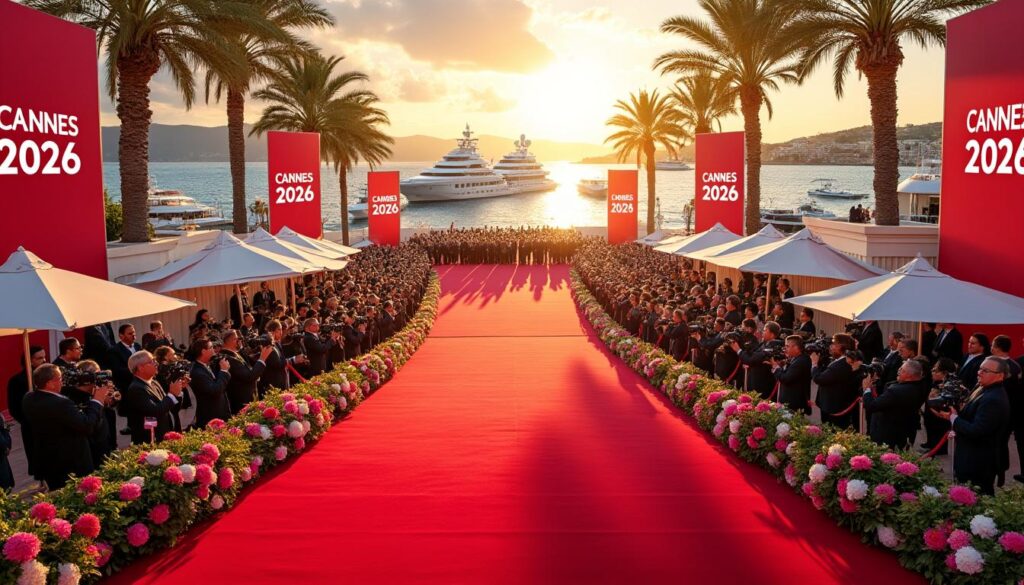
The Cannes Film Festival 2026 opens with a palpable breath of excitement, marking the start of a Radiant Cinematic Celebration. Following an opening ceremony filled with surprises, the anticipation is now at its peak to discover promising works that live up to this prestigious event. The films presented during this first day multiply emotions, combining humor, drama, and reflection on contemporary themes. Each screening thus becomes an immersion into captivating narratives and bold visual explorations.
The Cannes Film Festival 2026 has started with flair, marking the launch of a cinematic celebration rich in emotions and discoveries. This first day saw talents from all over the world, bold works, and poignant productions. Festival-goers, always thirsty for new experiences, were welcomed with enthusiasm for this new edition that promises to be memorable.
Honorary Palme d’Or: A Symbolic Opening
The opening ceremony of the festival displayed a special aura. The Honorary Palme d’Or, one of the most anticipated moments, was awarded to the iconic Peter Jackson, a name inseparable from cinematic history. His commitment to the art of storytelling was celebrated, and this award set the tone for the rest of the festivities.
Buoyed by this strong moment, the audience eagerly awaited the opening film that would kick off the screenings. Although many past openings have left the audience wanting, expectations were high this year, particularly after such a nostalgic introduction.
First Impressions: Electric Venus
It turned out that the opening film, Electric Venus, directed by Pierre Salvadori, managed to capture the attention of film lovers. With a style that is both humorous and light-hearted, this comedy explores the complexities of romantic relationships. Indeed, the depth of the characters, even within the farce, presents a poignant love story.
Salvadori has always had a knack for creating works that maintain a certain balance between laughter and drama. Despite an approach that did not excite all viewers, he managed to offer a reflection on death, disappearance, and memories, touching the sensitivity of spectators.
The Start of the Official Competition
Next, the official competition took flight with the screening of Few Days in Nagi by Kōji Fukada. This film, true to the humanistic style of its director, focuses on identity quests through the eyes of various protagonists. With characters ranging from young lovers to a woman in search of new love, the themes addressed are as varied as they are touching.
Fukada’s work is marked by a particular attention to how choices shape our lives. The emotional stakes, such as those related to romantic or geographical decisions, plunge the viewer into a necessary introspection, demonstrating that every choice has consequences.
The Place of Bodies
Through rich visual metaphors, the bodies of the characters become a powerful storytelling tool. The film explores what it means to evolve in an artistic and turbulent world, incorporating elements such as drawing and sculpture. A highlighting of artistic choices and their impact not only on the individual but also on those around them.
This introspection leads us to the quest for a shared humanity, where each fate is a mosaic of achievements and failures, resonating with a certain lightness. Fukada’s sincerity, carried by an honest gaze, touches and elevates, even though this film remains a modest chapter in his career.
A Tangible Disappointment: The Life of a Woman
Unfortunately, not all screenings managed to capture the attention of festival-goers. The Life of a Woman by Charline Bourgeois-Tacquet elicited mixed reactions. Although Léa Drucker shines in her role, the film suffers from a lack of substance. The portrayal of her character chooses to mix modern themes without truly exploring them in depth.
The film addresses careerism, motherhood, and bisexuality, but stops at already well-defined obviousness in today’s context. The dynamics of motherhood, for instance, are tinged with a sense of déjà vu, leaving the spectator wanting. These elements could have been deepened to offer a more nuanced perspective.
Observations on an Outdated Discourse
Instead, the narrative structure appears as an echo of questions that are almost anachronistic. Why discuss subjects that many consider already established? The Life of a Woman ultimately struggles, boring on both sides as it goes in circles around unoriginal concerns. This form of bourgeois restraint inhibits the narrative and leads to a growing indifference among the audience.
A Certain Look: Teenage, Sex and Death at Camp Miasma
While a breath of fresh air was hoped for, the opening of A Certain Look brought persistent and confusing productions. Teenage, Sex and Death at Camp Miasma by Jane Schoenbrun captivated as much as it bewildered. Its experimental approach juxtaposes a host of ideas while paying homage to the classics of the slasher genre.
Although the transgender theme is present, the assembly of different notions ultimately saturates the plot. The promise of an original exploration struggles to materialize, and the film, sometimes chaotic, becomes a difficult mount to follow. Inconsistencies abound, leaving the audience both delighted and perplexed.
A Jolly Mess with Overambitious Goals
By playing on well-measured self-deprecation, Schoenbrun reveals a critical gaze but without truly advancing the discussion. This blend of styles creates a climate of confusion where the narrative break creates anxiety. Thus, the film oscillates between enjoyable moments and irritating inconsistencies.
This leaves a strange imprint, balancing between the chaotic and the successful. Many hoped for more, a stronger thread to connect its aspirations. However, the day, rich in emotions, laid the foundations for a celebration that, despite its highs and lows, embodies the vitality of the cinema world.
For further insights into the festival and other reviews, feel free to visit these articles: Scarlett Johansson: The Captivating Portrait of Eleanor, Cannes 2025: A Subjective Assessment, and Emanuel Parvu Three Kilometers from the End of the World.
The curtain rises on the Cannes Film Festival 2026 with mixed feelings, oscillating between excitement and concern. The opening ceremony, marked by the awarding of an Honorary Palme d’Or to Peter Jackson, left the spectators eager to discover the works that were to follow. Although several opening films from previous years have disappointed, Pierre Salvadori’s sparkling Electric Venus managed to find the right balance between comedy and reflection on more serious themes, evoking death and love with a feigned lightness that charmed without truly delighting.
The tone of the official competition was set by Few Days in Nagi by Kōji Fukada, whose humanistic cinema has managed to question the stakes of identity and the crucial choices that shape our lives with finesse. This film captivated the audience by exploring personal quests while diving into the heart of interpersonal relationships, while anchoring its characters in palpable realism. This work revealed the strength of human emotions, even if it positions itself somewhat modestly within Fukada’s entire filmography.
On the other hand, disappointment struck with The Life of a Woman, a film that, despite an interesting potential, became mired in outdated reflections. Thus, the issues of polyamory and motherhood were merely touched upon without ever really dominating, initiating a sense of indifference towards the urgency of the addressed issues.
Finally, the selection for A Certain Look brought its share of chaos with Teenage, Sex and Death at Camp Miasma. This film worked the theme of transgender identity in an explosive setting but suffered from an excess of unfinished ideas, leaving a taste of the incomplete. In this whirlwind of emotions and frustrations, the opening day of the festival managed to evoke, question, and stimulate debate, highlighting the richness and diversity of today’s cinematic landscape.