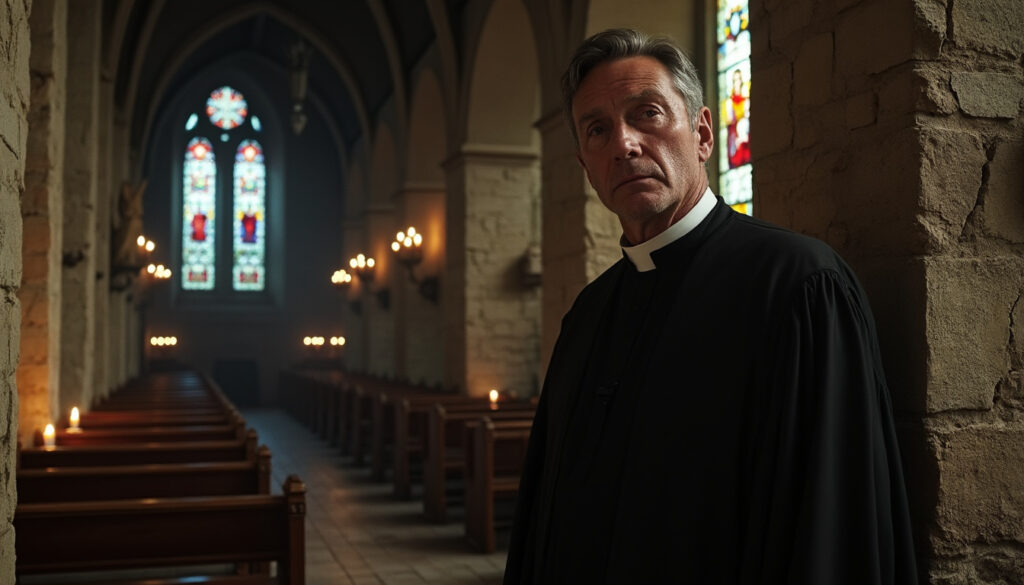
The film “The Priest”, directed by Eloy de la Iglesia and released in 1978, stands as an essential work that illustrates the torments of a Spanish society in full transition, on the dawn of the end of Francoism. With a bold narrative, the film explores the internal contradictions of a young conservative priest, caught between his faith and his inner demons. Through a provocative staging and a sharp critique of the Church, De la Iglesia manages to establish a rare empathy for his protagonist, thus offering a powerful reflection on the relationship between religion and humanity.
The film “The Priest” directed by Eloy de la Iglesia is an unforgettable cinematic work. Released in 1978, it deals with the torments of a young priest in Francoist Spain, addressing themes such as repressed sexuality and the struggle between faith and desire. This article explores the depths of this daring film, highlighting its poignant message, its unique storytelling style, as well as the impact it had on the cinema and society of its time.
A Dive into the World of Eloy de la Iglesia
Eloy de la Iglesia is known for his powerful and provocative films, particularly “The Priest.” This film audaciously exposes the contradictions within the Catholic Church under Franco. De la Iglesia skillfully mixes sarcasm, irony, and drama, making his protagonist a complex and tormented character. In this work, the tension between sexuality and religion is highlighted in an almost palpable way, leaving an indelible mark on the viewer.
It is interesting to note that, in the main character, we find the contradictions of a man torn between his urges and his faith. This duality is representative of a larger struggle in Spanish society, where voices of dissent and change are beginning to emerge.
A Captivating and Emotional Narrative
The staging of “The Priest” by Eloy de la Iglesia succeeds in capturing the internal drama of its hero. He is confronted with hallucinations and blasphemous visions, which materialize his inner conflict. The film skillfully illustrates how sexual frustration can lead to devastating introspection. The tension between apathy and the cry of revolt is ever-present throughout the narrative, cultivating an atmosphere of helplessness and despair. The priest, consumed by his desires, is characterized by a sharp criticism and a troubling self-denunciation.
This visual writing does not simply limit itself to a moral dualism. Indeed, Eloy de la Iglesia seeks to show that religion can be political, and it is not merely a question of faith or morality. Through each scene, the director aims to unveil the fragility of the human condition in the face of the authority of the Church. The story is thus much more than just a personal drama; it is inscribed in a socio-political reflection.
The Central Themes of “The Priest”
- Conflict with Faith: The priest’s struggle with his moral beliefs.
- Taboos and Provocations: A bold representation of sexuality.
- Identity Crisis: The quest for self through internal and external struggles.
The central themes of this film resonate even today. The conflict between faith and desire is palpable, amplified by the demands of a society that imposes strict norms. The main character, despite his misadventures, gains in empathy. This tragic humanity offers viewers reflections on the human condition and the role of religion.
The Social Resonance of a Period Film
By confronting the realities of Francoist Spanish society, “The Priest” transcends the framework of a simple film. Eloy de la Iglesia, through his critical eye, shows that religion itself can be an entity out of sync, disconnected from the fundamental needs of humanity. This message of equality and understanding resonates deeply in a world still too marked by ideological dogmas.
To mention “The Priest” is also to evoke a work summarizing the social and cultural evolution of a country. In making this film, de la Iglesia allowed for a crucial dialogue on the necessity of transformation within the religious institution itself. The critical viewpoints articulated in the film are as much a denunciation of conformity as a call for reflection.
Artus Films, by distributing this emblematic work, highlights the strength of this powerful narrative. The choice to bring such sensitive topics to the screen shows a willingness to provoke debates in a society still marked by the remnants of the past. Culture aims to encourage collective awareness, which is admirable.
“The Priest,” directed by Eloy de la Iglesia in 1978, asserts itself as a landmark film of the transition between the Francoist dictatorship and cultural emancipation. By denouncing the internal struggles and contradictions of a priest faced with his unconfessed desires, de la Iglesia boldly addresses defiant attitudes towards the Catholic Church, revealing through a poignant narrative the duality between faith and human nature. The story of the young cleric, torn between guilt and desire, resonates with undeniable contemporaneity, offering a sharp critique of the religious dogmatism that dominated the era.
The power of the film lies in its ability to marry humor and tragedy, thereby creating empathy for the protagonist while masterfully portraying the emotional turmoil that inhabits him. The hallucinatory and blasphemous visions, illustrating the struggle against repression, underscore how human desire can transgress established norms, a theme dear to de la Iglesia. This boldness makes “The Priest” a catalyst for discussions, where religion becomes political, ambiguous, and accessible.
In a country where repression imposed limits on artistic expression, Eloy de la Iglesia uses the priest as a symbol, proving that protest can manifest through cinema. His direction transcends ideologies, questioning and analyzing the human condition within a waning system. With this work, the filmmaker leaves an indelible mark on the cinematic landscape, asserting that every film can be a political act and a voice for the voiceless. “The Priest” thus remains a significant and emblematic work in the history of Spanish cinema.