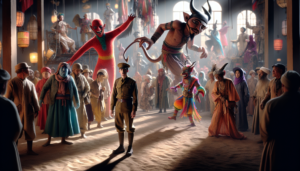
At the heart of Eric Rondepierre’s work, the story Fugue opus 36 stands out as a fascinating musical exploration, mixing sounds and words with rare delicacy. Immersed in the world of seventeen young residents of a reformatory, this work reveals the complexity of human emotions through intertwined voices. Rondepierre strives to capture the essence of the moment, playing on the resonances and echoes that transcend time and space, while opening up a reflection on the social issues of its time.
In his latest work, “Fugue opus 36”, Eric Rondepierre offers us a fascinating work rich in emotions. By exploring themes of escape, identity and human relationships, the author weaves a multi-voiced narrative inspired by historical events. The very structure of this book evokes the complexity of music, hence its evocative title. The different facets of this fugue broaden our understanding of the characters and their quest for freedom. Through delicate and evocative prose, Rondepierre succeeds in capturing fleeting moments, while skillfully playing on meanings.
A fugue with several voices
The term of fugue designates a musical style where a theme is reproduced in different voices. Rondepierre applies this notion to his story, highlighting the intertwined destinies of several protagonists. These voices, although distinct, come together to form a harmonious whole. They grasp the nuances and contradictions of their respective experiences. The narrator, Évelyne Forest, serves as a guide through the odyssey of these women whose dreams of escape take root in troubled times.
Through characters like Marcelle Géniat, the director of the establishment, and André Breton, the famous surrealist, the author immerses us in a France of the 1930s, marked by its social tensions. Artistic inspirations and political struggles skillfully blend together. Each voice adds a layer of depth and resonance, inviting us to reflect on the complexity of human relationships.
Echoes of social struggles
In this work, the political dimension is omnipresent. The runaways, all from difficult backgrounds, illustrate the social inequalities that reigned at that time. Their escape is as much an act of rebellion as a call for freedom. The condition of women, often oppressed, is highlighted through the poignant gaze of Rondepierre. The quest of these young girls is not only personal, it resonates with the struggles of their time. Rondepierre also evokes the fight against social and psychiatric classifications that judge and condemn. The author questions the stereotypes and prejudices that have shaped the destiny of the marginalized. Through Germaine, one of the runaways, he highlights the fragility of human life and the stigmata of a cold and indifferent society. Every emotion, every dream or disillusionment is captured with an irresistible intensity. The Interaction between Reality and Fiction
A fascinating feature of
“Fugue Opus 36”
is the way Rondepierre mixes reality and fiction. The representation of Marcelle, for example, echoes her role in the world of theater. She symbolizes the hypocrisy of a system that claims to be philanthropic while exercising strict control. This parallel between theater and the reformatory underlines the pitfalls and resonances that must question us about our own reality. André Breton and the Surrealists also bring a unique flavor to the story. Their willingness to act and challenge injustices underlines the importance of art in the fight for freedom
. The literary scene of the time is transcended by these actions, which makes the story all the richer. The viewer is invited to question the apparent stability of his world, and the representations of reality turn out to be misleading. The melancholy of the ephemeralWhat is fascinating about Rondepierre’s work is his ability to capture the
short-lived
. The lightness of the fleeting moments contrasts with the depth of the themes addressed. It reminds us that human memory is often fragile, and memories can vanish over time. Through narration, he creates poignant moments of touching melancholy, anchored in the urgency of living.On each page, the reader feels a palpable tension, a nostalgia not only for the characters, but also for the inexorable passage of time. The trajectories of Germaine and her friends underline the transience of decisions and actions. The ending leaves us with a lingering question: can we hold on to what we have learned or let it slip away?In a way, the
music
of this story, just like a fugue, invites us to feel, to reflect, to vibrate to the rhythm of the human lives which intersect on this stage of History. Eric Rondepierre manages to create a work where each note resonates deeply and where each silence is equally charged with meaning. IN BRIEF Last story of
|
Eric Rondepierre
|
“Fugue opus 36”
, Eric Rondepierre takes us into a rich explorationand complex themes of escape and representation. Through narration several voices , he weaves an engaging discourse around the five young residentsfrom a reformatory, whose escape on September 26, 1936 marked a turning point in their destiny. This posthumous work reveals the author’s finesse in approaching events while playing with narrative codes of the story. Rondepierre succeeds in making musical echoes resonate within his story thanks to the use of the word “fugue”
. It is not only a movement towards freedom, but also a polyphonic compositionin which each voice brings a unique perspective to this tragic event. The skill with which he combines history and fiction allows us to explore profound issues, particularly those linked to social oppression and the condition of women in a specific historical context. Through this narration
multiple, Eric Rondepierre also succeeds in creating dialogues between the past and the present, thus questioning our way of understanding history. The characters, like Marcelle Géniat and André Breton, add political dimensions and social to the story, testifying to a broader context where art And reality intermingle. In the final analysis, “Fugue opus 36” is part of a quest for meaning, establishing a link between the real and representation , while leaving an indelible imprint on the reader.