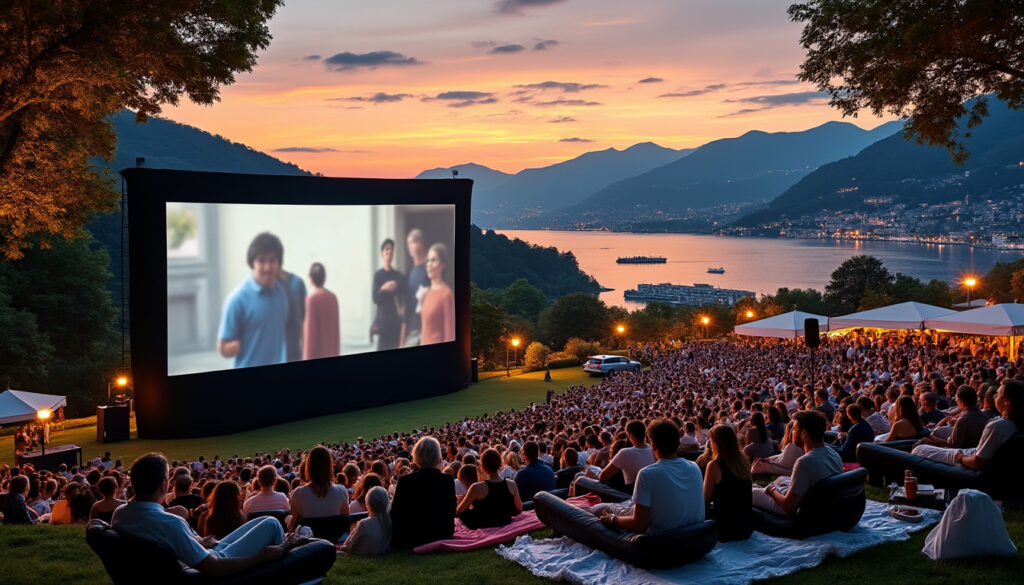
The Locarno Festival 2026 has proven to be an essential platform for discovering captivating cinematic works. Among the standout productions, three films particularly shine: “Until Then”, a poetic exploration of memories and connections to our place of origin; “Demony”, a corrosive fable painting the sociopolitical tensions of a Ukrainian village; and finally “Bruton”, a touching prison drama that addresses life in prison with both a humorous and emotional approach. Each of these works offers a unique reflection on the human condition and interpersonal relationships.
The Locarno Festival 2026 was marked by the screening of captivating and unique films. Among them, three works stand out particularly: “Until Then”, a poignant film by director Sarah Leonor, “Demony”, a striking chronicle by Natalka Vorozhbyt, and finally “Bruton”, a dramedy by Vincent Grashaw. These films offer a unique vision on themes such as connection to one’s roots, social tensions, and the prison universe, each in its own way, promising an enriching cinematic experience.
The emotional story of “Until Then”
“Until Then” is set in a small town in the Vosges, the cradle of the author’s memories, Sarah Leonor. This film, which claims to be a collection of cinematic short stories, invites viewers to an introspective exploration of identity. The three main characters, Lucien, Aline, and Jade, are connected by the thread of a past that catches up with them. Lucien chooses freedom in nature, far from society, while Aline, armed with her camera, attempts to capture the essence of the world around her. Jade, the youngest, aspires to an ideal fusion with her environment. But at what cost?
This feature film raises the question of returning to one’s roots and the imprint of our childhood. Lucien, played by Frank Beauvais, illustrates this desire for escape while being confronted with the memory of his former life. Aline, portrayed by Dinara Droukarova, experiences an obsessive quest that leads her to a breaking point. As for Jade, a promising young actress, she embodies a youth full of hope but also of illusions. The film is an ode to simplicity, both in its aesthetics and its narration.
“Demony”: a sharp look at society
In contrast, “Demony” directed by Natalka Vorozhbyt depicts a Ukrainian village in 1994, a closed, isolated space, yet rich in conflict. This film portrays Slavik, a wandering writer, and Nina, a shopkeeper marked by the years. Their love, despite the age and nationality differences, becomes a mirror of the historical tensions between Ukraine and Russia. The atmosphere of this tale is imbued with internal struggles, violent passions, and a slow degradation of human relationships, unfolding under the watchful eye of a suspicious community.
In this painful context, the characters’ decisions are scrutinized, each act bearing consequences. The power dynamics between Slavik and Nina illustrate the ramifications of a society in full transformation. The beautiful images, both vibrant and dark, reinforce the political portrait that Vorozhbyt paints of this community. This filmmaker, through a bold visual approach, immerses us in the underlying tensions, thus revealing the wounds of yesterday that still pulse today. The tragic and humorous dimension in this film echoes the inner struggles of each character.
“Bruton” and the complexity of family ties
“Bruton”, directed by Vincent Grashaw, transports us into the prison universe of Florida. Bryan Bruton, played by Theo Rossi, finds himself imprisoned in a world he himself helped shape through wrong choices. The film delicately evokes the struggles of a man desperately trying to maintain a connection with his daughter, Crystal, while he is sentenced to ten years of confinement. Bruton’s life then becomes a balancing act between survival and depression, between the hope of a future and the shadows of his past.
With a touch of humor, the narrative tackles serious themes such as redemption and familial love. The dynamic between Bryan and Maura, a prison guard, adds a dimension of humanity to this austere environment. Their relationship is both tragic and full of promise, illustrating the fragility of the bonds that unite us. The second part of the film shifts towards a more serious drama, revealing the injustices of the penitentiary system. Despite everything, “Bruton” manages to maintain a subtle lightness, rendering these heavy themes in an incredible way.
An unmissable discovery at the Locarno Festival 2026
These films, “Until Then”, “Demony”, and “Bruton”, are all essential works that stood out during the Locarno Festival 2026. They offer a rich palette of emotions and reflections on identity, love, and the complexity of human relationships. Manifestly, this edition allowed for the emergence of unique voices, reflecting different realities through the prism of cinema. In short, these films remind us that the 7th art always has a precious role to play in the understanding of our world.
- Suspense and surprises at the festival
- Highlight moments at La Roche sur Yon
- Discovery of new talents
- Immersion in powerful narratives
- Explore diverse themes
Locarno Festival 2026: A retrospective of the flagship films “Until Then,” “Demony,” and “Bruton”
The Locarno Festival 2026 offers a rich and varied cinematic palette, highlighting works that explore profound and often difficult themes. Among the most remarkable films, “Until Then” by Sarah Leonor stands out for its ability to capture the essence of the places and memories that shape our lives. Through the story of Lucien, Aline, and Jade, the director invites us to reflect on our relationship with our environment and the choices we make, whether voluntary or involuntary, in search of freedom or a connection to our past.
“Demony,” directed by Natalka Vorozhbyt, immerses us in a darker and more complex universe, highlighting the tensions between Ukraine and Russia through the tumultuous relationship between Slavik and Nina. This film questions the nature of love and bonds, set against a sociopolitical context that alters human behavior, making interactions unpredictable and often pathetic.
Finally, “Bruton” by Vincent Grashaw offers a novel approach to the prison genre, focusing on the emotional challenges of an imprisoned father. Through the life of Bryan Bruton and his struggle to maintain a connection with his daughter, the film addresses themes such as redemption and humanity within a dehumanizing penal system.
In short, these three films reflect the potential of cinema to address varied human experiences, thus transcending cultural and emotional boundaries. The Locarno Festival presents itself as a space of meeting and exchange, where cinematic art becomes a powerful vehicle for dialogue and reflection.