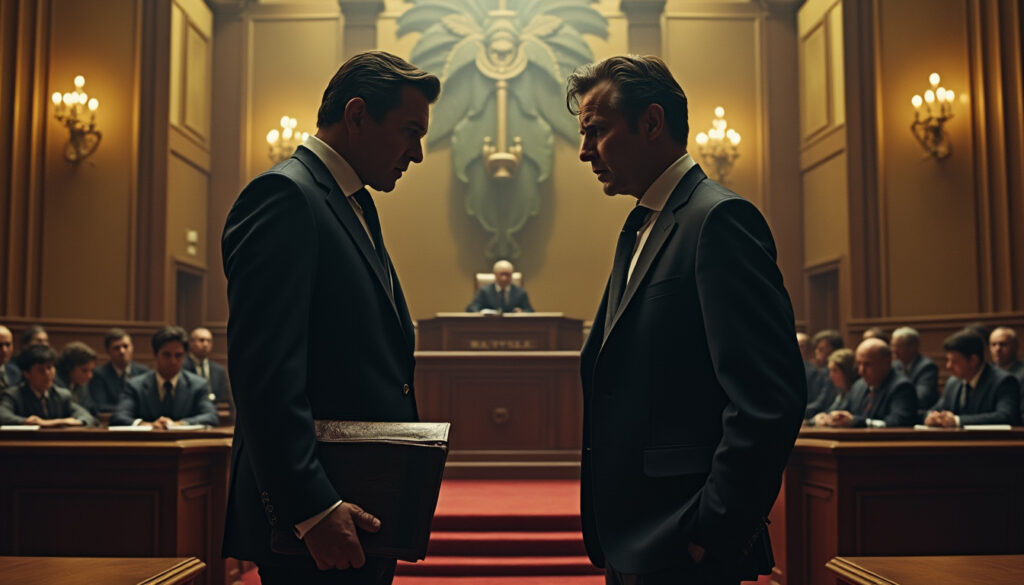
The film “Two Prosecutors”, directed by the talented Sergei Loznitsa, is making waves by being presented in official competition at the 78th Cannes Film Festival. Based on a short story by Georgi Demidov, this historical drama immerses us in the dark twists of the Stalinist purges of 1937 and offers a poignant reflection on the themes of justice and faith within a totalitarian regime. Armed with impactful narration and striking visual aesthetics, Loznitsa succeeds in transcending the simple narrative to deliver a true meditation on the excesses of Soviet oppression.
The film “Two Prosecutors”, directed by Ukrainian filmmaker Sergei Loznitsa, is making a splash at the 78th Cannes Film Festival in 2025. Adapted from an iconic short story by Georgi Demidov, this work deeply immerses us in the Stalinist purges of 1937. Loznitsa, known for his expertise in Russian and Ukrainian history, brilliantly exploits material of rare intensity. This poignant analysis of justice within a totalitarian regime is a concentrate of emotions and questions about humanity.
A poignant narrative at the heart of the Stalinist purges
At the heart of the intrigue, we discover Alexander Kornev, a young idealistic prosecutor, brilliantly portrayed by Aleksandr Kuznetsov. His journey is marked by an unwavering quest for truth following the discovery of a letter left by a prisoner. This missive, escaping the flames, reveals the horrors inflicted by the Soviet secret police. As Kornev navigates the mazes of a corrupt administration, his determination forces him to confront powers far greater than himself.
This film, shot in Riga in authentic period settings, allows us to rediscover a historical reality unknown to some. The direction, stripped down yet charged with dramatic tension, accentuates the oppressive atmosphere. Oleg Mutu’s camera brilliantly captures every nuance of gray, enhancing the feeling of claustrophobia so characteristic of Soviet institutions. All of this is a realization of rare depth.
An exploration of the mechanisms of oppression
The moral complications faced by Kornev illustrate the complexity of the third shark, this system where bureaucracy and humanity are constantly at odds. The subtle yet tangible black humor manages to infiltrate certain moments, as if to lighten the gravity of the message. One finds oneself faced with Kafkaesque situations that highlight the absurdity reinforced by an unyielding logic.
Among the notable performances, that of Alexandr Filippenko, in the role of Stepniak, stands out. With a character rich in ambivalences, he reveals the internal conflicts between honesty and betrayal in times of war. This portrayal of characters struggling amidst the ruins of a brutal system is essential for understanding the implications of such a cinematic project.
A reflection on contemporary authoritarian excesses
Beyond its exploration of past events, “Two Prosecutors” engages with our need for critical analyses of contemporary realities. By referencing Stalinist terror, Loznitsa poses unsettling questions about excesses that could resonate to this day. Indeed, the mechanisms of control, oppression, and dehumanization that traverse history are more relevant than ever.
The film is also the result of a collaboration among several European countries, reflecting a shared desire to question historical memory. In this regard, it is fascinating to think of the documentaries previously presented at the festival, such as “Maidan” in 2014 and “The Invasion” in 2024. These works testify to a committed approach and a desire to document past and present struggles.
A significant screening at Cannes
The screening of “Two Prosecutors” in the Debussy hall, especially in contrast with the blockbuster “Mission Impossible: The Final Reckoning” taking place nearby, had a particular character. Attending this sober and realistic lament while being surrounded by the ode to the American dream highlighted the irony of a world sometimes divided between fantasies and poignant realities.
In summary, Loznitsa’s work challenges, questions, and defies our understanding of the excesses of authoritarian systems and their legacy in today’s world. “Two Prosecutors” is not just a simple film: it is an invitation to reflection on the place of the individual in the face of the state machine.
|
IN BRIEF
|
Conclusion on “Two Prosecutors” by Sergei Loznitsa
The film “Two Prosecutors” by Sergei Loznitsa turns out to be a masterful work that illustrates the unsaid and the complexity of individual struggles against the state machine. By plunging the viewer into the abysses of the Stalinist repression of 1937, the Ukrainian director weaves poignant connections between past and present. The character of Alexander Kornev, a young idealistic prosecutor, embodies the tension between the desire for truth and the realities of a totalitarian system.
The finesse of Oleg Mutu‘s direction and the bold choice of the square format enrich the narrative, creating an atmosphere where oppression and claustrophobia become palpable. The photography accentuates the tragic dimension of the story, allowing the audience to feel the intensity of every moment experienced by the protagonists. The blend of black humor and absurd situations adds an unexpected depth to this fresco, reminding us that even in the heart of tragedy, the absurdity of the human condition can surface.
In parallel, Loznitsa succeeds in evoking a reflection on contemporary authoritarian excesses, highlighting the importance of historical memory in the fight against oblivion. Through the lens of history, “Two Prosecutors” prompts us to question our own relationship with humanity, betrayal, and justice. It is an invitation to remain vigilant against the abuses of power that persist, reminding us that the past is always a mirror of present issues.
In a Cannes festival where diverse works coexist, the screening of “Two Prosecutors” stands out for its sobriety and depth, leaving an indelible mark on the minds of those fortunate enough to discover it.