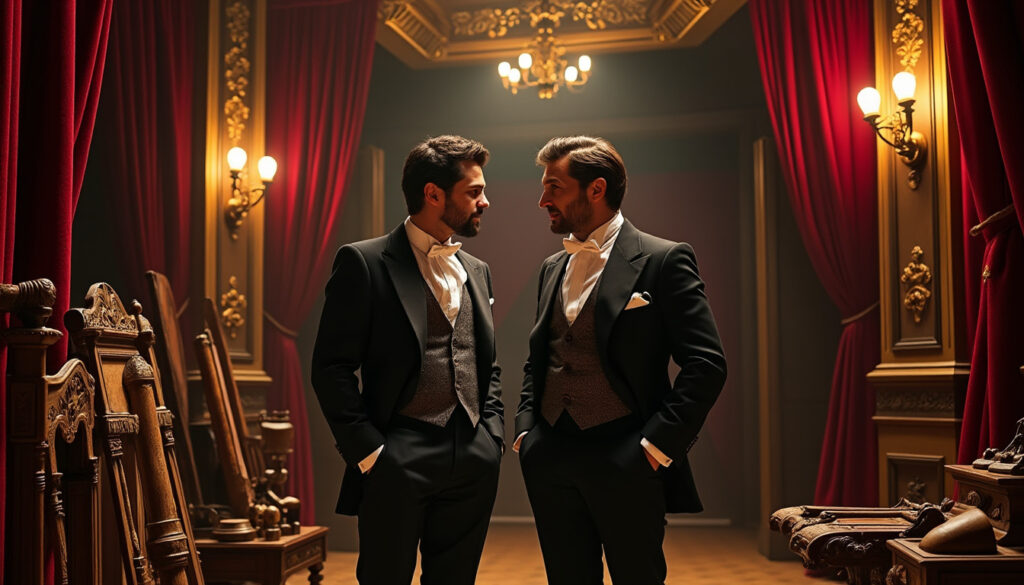
Directors Martin Darondeau and Bertrand Usclat invite us to a fascinating exploration of the behind-the-scenes at the Comédie-Française through their bold work, De la Comédie-Française. This film offers an immersive experience into the hectic daily life of actors, revealing both the challenges and successes of an iconic production. By using a cast primarily made up of actors from the famous theatrical institution, Darondeau and Usclat manage to resonate universal themes of artistic creation within us while offering a refreshing perspective on a theatrical world that is often overlooked.
In the French cinematic landscape, Martin Darondeau and Bertrand Usclat have made their mark with their bold film “De la Comédie-Française”. This feature film, which showcases the behind-the-scenes of the famous theatrical institution, stands out for its originality and unique approach. With an unprecedented cast of actors from the Comédie-Française, Darondeau and Usclat renew the genre and question current cinematic practices. Through this journey, let us dive together into the machinations of this work, its artistic challenges, and its reflections on theater and cinema.
A creative duo at the service of theater
The journey of Martin Darondeau and Bertrand Usclat is enlightening. These two artists, hailing from the theatrical world, have surrounded themselves with the best to realize an ambitious project. Their approach reflects a desire to show the behind-the-scenes of one of the most famous theaters, while blending comedy and drama. Their respective knowledge of live performance has allowed them to conceive a narrative in tune with the realities of the theatrical world. They take us into the depths of a universe often unknown to the general public.
The use of actors from the Comédie-Française is no accident. This decision highlights the authenticity of the narrative and the commitment of the artists. Darondeau and Usclat have been able to draw from their stage experience to deliver memorable performances. The risk taken is very real, but it proves fruitful, foreshadowing future successes.
The themes addressed in the film
“De la Comédie-Française” addresses several exciting themes. The film primarily deals with the challenges faced by artists in their quest for success. The main character, Nina, embodies these daily struggles within such a prestigious institution. Through a plot centered around the preparation of a play, the directors question the expectations of the audience as well as the perception of the theatrical world.
The various comedic situations that punctuate the film also reveal a darker reality. Indeed, competition, the ego of artists, and their personal struggles are at the heart of the narrative. It is a universal story that anyone can relate to. The numerous twists keep the audience on the edge of their seat. Thus, humor intertwines with a more complex reflection on the world of creation.
A bold and unprecedented staging
The staging by Darondeau and Usclat is distinguished by its uniqueness. Far from the usual clichés, it revolves around a dynamic and captivating narrative. The two directors integrate theatrical elements within the film, paying homage to the dramatic art while offering a modern interpretation of it. Their artistic choices reflect a desire to break free from established standards.
By opting for a cast exclusively made up of company members, they bring a breath of fresh air. Their performances, or the excellence of the collective work, infuse new energy into each scene. The viewer thus benefits from a successful immersion into the universe of the Comédie-Française. This setup highlights the distinct talents of each performer while maintaining a strong narrative coherence.
The success of the film and its impact
“De la Comédie-Française” has been not only a critical success but also a popular success. The film delighted many spectators upon its release in theaters. Winning several awards at the L’Alpe-d’Huez Festival, it also sparked lively debate around the representation of artists and their evolution in the film industry. By revealing talents often overlooked, Darondeau and Usclat contribute to an essential reflection on culture and French identity.
This film could well mark a turning point in the way the public perceives works inspired by classical theater. The lightness of the narrative contrasts with themes that question and invigorate cultural heritage. A resonance that could serve for other upcoming artistic projects, as the directors are not stopping here.
A celebration of dramatic art
It is important to emphasize that “De la Comédie-Française” goes beyond the framework of mere entertainment. It is also a celebration of dramatic art and its history. By showcasing the complexities behind the success of a theatrical production, Darondeau and Usclat revive the legacy of great writers and directors. This allows the audience to rediscover the richness of the sources of inspiration that nourish the contemporary world.
The film thus becomes a true tribute to the pioneers of theater while embodying an accessible modernity. The originality of their approach will awaken the interest of a broader and more diverse audience, placing theater back at the center of today’s artistic discussions. In short, this work presents itself as a valuable testament to the issues of theater and cinematography.
An unprecedented immersion into the world of the Comédie-Française
The collaboration between Martin Darondeau and Bertrand Usclat invites us to a true exploration of the behind-the-scenes at the Comédie-Française, an emblematic place of French theater. With their film “De la Comédie-Française”, they succeed not only in providing a refreshing look at a space often idealized, but also in depicting the unique challenges faced by artists in full creation. Through a comedy packed with twists and turns, they expose the reality behind the veneer of theater, highlighting the chaos and passion necessary for staging a classic play like Macbeth.
This bold project, which showcases a cast exclusively made up of actors linked to the Comédie-Française, demonstrates a call for diversity and innovation, breaking with the stereotypes often conveyed by French cinema. Darondeau and Usclat, by integrating less well-known faces to the general public, pave the way for a new artistic vision while retaining the humor and lightness that characterize the field of comedy.
With incisive writing and richly complex characters, the duo manages to capture the very essence of theatrical creation: the constant struggle between dream and reality, between ambition and the unexpected. Their narrative choices are not limited to mere entertainment but also aim to be introspective, revealing the worries and frustrations of those who move under the light of the spotlight.
“De la Comédie-Française” thus positions itself as a true cinematic event, combining humor, reflection, and sensitivity, while paying homage to an essential French cultural heritage. Darondeau and Usclat succeed in the challenge of desacralizing this majestic world while celebrating it with tenderness and authenticity.