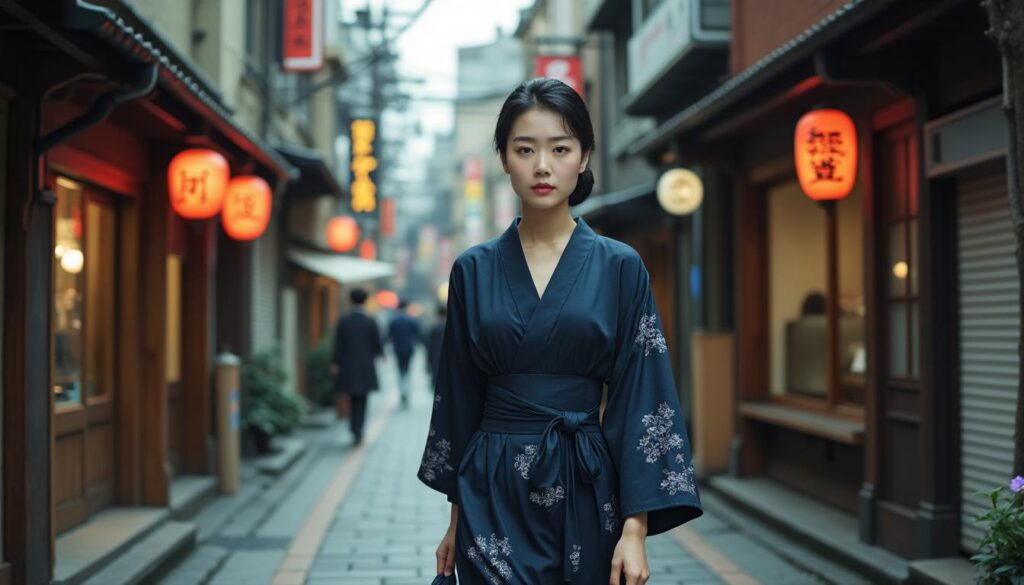
Mikio Naruse, master of Japanese cinema, offers us with “Ginza Cosmetics” (1951) a masterpiece of dazzling elegance. In this film, he finely portrays the daily life of ordinary people, exploring the themes of solitude, human relationships, and sacrifices. Through the eyes of the protagonist, Yukiko, a hostess in a Tokyo club, Naruse examines the tensions between personal aspirations and the harsh realities of a Japan undergoing modernization after the war. This work, thanks to its newly restored version, deserves special attention and immerses us in the dilemmas of an evolving era.
“Ginza Cosmetics”, a film by Mikio Naruse released in 1951, is often considered a true treasure of Japanese cinema. Through the saga of Yukiko, a hostess in a club in Ginza, Naruse poignantly depicts the quest for dignity in a society in flux. This film is not only a chronicle of a woman’s struggles, but also a reflection of the social issues of post-war Japan, at a time when traditional values and modern aspirations clash. In this article, we will dive into Naruse’s universe and how he uses his art to explore universal themes through the lens of elegance and the everyday.
The Masterpiece of Mikio Naruse
Mikio Naruse, one of the great masters of Japanese cinema, is recognized for his subtle and realistic approach. “Ginza Cosmetics” fits into this lineage of works deeply rooted in social reality. By using minimalistic narration, Naruse avoids any excessive pathos that could distort the reality of his characters. This stylistic choice makes each interaction palpable, each glance full of meaning. He does not seek to overly move but to provoke reflection in the viewer.
Naruse’s notoriety also lies in his ability to create strong female characters. Yukiko, portrayed by actress Kinuyo Tanaka, is a striking example of this complexity. Through her dilemmas, sacrifices, and hope for a better future, she becomes much more than just a film character. Mikio Naruse makes her an emblematic figure of the post-war women’s struggles, offering a representation of quiet strength and resilience.
The Ginza Scene: A Mirror of the Era
The setting of “Ginza Cosmetics” is not trivial. Ginza, a chic district of Tokyo, is known for its luxury shops and nightlife. It is a place where modernity and tradition clash. Through sequences of daily life, Naruse illustrates how this space is both a symbol of prosperity and a reflection of the solitude of its inhabitants. The protagonist Haruo, Yukiko’s son, is seen asking passersby for the time, symbolizing his desire to find his mother while representing the alienation of individuals in a changing society.
This district, while being a place of entertainment, turns out to be a space of tension. Naruse chooses to show the other side of the coin: the precariousness of workers, the emphasis on appearance at the expense of substance. The film, through its striking images, subtly critiques Japanese society of the post-war era and underscores the gap between personal aspirations and social realities.
The Humanity of the Main Characters
Yukiko is a complex and human character. She navigates an environment where honesty and good intentions are often undermined. Her job, while demanding, offers her no security. On the contrary, she must juggle the need to provide for her son Haruo and the desire to escape from a future without promise. This dualism is palpable at every moment of the film.
In contrast, the men in the film, often presented in an unflattering light, turn out to be selfish and sometimes even cruel. A reflection of the era where masculinity is often synonymous with power and abuse. We see a nuanced humanity, but also echoes of weaknesses. The dialogues are crafted and poignant, capturing both pain and hope. Yukiko, with her generous spirit, opens the door to a sensitivity in a world where men are often labeled as “disgusting” or “beasts”.
A Realistic Aesthetic
The aesthetic of the film reinforces its message. Naruse, with his sober style, uses black and white to heighten the raw emotions of his characters. Each shot, each staging is deliberate. The cameraman’s gaze captures not only the faces, but also the environment. The shop windows of Ginza become reflections of the unattainable dreams that haunt its protagonists. Even Yukiko’s representation in front of her mirror testifies to the inner struggle of her beauty, her age, and her aspirations.
The recently restored 4K version, presented by Carlotta Films, allows us to rediscover this work in a new light. The clarity of the images and the depth of the shadows enrich the visual experience, paying tribute to Naruse’s artistic finesse. This remarkable treatment underscores the importance of this film in cinematic history.
An Timeless Work
“Ginza Cosmetics” is part of a cinematic tradition deeply rooted in time. Although the film is set in a specific context, its themes are universal. The quest for identity, the fight for dignity, and the critical gaze on social norms transcend eras. Some reflections evoked in the film still resonate today, making this masterpiece a pillar of Japanese cinema.
The emotional power of the film also echoes in today’s world, where social pressures and individual struggles remain current. Yukiko’s resilience in the face of adversity inspires generations and reminds us that, despite obstacles, hope remains a living force.
The richness of “Ginza Cosmetics” lies in its blend of humanity and depth. Mikio Naruse, through his sharp gaze, invites us to contemplate this inner journey while offering a stark social critique. This masterpiece continues to shine in the cinematic world, and its impact remains undeniable.
Elegance and Emotion in “Ginza Cosmetics” by Mikio Naruse
The direction of Mikio Naruse in “Ginza Cosmetics” (1951) stands out for its singular elegance that transcends simple storytelling, touching on universal themes such as love, solitude, and the quest for identity. Naruse’s mastery of image and sound creates a rich setting, where each shot tells a story and where each silence resonates with the characters’ pain. By centering his narrative on Yukiko, a single mother working in a Ginza club, the filmmaker immerses us in the daily reality of Japanese women in the post-war era, while exploring their vulnerability and inner strength.
The narrative structure of Naruse, which combines moments of intimate reflection and social interactions, offers a marked contrast between Yukiko’s dreams of love and the harsh reality of her existence. Thus, each encounter, whether sweet or bitter, resonates with a disconcerting authenticity. The character of Yukiko, beautifully portrayed by Kinuyo Tanaka, embodies not only the struggles of the women of her time but also their hopes for connection and belonging.
By integrating elements of social realism, Naruse unveils a nuanced vision of the feminine condition in Japan. Far from falling into miserabilism, he presents a heroine who, despite setbacks, remains determined to move forward. Reflections on the passage of time and the desire to accept one’s condition are beautifully illustrated by the scenes in front of the mirror, symbols of identity reflection and despair.
In sum, “Ginza Cosmetics” is a masterpiece of Japanese cinema that resonates even today. The delicacy of the mise-en-scène and the depth of the characters make this work a valuable testimony to humanity and an invaluable cultural contribution. Mikio Naruse, through his attention to detail and understanding of human nature, offers us a poignant look at our condition and aspirations, thus marking the history of cinema with rare finesse.