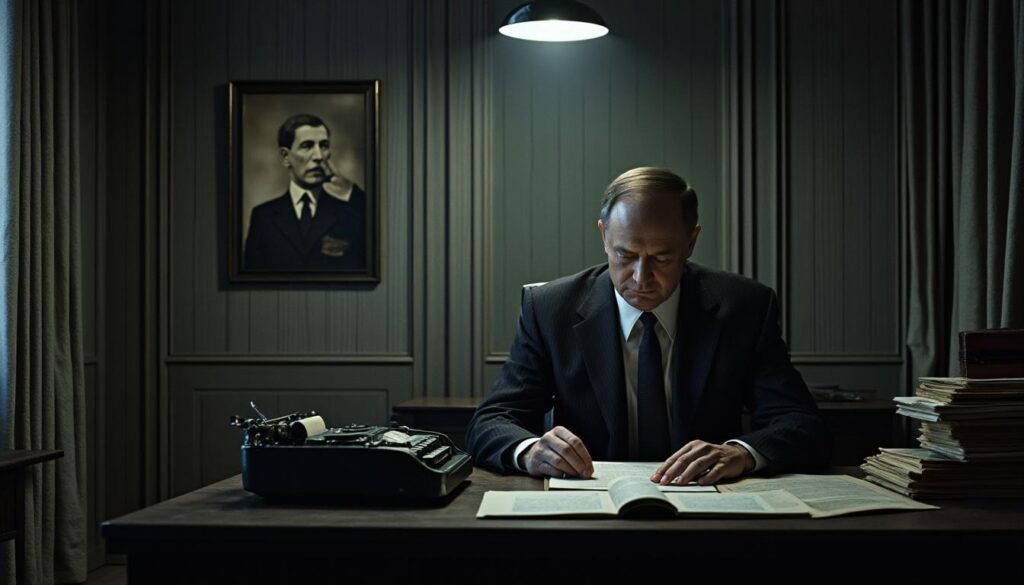
Serguei Loznitsa, a filmmaker recognized for his exploration of social themes, addresses the complexities of justice under a totalitarian regime in his film Two Prosecutors. Adapted from the novel by Georgy Demidov, this feature-length film immerses the viewer in the anxiety of oppressive bureaucracy, illustrating how administrative absurdity can annihilate human rights. Through the journey of the young prosecutor Kornev in a Stalinist prison, Loznitsa reveals the mechanisms of an administration deaf to individual suffering, thus offering a stinging critique of the judicial system of his time and more broadly, the implications of repression within a totalitarian state.
The film Two Prosecutors, directed by Serguei Loznitsa, stands out as a committed and powerful work. In this feature, the director examines the complex mechanisms of justice in the USSR, shedding light on the shortcomings of Stalinist administration. Through the journey of a young prosecutor, Alexander Kornev, the film reveals the anxiety-ridden realities of totalitarian regimes and their impact on the human condition.
An Anxious and Claustrophobic Atmosphere
Loznitsa’s staging is both virtuosic and deeply unsettling. Through dark and labyrinthine corridors, he creates an atmosphere of palpable despair. The prison rooms seem to trap the characters in an inhuman universe, accentuating their suffering. Far from the image of serene Justice, the film presents an oppressive and dehumanizing System, where power is exercised with formidable efficiency.
Each scene in the prison is imbued with a particular tension. The viewer feels uneasy, as if the walls are closing in on him. The portrayal of the inmates testifies to a flow of contradictory emotions, ranging from anxiety to the absurd. Thus, Kesnié, a key character, offers us a stark vision of the Stalinist regime, where the individual is reduced to a mere number.
The Character of Alexander Kornev: A Prosecutor Struggling with the System
Alexander Kornev, an idealistic young prosecutor, finds himself plunged into the meanders of a stifling bureaucracy. His growing despair in the face of injustice is both touching and revealing. As he strives to meet the dissident Stepniak, who has become a symbol of resistance, his journey within the administration evokes broader themes. Kornev confronts a world where individual freedom is constantly questioned.
Kornev’s interactions with other characters reflect this power dynamic. Each encounter is a struggle for dignity, where humanity seems absent. He gradually discovers that his values are eroding while he is imprisoned by a rigid and ruthless System. This echoes themes explored in other films, such as those examining the excesses of totalitarianism.
A Critique of Totalitarianism and its Devastating Effects
Loznitsa, through his film, challenges the viewer regarding the realities of a regime where repression is the norm. The letters of prisoners, burned in indifference, affirm this oppressive atmosphere. They highlight the mechanisms of silence that instill fear and oblivion. The prescriptivism of bureaucracy thus becomes a method of control, where the lines between good and evil are blurred.
- The prison as a metaphor for oppression.
- The disillusionment of an ideal that has become a nightmare.
- The characters trapped in their destiny.
These elements constitute a heartbreaking picture of the consequences of a quest for totalitarian power. The film’s realism is further reinforced by scenes of waiting in offices destined for inefficiency. These moments illustrate the despair of the main character, who ultimately realizes that he has himself become a prisoner of the System.
The Vibrant Staging of Serguei Loznitsa
The finesse of the artistic direction is palpable. Loznitsa manages to create an atmosphere that is both intriguing and nightmarish. Each frame is carefully arranged to convey a sense of unease. The interplay of light and shadow amplifies this latent tension. The repetitive corridors become a symbol of the absurd, seemingly leading to a dead end.
This staging ability particularly resonates when comedic elements emerge in a tragic context. The main character, through his often absurd interactions, becomes a mirror of this bitter reality. He sometimes appears as a hapless clown in a universe where laughter is stifled by fear and conformity.
An Echo to Contemporary Reality
By depicting this parallel between the past and present, Loznitsa reminds us that the lessons of history must never be forgotten. Even though Two Prosecutors focuses on a well-defined period, the themes addressed resonate with current events. The struggle for justice is more than ever a reality in our modern world.
Through this work, Loznitsa encourages reflection on power, the individual, and the necessity of defending freedom. The issue of justice in a totalitarian regime extends far beyond the boundaries of time and space. Thus, the film questions our own relationship with justice and the prejudices that underlie it.
Justice Put to the Test in “Two Prosecutors” by Serguei Loznitsa
In his feature film “Two Prosecutors“, Serguei Loznitsa presents a profound exploration of the themes of justice and administration in a Stalinist context. Through the main character, Alexander Kornev, Loznitsa immerses us in a universe where bureaucracy crushes human values and where the very notion of justice becomes blurred. The film reminds us that under a totalitarian regime, arbitrariness and the unjustifiable are elevated to norms, rendering any quest for justice futile.
The tortuous journey of Kornev through the dark corridors of a prison and a labyrinthine administration highlights how freedom and humanity are often sacrificed on the altar of bureaucratic order. The letters of prisoners, filled with hope and despair, are lost in the meanders of the state machine, illustrating the dehumanization to which these individuals are subjected. More than just a narrative about repression, “Two Prosecutors” thus becomes a mirror of the mechanisms of power that suffocate all forms of dignity.
Loznitsa captures the palpable anxiety that emanates from each scene, affirming through his staging that every interaction, every moment of waiting in the sterile rooms of administration, is charged with tension. This irrepressible sense of absurdity, a hallmark of the daily life of citizens under an oppressive regime, echoes the human condition itself, questioning our relationship with law and justice.
“Two Prosecutors” does not simply explore the coldness of the judicial system; it also interrogates the values that should underpin the pursuit of justice. By revealing the flaws in the system, Loznitsa forces us to reflect on our own conception of justice and human rights in a context where these values are continually threatened.