
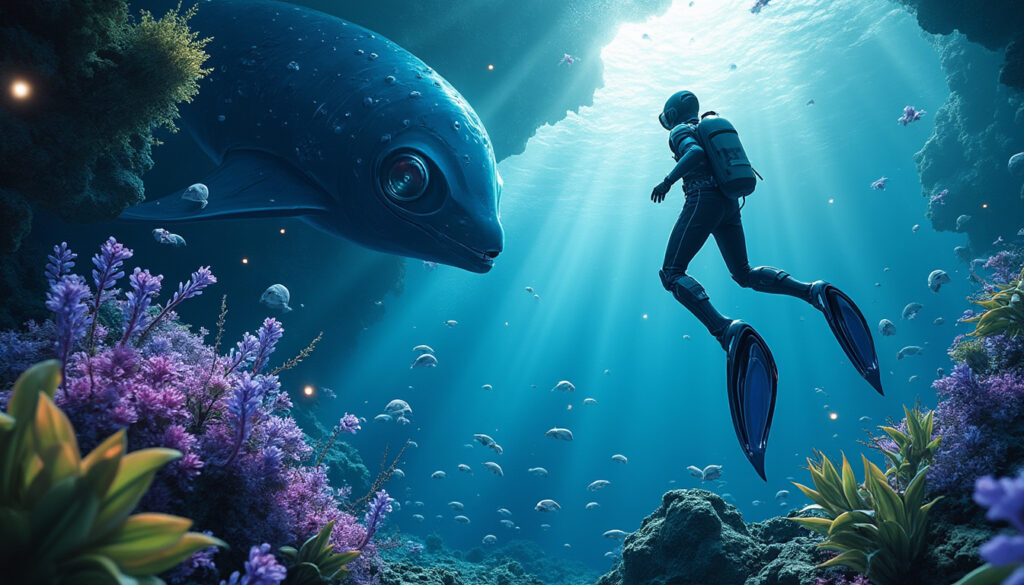
In a context of climate catastrophe and political oppression, The Fin 지느러미 by PARK Syeyoung 박세영 stands out as a revealing work of South Korean science fiction. This film, featuring mutants called Omégas, explores deep themes such as resistance and identity in the face of an authoritarian system. By following the trajectories of characters trapped in a troubling dystopia, PARK offers an unprecedented sensory immersion, blending bold aesthetics with poignant storytelling that questions our relationship with society and the environment.
In a context of ecological disaster and an alienating dictatorship, “The Fin” by PARK Syeyoung presents a work that transcends the boundaries of classic science fiction. Through the journeys of its characters, Mia and Sujin, the film explores profound themes of resilience and resistance. The story takes place in a universe where the Omégas, hunted mutants, symbolize exclusion and exploitation. The work stands out not only for its bold artistic direction but also for its immersive narrative that interrogates our relationship with nature and society.
A dystopian vision of South Korean society
“The Fin” takes place in a dark and disturbing portrayal of a near future. At the heart of this dystopia, we discover a world where the Omégas, beings marked by malformations due to pollution, are seen as outcasts. In this narrative, PARK Syeyoung’s film transcends the classic norms of the genre. By using
unique visual techniques, it manages to capture the pain and beauty of these marginalized characters.
The direction is striking from the very beginning with its singular aesthetics. Indeed, the images present saturated colors and compositions that evoke the severity of the human condition. The creation of a desolate setting mixed with elements of damaged nature reinforces this atmosphere. The director’s vision, although tinged with palpable pessimism, reveals glimmers of hope through endearing characters. Their struggle is captivating, and every moment is filled with emotion.
A striking artistic direction
The artistic work of PARK Syeyoung is unprecedented. With limited resources, he succeeds in depicting a society in the midst of collapse. The way the Omégas are filmed, their interactions and battles, prove to be deeply evocative. Through often stark scenographies, the director immerses us in this existential crisis.
The post-production process was long and arduous, with nearly three years of hard work to create an immersive atmosphere. The graphic choices reinforce the feeling of helplessness and abandonment. The viewer feels the weight of each image, like an invitation to reflect.
It is also interesting to note the use of recurring themes in PARK’s filmography. His previous productions, such as “The Fifth Thoracic Vertebra,” demonstrate his inclination to explore the ramifications of human relationships in the face of crisis. The continuity of motifs in “The Fin” makes it a centerpiece of his journey.
A narrative of inner struggles
One of the most striking elements of the film lies in the personal struggles of its protagonists. Mia, in particular, embodies the duality of the human being caught in a repressive system. Her journey, filled with uncertainties, immerses us in a reflection on the nature of identity and belonging. Sujin, on her side, oscillates between duty and conscience, representing everyone’s struggle to rise above imposed authority.
The complexity of their relationships prompts us to question our own social situation. Is there really a mistrust of others? Or is it a survival mechanism? The film manages to pose these questions without providing simplistic answers. Each tense scene reminds us of the fragility of human bonds and the importance of solidarity in a hostile environment.
Sound as a vector of emotion
Beyond the artistic direction, the sound layer plays a crucial role in the viewer’s immersion. The film is punctuated by music that contrasts with the dark themes. This juxtaposition serves to accentuate the surrounding discomfort. Nostalgic melodies, interwoven with indoctrination slogans, create a complex sensory universe. The musical choices, stemming from an allegedly obsolete culture, provide an auditory depth that questions the viewer on the notion of beauty within a declining society.
It is fascinating to see how these intrusive sounds can inspire a sense of belonging. It is a nod to the collective memory, rooted in traditions and the memories of those who have lost their bearings.
A reflection on the modern world
Finally, “The Fin” raises relentless questions about our reality. Through the metaphor of the Omégas, PARK illustrates the stigmatization and exclusion of minorities in a consumerist world. The echoes of this narrative are hard to ignore, especially in a context where inequalities are growing. The way society treats its most vulnerable members is a direct reflection of our time. This film can be seen as a wake-up call.
Recent events in South Korea, such as corruption and struggles for social justice, amplify this message. “The Fin” questions our own responsibility and invites a critical examination of our societal values. The film’s purpose is thus universal, engaged, and pertinent.
In sum, “The Fin” asserts itself as an example of a new wave of South Korean science fiction. PARK Syeyoung’s work, with its singular aesthetics and strong message, takes us on an unforgettable journey. It pushes us to reflect and engage, making us actors of our own change.
If you are passionate about innovative cinema, do not hesitate to discover other films addressing similar themes, such as those presented in festival reports or contemporary reviews. These works, like “The Fin,” promise to hit you hard and transport you into deep reflections.
For those looking to explore further the culture and art of cinema, complementary articles await you. For example, recent festival accounts or new developments in the gaming world could enrich your experience.
A striking immersion in a South Korean dystopia
The Fin by PARK Syeyoung is undoubtedly a remarkable work that fits into the landscape of South Korean science fiction. With a bold vision, the film immerses us in a future where society is fragmented and dominated by an oppressive dictatorship. Through the trajectories of its main characters, Mia and Sujin, the director explores deep themes related to stigmatization and human nature, while placing his narrative in an alarming ecological context.
PARK’s artistic direction, coupled with innovative use of technology, creates an immersive and unsettling atmosphere. The film’s aesthetic choices, ranging from the saturated visual rendering to the poignant sound design, combine to offer a unique sensory experience. One genuinely feels the impact of the events unfolding on screen, reinforcing the notion of alienation and despair. The use of Omégas as a metaphor for society’s marginalized illuminates how individuals are shaped by their environment and the ideologies surrounding them.
The editing and post-production work testify to PARK’s ambition to transcend budgetary constraints, using bold techniques to amplify the viewer’s feelings. By integrating elements of documentary cinema, the director manages to blur the boundaries between fiction and reality, offering a striking reflection of contemporary struggles. Indeed, The Fin is not just a genre film, but a rallying cry against the repression and dehumanization of a society in crisis.


