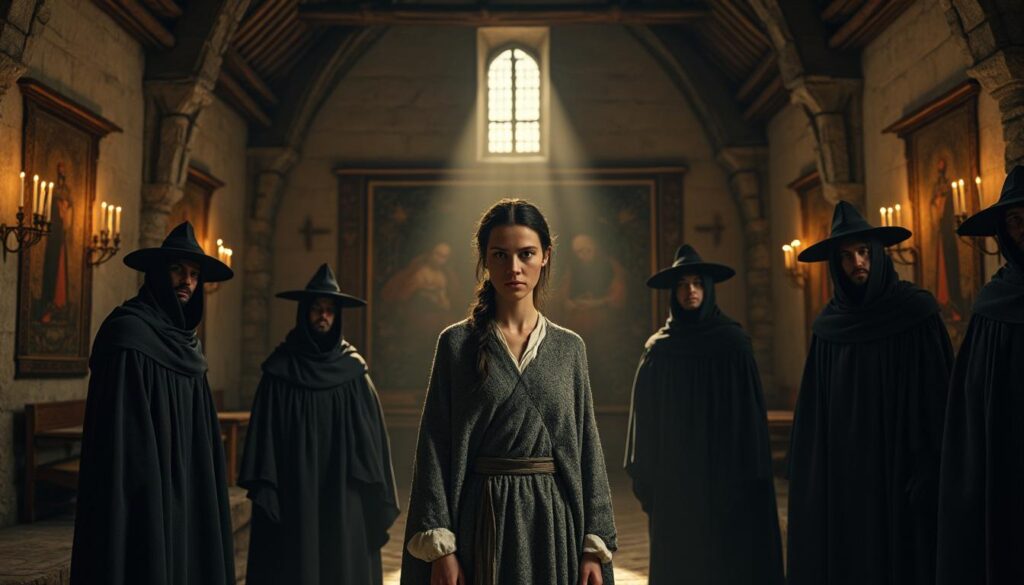
In the troubling universe of contemporary theater, “ The Trial of Jeanne ” stands out for its captivating staging signed by Yves Beaunesne. This ambitious work reinterprets the iconic story of Joan of Arc through a bold exploration of the themes of faith and judgment. Beaunesne, with his innovative approach, manages to infuse new life into this tragic story, inviting the audience to question the eternal stakes of truth and justice.
The Trial of Jeanne: A Captivating Staging by Yves Beaunesne
The play The Trial of Jeanne, directed by Yves Beaunesne, immerses us in the fascinating history of Joan of Arc. With an inventive approach, the production succeeds in bringing a historical narrative to life while provoking deep reflections on the relationship between past and present. The scenic choices, combined with impressive artistic performances, provide a unique theatrical experience that captivates attention.
An Artistic Exploration of History
The play tackles a crucial moment in French history. Joan of Arc is often perceived in popular tradition as a patriotic heroine, but through the lens of Yves Beaunesne, other facets of her personality and journey are revealed. This allows us to reflect on themes such as mysticism and resistance against established authorities.
Beaunesne ventures into a staging that can seem bold. By choosing a minimalist set, he focuses on strong emotions and the confrontations between characters. These exchanges are driven by powerful dialogues, as well as a psychological depth that paints a nuanced portrait of the heroine.
In summary, this aspect of the staging allows us to revisit the fears and hopes that animated this mythical character. The echo of her struggles resonates even today, awakening a questioning of our own relationship to authority and engagement. The spectator is thus invited to oscillate between historical past and its present relevance.
Scenography and Sound Atmosphere
The scenography of The Trial of Jeanne is distinguished by its simplicity. A luminous octagon evolves throughout the performance. This design choice creates both a space of tension and connection, facilitating the characters’ movements while keeping the audience on edge.
Furthermore, the soundtrack plays a crucial role in immersion. The enchanting melodies and ambient sounds composed by the musicians enhance the dramatic atmosphere. The music is not simply an accompaniment, but a fully-fledged actor, bringing breath to the narrative.
The moments of lyrical singing, punctuated by the performers’ acting, help transcend the simple representation. They bring an almost spiritual dimension to moments of tension, allowing for reflection on the faith and doubts that inhabit each character.
A Powerful Emotional Treatment
As the actors progress on stage, their performances are remarkably carried by palpable emotions. Judith Chemla, in the role of Joan, embodies this duality; both warrior and vulnerable. The audience witnesses an internal struggle that reveals the humanity of the historical figure.
This blend of present forces creates palpable tension. The exchanges between the protagonists are rich and charged, allowing the audience to feel every door slam, every whisper. The hesitations and moments of anger succeed each other, hypnotizing the audience.
Contemporary Resonances
The Trial of Jeanne does not stop in a historical framework. It touches on themes resonating with our time; the question of freedom of expression, the quest for meaning, and sacrifice are more relevant than ever. The show acts as a mirror of our society, questioning our individual responsibilities.
Through striking scenes, the play highlights our relationship to truth and justice. What does it mean to be a hero today? The answers are sometimes disorienting and even painful, but the challenge is indeed laid down.
Ultimately, Yves Beaunesne succeeds in creating an atmosphere where the story of Joan of Arc seems to resonate with astonishing relevance. The spectator is left with a multitude of questions, echoing long after the curtain falls.
For those who may get bogged down in the complexity of the narrative, I invite you to discover the edible landscapes of Carl Warner, or explore other accessible artistic dimensions, such as contemporary cinematic explorations.
A Captivating Staging by Yves Beaunesne
The Trial of Jeanne is a theatrical work where the genius of Yves Beaunesne is revealed with force. The play immerses us in the complex history of Joan of Arc, drawing on a bold scenic device, blending video and music. The interaction between visual and sound elements creates an immersive atmosphere, allowing the audience to explore conflicting emotions and echoes of a bygone era. Although the text sometimes becomes entangled in difficult details, it nevertheless manages to evoke authentic and profound feelings.
Beaunesne, through his approach, provokes a reflection on our relationship with the past and history. The choice of episodic narratives, making a blend of contemporary and historical references, compels us to question our place in the continuum of genders, beliefs, and struggles. The staging, while resolutely modern, retains a depth and richness that remind us of the universal significance of the themes addressed.
Beyond aesthetics, The Trial of Jeanne invites a more personal reading. Listening to the songs and dialogues while feeling the vibrations of the instruments allows for communion between the artists and the spectators. This shared moment, this moment of grace, elevates the narrative into a sort of modern ceremony, where each can find their own interpretation. Thus, Beaunesne’s creative vision transforms a simple theatrical representation into an exploration of human feelings, struggles, and beliefs that continue to resonate today.