
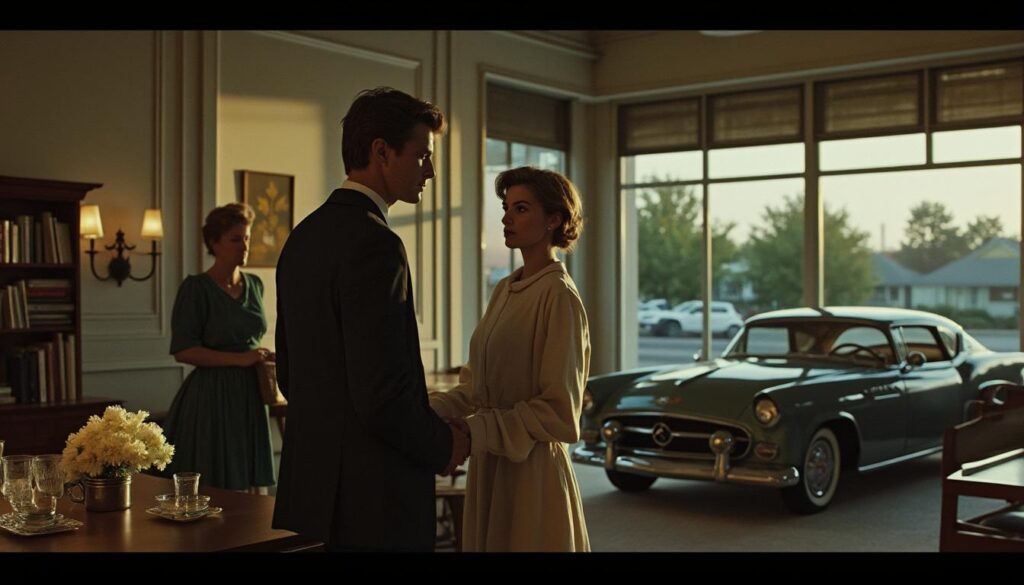
Todd Haynes, director of the famous American cinema, left a mark with his iconic work “Carol”, released in 2016. Adapted from the novel by Patricia Highsmith, this film of great visual and emotional richness explores the love between two women within the rigid and conservative framework of the 1950s. Through memorable performances, notably by Cate Blanchett and Rooney Mara, Haynes succeeds in capturing the tension between desire and conformity, while establishing a rare aesthetic style of meticulousness. This work is not only a love story but a true manifesto on liberation and female emancipation, thus solidifying its place in the pantheon of modern cinema.
Todd Haynes and his Cinematic Masterpiece: “Carol” (2016)
Todd Haynes, an exceptional filmmaker, has made history in cinema with his film “Carol” released in 2016. This feature film is set in a time when themes of love and sexual identity began to emerge strongly. “Carol” stands out for its sensitive storytelling and refined aesthetics, drawing the attention of both audiences and critics. In this article, we will explore the origins of this project, its complex development, and its impact on both cinema and culture.
The Origins of the Project
The film was born from a long creative process and is inspired by Patricia Highsmith’s novel, “The Prince of Salt”. Originally published under a pseudonym in 1952, the book was renamed “Carol” in 1990. This unique work is not part of the author’s crime novels but presents a poignant romance between two women in 1950s America. The first draft of the screenplay was written by Phyllis Nagy, a playwright with valuable experience in adapting literary works.
This adaptation faced several financial obstacles before taking shape. Over the years, the love story between Carol and Therese, the two protagonists, experienced false starts. Supported by producer Elizabeth Karlsen, this adaptation eventually came to fruition, notably thanks to Cate Blanchett’s commitment to the role of Carol. Its potential then caught the attention of Todd Haynes, who agreed to take the reins of the project while he was free from any contract.
Todd Haynes’ Vision
Todd Haynes is known for his ability to create visually captivating and emotionally charged narratives. With “Carol”, he renews his approach to romantic storytelling. The direction is meticulous, blending a retro style with intriguing psychological depth. The sense of authenticity through realistic costumes and settings is palpable. Haynes manages to evoke the atmosphere of the 1950s while fostering a critical view of the society of the time.
A central element of his vision is the importance of subjective narratives. The narrative mainly focuses on Therese, brilliantly embodied by Rooney Mara. Through her eyes, the viewer explores both wonder and inner struggles. The symbolism of photography, which is essential to the character, is used to draw attention to what is captured beyond appearances. The camera thus becomes a means to discover desire and intimacy.
The Performances of the Actresses
The performances of the two lead actresses are often (according to critics) praised as one of the film’s highlights. Cate Blanchett and Rooney Mara form an exceptional duo that transcends the conventions of romantic cinema. Their chemistry is palpable, captivating the audience from the very first encounter between Carol and Therese. Blanchett’s technical mastery allows her to embody a woman who is both strong and vulnerable. On her part, Mara brings a naive freshness that enhances the dramatic tension between the two.
- Cate Blanchett: A subtle performance, rooted in the complexity of her character.
- Rooney Mara: A touching interpretation, full of nuances and fragility.
Their performances perfectly capture the struggle against the social norms of the time. Carol, as a woman of high society, faces moral challenges, while Therese, from a modest background, navigates between her artistic aspirations and societal pressures. This conflict creates a palpable tension, both personal and universal, allowing the film to resonate with a wide audience.
A Film with Multiple Awards
Since its release, “Carol” has received a warm welcome, winning several prestigious awards. In particular, Rooney Mara was awarded the Best Actress prize at the Cannes Film Festival, sharing this honor with Emmanuelle Bercot. The film’s recognition by international festivals illustrates its importance in the contemporary cinematic landscape.
Critics have praised not only the performances of the actresses but also the artistic direction and the original score composed by Carter Burwell. His subtle music accompanies the narration without ever distorting its delicate essence. This alchemy between visual and auditory elements contributes to the emotional impact of the film.
The Cultural Impact of “Carol”
The film also had a significant impact on the representation of LGBTQ+ relationships in mainstream cinema. At a time when love stories between women were often caricatured or marginalized, “Carol” offered an authentic and poignant perspective. The themes of love, desire, and sacrifice are universal and resonate even today.
As the film celebrates its tenth anniversary, it is the subject of re-releases and renewed analyses. This is the case with the collector’s edition produced by BubbelPop, which offers a new remastering with fascinating bonuses. This decade has allowed viewers to rediscover the masterpiece in an enriching way.
Todd Haynes, with “Carol”, offers us a work that transcends time. Evoking the struggles of yesterday and today for love, this film will continue to inspire and provoke thought in generations to come.
Todd Haynes: The Artisan of “Carol”
Todd Haynes, an emblematic figure in contemporary cinema, asserts himself as an exceptional director due to his mastery of cinematic language and his ability to delve into complex themes. With his film “Carol”, released in 2016, he marks a major evolution in his career, transcending the boundaries of genre and establishing himself as a storyteller of universal human stories. Haynes manages to capture the essence of romantic relationships while shedding light on the social and emotional challenges his characters must face.
In “Carol”, inspired by Patricia Highsmith’s novel, Haynes observes the dynamic between two women, Therese and Carol, whose blossoming love clashes with the norms of a conservative 1950s society. Thanks to the masterful performances of Cate Blanchett and Rooney Mara, the film rises above a mere romance by exploring notions of desire, identity, and female emancipation. The visual richness and meticulous historical recreation enhance the emotional impact, making “Carol” not only a love story but also a powerful advocate for individual freedom.
One of the most remarkable aspects of “Carol” is Haynes’ ability to create an atmosphere that is both nostalgic and poignant, where formal beauty is in perfect harmony with the characters’ pain. The soundtrack by Carter Burwell and the precise direction contribute to this immersion, underscoring the protagonists’ internal struggles. Haynes manages to transform each image into a living tableau, combining technique and emotion to provide an unforgettable cinematic experience.


