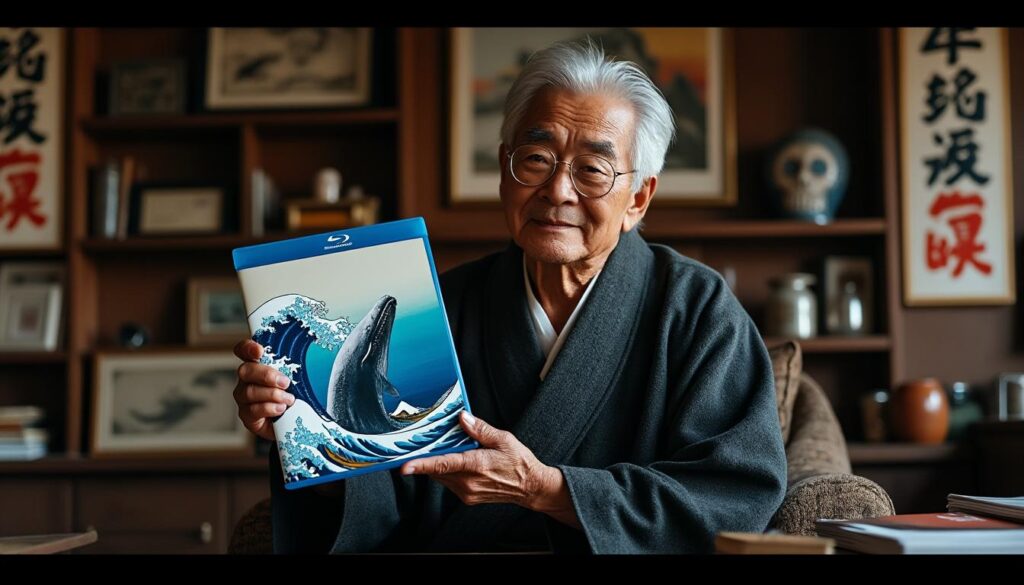
In the Japanese cinematic universe, Tokuzo Tanaka stands out for his remarkable work, “The Whale God” (Kujira Gami), a film released in 1962 that combines mythology and human tragedy. This masterpiece, long underrated, deserves to be rediscovered, especially thanks to its recent Blu-ray release by Roboto Films. Through rich and poignant animation, Tanaka depicts the struggle between man and an almost divine whale, revealing the depths of the human soul in the face of this mythical creature. This iconic film deserves particular attention, both for its artistic dimension and for the philosophical reflection it provokes.
Tokuzo Tanaka and his masterpiece “The Whale God” in Blu-ray edition (1962)
The film “The Whale God” (Kujira Gami), directed by Tokuzo Tanaka in 1962, is an often underestimated work of Japanese cinema. Recently, it was unearthed by Roboto Films in a beautifully restored Blu-ray edition. This masterpiece transcends mere entertainment to become a deep meditation on human nature, tragedy, and the struggle against incomprehensible forces. Through a dive into mythology and inner conflicts, Tanaka succeeds in merging personal history with great symbolic significance.
A mythical cinematic work
“The Whale God” falls within a rich cinematic tradition steeped in mythology. The film illustrates the complexity of the relationship between man and nature in both spectacular and poignant ways. By using mythology, Tanaka pays homage to ancestral tales, such as those found in the Bible and eternal legends. The film evokes legendary aquatic beings, such as the Loch Ness monster and the well-known Moby Dick. Through these references, the director invites us to reflect on our place in the universe.
The whale itself appears as a powerful symbol. It is both a monster and a deity, embodying a wild force. This ambivalent relationship with the sea creature creates a palpable tension between fear and veneration. A lantern shines on the fundamental beliefs that inhabit the human soul, illuminating our inner demons.
A tragic plot with multiple layers
The protagonist, Shaki, represents the struggle, both personal and collective, against a force that seems invincible. Raised in pain and surrounded by loss, he bears the weight of his family decimated by this fearsome animal. His quest for revenge reveals the depths of his love and despair. Yet, behind this quest lies a darker truth. His anger consumes him, and the spotlight on his emotions reveals an even more formidable enemy.
Kishu, a man with obscure motivations, becomes the antagonist. His rivalry with Shaki is emblematic of the struggle between honor and personal ambition. This tension between them fuels the narrative: one for redemption, the other for material gains. Thus, the story unfolds a tragic narrative that challenges viewers, prompting them to question human values.
A film at the heart of emotion and philosophy
The themes addressed in “The Whale God” are of incredible richness. Indeed, the film stands as a work that is both austere and philosophical. Through its narrative meanderings, it questions the notions of destiny and vengeance. The way Shaki must confront not only the whale but also his personal demons makes the story extremely poignant.
- The representation of successive griefs.
- The quest for inner peace.
- The allegory of evil as a powerful enemy.
“The Whale God” does not merely narrate a simple survival story. It plunges us into an existential ordeal, where the hero’s quest begins from within to touch the deepest spheres of the human psyche.
A Blu-ray edition not to be missed
The recent restoration of the film by Roboto Films offers an invaluable opportunity for cinephiles. Thanks to this Blu-ray edition, viewers can discover, or rediscover, this work with exceptional image and sound quality. Furthermore, the additional content enriches the experience. The original trailer and the new exclusive trailer immerse viewers even deeper into the fascinating universe of this cult film.
In summary, this work is a model of exploration of human emotions, perfectly conveyed by a polished aesthetic. An invitation to reflection and wonder opens up simply by diving into this universe. “The Whale God” is thus a must-see for all enthusiasts of Japanese cinema and for those looking to explore narratives of incredible depth.
Tokuzo Tanaka and his masterpiece “The Whale God” in Blu-ray edition (1962)
Tokuzo Tanaka is a Japanese director whose name deserves to be etched in the history of cinema, particularly for his remarkable work, “The Whale God” (Kujira Gami) released in 1962. This work transcends simple film categories to slip into the realm of mythology and human tragedy. Not only does Tanaka brilliantly capture access to ancestral tales, but he also makes it a mirror of the struggles of the fishermen of Hirado against a force of nature that is almost divine. The film recalls the dark beauty of this struggle for survival, as well as the fatality that awaits the characters at every turn.
With a recent Blu-ray edition released by Roboto Films, this forgotten work finally finds a deserved place in the cultural cinematic landscape. The remastering not only allows for the rediscovery of the breathtaking visual aspects of this masterpiece but also dives into its universal themes of struggle, vengeance, and sacrifice. By making this rare film accessible, Roboto Films acts as a carrier of memory, allowing new generations to admire the legacy of Japanese cinema.
The character of Shaki, rooted in a desire for revenge and redemption, as well as the powerful metaphor of the whale as the embodiment of curse, highlight the richness of the narratives and their relevance today. Ultimately, “The Whale God” reveals the depths of the human soul and the inner battles that each individual must confront, transforming a tale of a sea monster into a quest for peace and acceptance. This work, guided by Tanaka’s vision, awakens minds and glorifies the work of Japanese cinematic art.