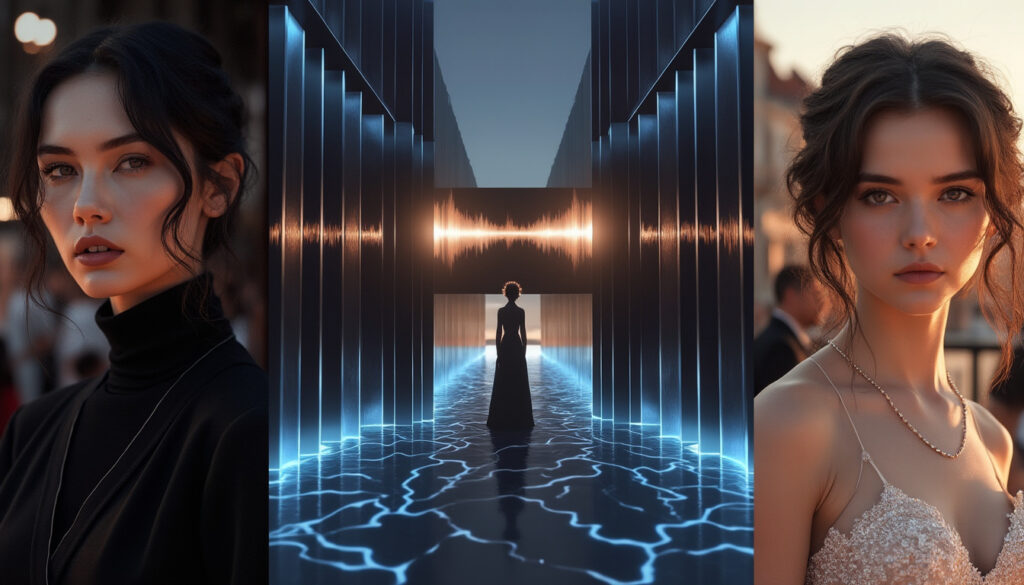
The Venice Film Festival 2026 promises to be rich in emotions and deep reflections with three competing films that explore varied and poignant themes. “Woman Unknown” by May El-Toukhy depicts a woman’s inner struggle in a post-war context, while “The Echo Chamber” by Andrea Pallaoro addresses the tragic outcomes of love and substance dependence. Finally, “The Difficult Bride” by Rubayat Hossain highlights the unattainable standards of beauty, questioning female identity through the eyes of a bride subjected to societal dictates. Each of these films offers a striking dive into the emotional and societal complexities of the characters, promising a captivating competition.
Venice Film Festival 2026: “Woman Unknown” by M. El-Toukhy
The Venice Film Festival 2026 stands out with a selection of captivating films, among which is “Woman Unknown” by May El-Toukhy. This feature film sheds light on the fate of women during a tumultuous period, just after the Liberation in Denmark. The palpable tension that establishes itself from the outset is the guiding thread of a work that questions the social and personal realities of the characters.
Marie, played by actress Mathilde Arcel, is at the center of the story. She finds herself torn between her past and her present after meeting a childhood friend. This friend awakens buried memories that haunt her. At the moment this character emerges in her life, everything she has built begins to crack. Her status as the wife of a wealthy man does not protect her existence from painful revelations.
The dramatic tension and the quest for identity
This film does not simply explore Marie’s past; it also raises questions about her identity. As the future wife of a respected business director, she seems to enjoy certain privileges. However, these privileges do not shield her from the expectations and judgments of society. Moreover, the patriarchal norms that govern her life condemn her to a role where she must constantly justify herself.
Through strong and evocative images, the director succeeds in conveying her heroine’s despair and anguish. The striking scenes where we see shorn women dramatically evoke the brutality of social judgment. The viewer is thus immersed in a heavy and oppressive atmosphere, where the quest for truth becomes unbearable for Marie.
Venice Film Festival 2026: “The Echo Chamber” by A. Pallaoro
Andrea Pallaoro returns to competition with “The Echo Chamber,” a work that proves to be singular yet bewildering. With a striking opening, this film begins on an intriguing note thanks to bold stylistic choices. Thus, we are instantly immersed in Leo’s world, a musician plagued by internal struggles.
Leo, portrayed by Luca Marinelli, is a pop-rock star who isolates himself in his London apartment. We immediately feel his isolation and suffering as he attempts to record a new album. But the film does not just reveal Leo’s career; it also addresses his dependence in a subtle manner.
The drift toward dependence
The relationship between Leo and Anne, a doctor played by Alicia Vikander, becomes a complex tableau of addiction. As the initial treatments seem effective, the tension of dependence becomes increasingly palpable. Pallaoro’s minimalist staging manages to capture the escalation of isolation. The doses of opioids increase, and the descent into darkness accelerates.
Unfortunately, the film sometimes seems to suffer from a lack of depth in its themes. The relationship between the characters is touched upon, but the emotions remain superficial. As the scenes progress, the viewer may feel a void, a lack of genuine connection that undermines the understanding of their respective suffering.
Venice Film Festival 2026: “The Difficult Bride” by R. Hossain
The first Bangladeshi feature film in competition, “The Difficult Bride” by Rubayat Hossain, offers a sharp critique of bourgeois society. With an avant-garde approach, the film highlights the body of Zaineen, a future bride constantly pressured over her appearance. The aesthetic expectations create an oppressive atmosphere, where beauty becomes a real burden.
In Zaineen’s world, beauty treatments and rituals become an obsession. With each passing minute, her body is subjected to degrading treatments in a quest to please her future husband. The film brilliantly evokes a woman’s struggle for independence against unrealistic standards. As the film advances, the sequences of treatments become repetitive, almost hypnotic, illustrating the cyclical nature of this futile quest.
An unsettling aesthetic
Hossain explores themes of contamination and decomposition, transforming Zaineen’s body into a battlefield. A worm symbolically slips under her body, representing the inner discomfort that slowly sets in. Through this metaphor, the film questions the superficial notion of beauty. Despite this, some critiques highlight confusion in the narrative, exacerbated by a choice of aesthetics deemed too garish.
Although “The Difficult Bride” reveals a social critique, some scenes seem to drag. This can sometimes give an impression of length, diluting the strong message about the female condition. A vast debate emerges around the director’s intention and the film’s reception. Is it a genuine denunciation or a form of visual sadism? To this question, each viewer arrives at their own answer, but the film’s impact remains undeniable.
In sum, the Venice Film Festival 2026 is shaping up to be an essential showcase for these works that explore deep and varied themes. Whether it’s Marie’s quest for identity, Leo’s dependence, or the aesthetic pressure suffered by Zaineen, each of these films offers a strong socio-cultural reflection, sweeping across a wide spectrum of emotions and human experiences.
At the heart of the festival’s screenings, it will be interesting to see how the audience reacts to these contemporary narratives, at the crossroads between lucidity and cruelty. For cinema lovers, these stories carry pressing questions that continue to resonate beyond the screen.
For those looking to discover more about the wonderful landscapes and cultural heritage of Venice, useful guides are available, such as The Essentials of Venice, which will offer you an enriching perspective on this legendary city.
Conclusion on the Venice Film Festival 2026
This edition of the Venice Film Festival 2026 was marked by powerful and engaged works. “Woman Unknown” by M. El-Toukhy provided a decisive look at the internalized consequences of societal expectations, confronting viewers with the fear and revealing secret that weigh on Marie. The understated direction, combined with palpable tension, allowed for a complete immersion into the moral dilemma of its main character. Through its intense sequences and narrative choices, the film meditates on the concept of feminine identity within a post-conflict patriarchal framework.
On the other hand, “The Echo Chamber” by A. Pallaoro presented a troubling love story where isolation and dependence coexist. The film raises delicate questions surrounding addiction but struggles to provide sufficient emotional development. Inexplicably, the critical element of music and its significance for the main character was under-exploited, leaving viewers with a bitter taste of incompleteness. The lack of depth in the narrative arc sparked a certain frustration, as it seemed promising at first.
Finally, “The Difficult Bride” by R. Hossain, with its bold critique of beauty standards and the derived consequences of bourgeois society, grapples with a repetitive aesthetic that ultimately becomes tedious. Although every moment is visually striking, the redundancy of the sequences weakens the argument. The film necessarily fits into a discussion about the oppression of women but ends up grappling with its own desire to shock.
Thus, this competition highlighted the complexity of women’s struggles through diverse perspectives while revealing the need for more developed narratives to support powerful messages.