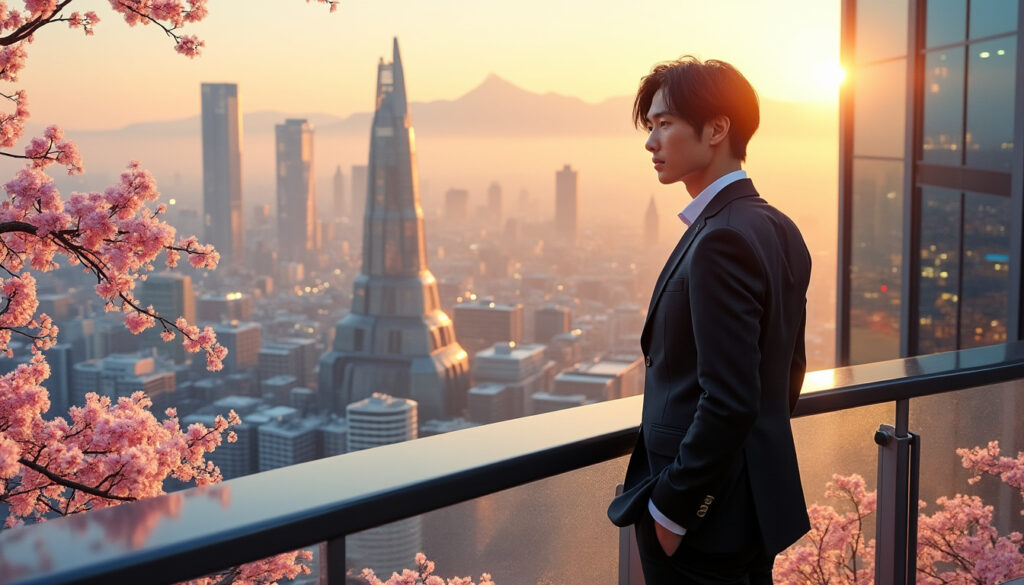
Yoshitoshi Shinomiya, an artist whose modest beginnings saw him working in the shadow of the great masters of animation cinema, now stands out as an essential creator. With his first feature film, A New Dawn, he shines a light on poignant themes such as grief, precariousness, and the impact of modernity on ancient traditions. In this visually stunning film, which evokes the beauty of Japanese landscapes while questioning our relationship with nature, Shinomiya reveals a unique sensitivity through the journey of his characters, whose dreams and memories intertwine in a tapestry that is as touching as it is enlightening.
Yoshitoshi Shinomiya: The Awakening of a New Dawn
In the limited world of Japanese animation, Yoshitoshi Shinomiya emerges as an innovative figure, having managed to convey intense emotions through his works. His film A New Dawn serves as a poignant reflection of themes that define modern society, such as precariousness, the search for identity, and the weight of the past. Throughout the paragraphs, we will discover how Shinomiya combines unparalleled technique with rich and complex storytelling.
A Decisive Collaboration with Makoto Shinkai
Yoshitoshi Shinomiya started his career as a background painter, notably for Makoto Shinkai. Initially, these early steps saw him working in anonymity, as when he participated in Journey to Agartha in 2011. However, his true fame exploded after his collaboration on The Garden of Words in 2013. This artistic crowning marked a transformation not only for him but also for Shinkai, who began to stand out as a reference creator.
The dynamic between these two artists proved fruitful. Indeed, the motif of rain, for example, is not just a simple visual element in their work, but becomes a symbol charged with emotions. Shinomiya, as an ambassador of Shinkai’s universe, illustrates this artistic symbiosis, making their projects even more engaging. Together, they have woven a rich tapestry of sensations and meanings.
The peak of their complementarity is undoubtedly visible in Your Name, an emblematic masterpiece that thrusts Makoto Shinkai into the spotlight. The emotional resonance of this film, supported by Shinomiya’s talent for visual art, has placed their duo at the heart of the Japanese cinematic landscape, sparking intrigue and admiration.
A New Dawn: Synopsis and Themes
After proving himself in the realm of short films with works like Tokino Kōsa, Shinomiya approaches his first personal feature film: A New Dawn. This film describes the journey of three childhood friends, called back to a house filled with memories. But this home, imbued with vibrant colors, is under threat. Keitaro, one of the protagonists, aspires to bring back to life an impressive fireworks display, the Shuhari, a legacy from his father. This project symbolizes both a tribute and a struggle against modernity.
The film highlights contemporary concerns: the pressure of urban development on traditions. The viewer is plunged into a universe where mysticism blends with the challenges of modern life. Additionally, this narration is enriched by the personal evolution of the characters, who must face powerful emotional challenges and a marked identity quest.
Yoshitoshi Shinomiya manages to juggle the poetry of the past with the anxieties of the present. This duality is perfectly manifested in the introspective gaze of his characters, whose search for meaning resonates deeply. This blend creates a captivating work, imbued with reflections on memory and loss.
An Aesthetic that Blends Technique and Emotion
The aesthetics of A New Dawn are breathtaking. By drawing inspiration from the graphic palette, Shinomiya manages to create a subtropical environment of rare beauty. The collaboration with the French studio Miyu Productions has refined an artistic direction that showcases the subtle modulation of colors. Each shot, each detail becomes revealing of a vibrant world, evoking a feeling of wholeness and melancholy.
The monsoons and humid landscapes found in his works evoke memories. They also embody ancient traditions while highlighting the environmental degradation threatening the forest surrounding Keitaro’s factory. This visual representation, sublime and troubling, embodies the strength of Shinomiya’s storytelling. The contrast between beauty and disaster is palpable, giving a new dimension to the narrative.
In order to transcend mere narration, Shinomiya skillfully plays with cinematic techniques. For instance, the stop-motion sequences are impressive and heighten the viewer’s perception. The inventiveness of the editing, which combines different scales and perspectives, further enriches the emotional content of the film.
A Critical Perspective and Societal Reflections
At its premiere at the Berlinale, A New Dawn stirred ambivalent feelings. A number of critics pointed out a confusing narrative, a point often discussed by the press. However, beyond this observation, the film reveals a depth that can be savored beyond its main story. Themes surrounding ecology and the struggle against social precariousness are delicately explored.
This film revolves around loss, the memory of a deceased father, and the doubts that plague the characters. Moreover, the immaturity, both narratively and emotionally, echoes a generation seeking to find its way in a changing world. In this sense, the story of a dream of independence collides with the brutal reality of precariousness.
Yoshitoshi Shinomiya thus paints a social portrait of a troubled youth, torn between aspirations and necessities. A New Dawn stands as an essential work, offering a sincere look at the vicissitudes of contemporary life. This blend of human stories and societal reflections creates invaluable richness, marking another step towards the culmination of his style.
A Promising Future
Looking to the future, there is no doubt that Yoshitoshi Shinomiya has much more to offer to the world of animation. He has established a unique trajectory that heralds even bolder works. A New Dawn is not just an introduction to his art but also a promise of stories to come, which will continue to touch and question the audience.
The echoes of his reflections on childhood, friendship, and the connection to nature will resonate endlessly. It is clear that Shinomiya will transform every new release into an event. Animation enthusiasts eagerly await to see what new dimensions he will explore in his future projects. Shinomiya’s presence in the creative sphere is a blessing for the world of animation cinema.
Yoshitoshi Shinomiya: The Awakening of a New Dawn
With A New Dawn, Yoshitoshi Shinomiya has made a decisive mark in his artistic journey, echoing the promises just glimpsed in the collaborations he has maintained with Makoto Shinkai. This first solo feature reveals a unique vision, rooted in the psychological complexity of its characters and a rich emotional panorama. Shinomiya’s camera films with remarkable sensitivity and captures the fleeting beauty of memories while confronting the protagonists with contemporary challenges such as precariousness and urban transformations.
The film highlights the reunions of a trio of childhood friends, uniting their fates around a house that is both symbolic and enriched with an immersive narrative. Through Keitaro’s struggle to preserve the legacy of his ancestors in the face of a changing world, Shinomiya does not merely address universal themes such as friendship and grief, but also invites reflection on our relationship with nature and traditions. The incorporation of the mysterious element of pyrotechnics as an illustration of the characters’ search for meaning places the film in a strongly poetic dynamic.
Furthermore, the innovative use of animation, distancing itself from conventional norms, underscores Yoshitoshi Shinomiya’s distinctive approach. The graphic palette, carefully crafted with pastel shades, enriches the visual experience, transcending simple images to create a true visual poem. This poem, while presenting an underlying social critique, skillfully combines the art of storytelling with technique, thus opening a promising path for a director whose potential seems limitless.