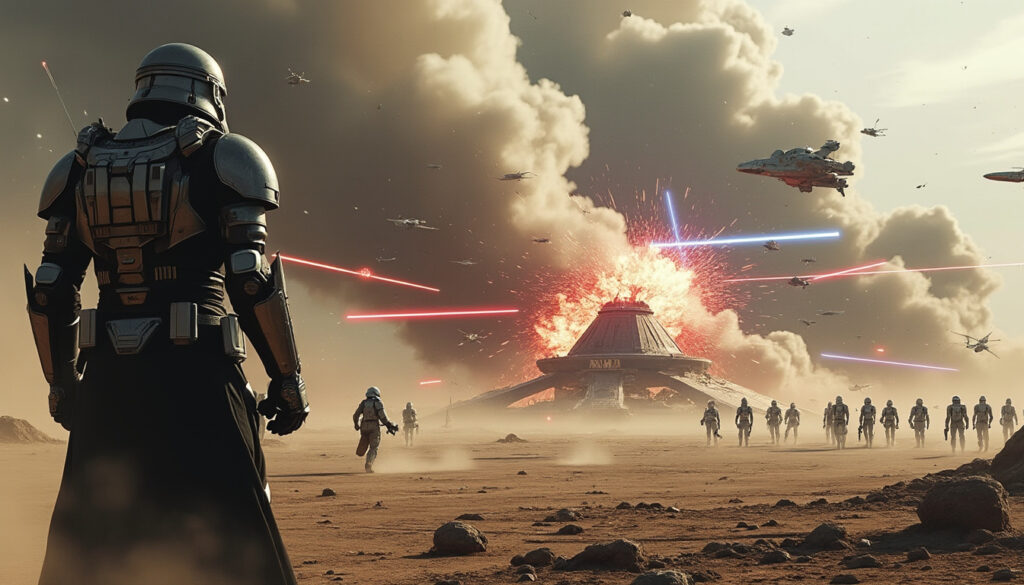
Imagining Bungie at the helm of Star Wars Battlefront 3 is to dream of spectacular galactic battles and a proven track record in science fiction. But entrusting this studio with an already sprawling galaxy could also distract its talents from creating a new original universe: a prospect as exciting as it is frustrating.
A new episode of Star Wars Battlefront has been a dream for years, and a rumor now suggests an unexpected candidate: Bungie. The idea could electrify fans, as the studio knows how to create rich science fiction worlds and tense confrontations. But entrusting the saga to them could also divert a precious team from its own worlds, without necessarily guaranteeing the spectacular return hoped for.
A rumor that puts the galactic battle back on track
Nearly a decade after the previous installment, the desire for a new game dedicated to the great battles of Star Wars remains strong. According to information relayed by Jeff Grubb, Lucasfilm is looking for a partner capable of taking over the sequel. However, nothing indicates that a project has been officially announced.
The origin of the buzz is unusual: a column of video game gossip that resurfaced in a special digital issue of Electronic Gaming Monthly. It mentioned studios interested in the project, notably EA DICE and Bungie. This mix of rumor, media relay, and speculation is enough to fuel discussions but does not constitute confirmation.
Why Bungie appears in conversations
The studio behind Destiny has solid experience with science fiction combat, instantly recognizable weapons, and universes that players love to return to. Its expertise could give a new Battlefront adventure a sharp pace, polished shooting sensations, and progression designed to last. On paper, the pairing seems almost obvious.
Bungie’s recipe could spark excitement
Battlefront is not just about lining up soldiers in a familiar setting. It’s crucial to give scale to the confrontations, make every class useful, and maintain a clear reading of the chaos, even when battles involve dozens of players. Bungie has long known how to transform these mechanical requirements into accessible yet challenging experiences.
The studio also masters the art of building an identity around weapons. In its games, every shot has a form of presence, and every piece of equipment suggests a different way to approach combat. Such precision could enhance the blasters, sniper rifles, and heavy weapons of the Star Wars universe, provided their behavior is not standardized.
Hero battles would offer another particularly promising playground. Bungie could design clear abilities, distinct roles, and confrontations where character mastery matters as much as power. The risk would be making them too close to the duels of Destiny, while iconic Star Wars figures demand their own personality.
Battles that would need the right scale
The talent for designing precise shots alone does not guarantee convincing galactic battles. It would also require achieving the balance between infantry, vehicles, heroes, and objectives, without making confrontations unpredictable or frustrating. The feeling of being at the heart of an interstellar war depends as much on this orchestration as on the quality of the controls.
A studio accustomed to arenas could bring more readable confrontations and excellent flow on the maps. However, fans also expect recognizable battlefields filled with details and capable of telling a story without diverting attention from the action. The staging should therefore enhance the fights, not stifle them.
There is also the question of pacing. Battlefront can alternate moments of tension, heroic breakthroughs, and long collective pushes, while a tighter formula often prioritizes frequent engagements. Bungie would need to find a cadence that respects the scope of the franchise while maintaining the responsiveness that defines its reputation.
Finally, fidelity to the saga is not measured solely by the number of planets or famous characters. Sounds, silhouettes, animations, and visual effects also contribute to the immersion. A blaster must evoke Star Wars from the very first second, rather than resembling a generic sci-fi weapon.
DICE’s past weighs in the balance
EA DICE remains the most natural name to take over the series. The studio has already signed two episodes and has tangible experience with large-scale battles. This familiarity does not guarantee success, but it reduces the unknown when relaunching such a prominent franchise.
The previous Battlefront II also left a lasting lesson on progression systems and microtransactions. The negative reactions triggered by certain mechanics showed how much players monitor how a game distributes its rewards. A new episode will need to regain their trust as much as deliver spectacular fights.
Choosing DICE could allow building on the series’ achievements, its visual language, and an already established understanding of audience expectations. But continuity can become a trap if it leads to replicating contested choices or presenting a simple evolution as a revolution. The studio’s return should therefore come with a true reassessment.
The safety of a return does not erase the risks
Entrusting the sequel to the team that already knows the license would limit some missteps. DICE would not need to discover how to reconcile infantry, vehicles, and heroes in the same battle from scratch. However, past experience never frees one from rethinking gameplay modes and progression.
The challenge for both the publisher and developers would be to leverage the heritage without being constrained by it. Players want to relive the sensations that marked them, but they also expect strong enough innovations to justify a new episode. Nostalgia attracts the audience; it doesn’t always keep them.
Another team could bring a fresh perspective, but this benefit would come at a cost: production time, identity choices to establish, and more delicate coordination with Lucasfilm. A studio change would therefore not automatically mean innovation. Everything would depend on the creative freedom granted and the clarity of the vision.
The great paradox: Bungie already has its own galaxies
The temptation to recruit Bungie is easily understood. Destiny has demonstrated its ability to sustain a universe over time, with a dense mythology and invested communities. Marathon, another science fiction project from the studio, also reminds us that its teams have long explored original territories.
These references make the studio particularly attractive for a space license. However, they raise an essential question: should we engage its creators on an already vast property, when they could develop new ideas? The best short-term commercial choice is not always the most stimulating option for a studio.
A Star Wars production would require years of work, tight coordination with the license holders, and constant attention to the coherence of the saga. Part of Bungie’s creative energy would then be dedicated to enriching a universe that already has its codes, history, and characters. For fans of its original creations, this perspective feels somewhat bittersweet.
This reservation does not imply that a licensed game would necessarily be less ambitious. Bungie could find new ground, unprecedented design challenges, and the opportunity to showcase its expertise to a different audience. But this would depend on its latitude: applying an existing formula is not the same as reinventing its principles.
The debate thus transcends the simple choice of a developer. It touches on the place of original games in an industry where major licenses offer immediate visibility but also impose considerable expectations. If Bungie embarked on Battlefront, the question would be how many of its original ideas could still breathe under the armor of the saga.
A prestigious license, a considerable production gamble
Creating a AAA game takes years, numerous teams, and decisions made very early on. For a studio undergoing a period of change, relying on a recognized license might seem less risky than starting from a blank page. The notoriety of Star Wars would immediately attract attention but would also amplify every misstep.
Bungie’s situation is fueling speculations while not allowing us to know the studio’s real plans. Observers mention an uncertain future for its projects and high expectations from Sony, its owner. In this context, a game known to the general public could seem easier to defend than a new intellectual property still without a community.
This financial logic can, however, conflict with creative ambition. A licensed project offers a solid framework and considerable potential audience but also involves validations, narrative constraints, and intense quality pressure. Success would therefore depend not only on Bungie’s talent but also on how the partnership was organized.
Furthermore, a new Battlefront would not necessarily be the quick solution some fans imagine. The creation of a large-scale multiplayer game requires significant work on technical architecture, balancing, and content available at launch. Even with a global brand, production could extend over several years.
A choice of studio should therefore address a broader question: what experience does Lucasfilm truly wish to offer? A sequel faithful to previous episodes, an ambitious overhaul, or a service game meant to evolve for a long time? Without this direction, even the most reputable teams could risk pursuing incompatible objectives.
What players would expect from a new episode
Expectations would not be limited to just impressive battles. Many would want fair progression, varied modes, and a generous representation of different periods of the saga. The content should also respect the balance between ground battles and more spectacular confrontations.
The business model would be scrutinized from the first announcements. After the controversies of the past, players would be attentive to rewards, paid options, and the role of cosmetic items. Transparent progression could become one of the most important signs of a change in direction.
The community would likely hope that the game is complete at launch, rather than relying on a series of updates to reach its full potential. Additional content can extend a successful experience, but it should not serve to artificially fill an initial gap. A solid launch is as important as promises of future content.
It would also be essential to avoid reducing the saga to a few confrontations between famous characters. Ordinary soldiers, squad battles, and collective objectives form an essential part of the identity of Battlefront. A brilliant system centered on heroes would not replace the feeling of participating in a larger war.
Competitive gamers and those seeking a relaxed experience would not necessarily ask for the same things. An inclusive design could offer multiple ways to play, without sacrificing the depth of confrontations. The challenge would be to make these options coherent rather than juxtaposing modes without a true connection.
The question of longevity would also remain at the heart of discussions. Players want a title capable of renewing itself but want to avoid systems that turn every match into a daily obligation. It’s a delicate balance, particularly when the project relies on a sustainable multiplayer community.
Between dream and missed opportunity
Imagining Bungie bringing a new Star Wars to life is thus thrilling. Its expertise could make battles more precise, equipment more memorable, and online confrontations particularly vivid. At the same time, the franchise’s reappearance would constitute an event long awaited by fans.
But this prospect still relies on unconfirmed information, and the rumor does not allow us to determine who will truly lead the next project. DICE remains an obvious candidate thanks to its previous experience, while Bungie embodies an intriguing possibility but raises creative and industrial questions. For now, the choice of developer remains open.
If Bungie were selected, the challenge would be to preserve what makes its games unique without mechanically imposing their systems on the Star Wars galaxy. The studio would need to demonstrate the ability to listen to an already demanding community while bringing a true vision. This would be an ambitious mission, somewhere between fidelity and reinvention.
Conversely, allowing Bungie to pursue its own universes could pave the way for a new science fiction franchise, less constrained by the expectations of an already established saga. This project would undoubtedly be more uncertain commercially and require more patience. It could also represent a rare opportunity to build something that does not yet exist.
Battlefront 3 by Bungie: the galactic dream and the risk of diversion
The idea excites fans: entrusting a new Star Wars Battlefront to Bungie, the studio that shaped the worlds of Destiny and Halo. Imagine gigantic battles where each planet has its own identity, confrontations readable despite the chaos, and a campaign able to give a human face to this interstellar war. Bungie knows how to build worlds that players want to linger in. Its expertise in shooting, pacing, and online gaming could give the saga a formidable energy.
But this promise conceals a thorny question: is this really the project Bungie needs — and the one players expect from the studio? The team is going through a delicate period, while its big projects are already mobilizing resources and ambitions. A Battlefront 3 could represent a more concrete opportunity to find the path to success than a new intellectual property, long to imagine and risky to produce. For Sony, Bungie’s owner, a famous license would also have the advantage of offering an immediately recognizable entry point.
The downside is that several years of work dedicated to the world of Star Wars might distance Bungie from what makes its uniqueness: inventing its own science fiction mythologies. The studio has already proven it can create memorable worlds without relying on a known galaxy. Seeing it apply its know-how to an existing franchise would be fascinating but could also resemble a costly detour, especially if the game had to meet the demands of a gigantic production and a sustainable online service.
Moreover, it is hard to ignore the experience of EA DICE, already associated with two modern episodes of Battlefront. Returning to a team that knows battles and their scale would make obvious sense, even if a new partner could bring a different breath. Between legacy, ambition, and economic necessity, the choice of studio would weigh as much as the choice of planets to explore. It remains to be seen which vision Lucasfilm will want to prioritize: the continuity of a proven formula or the surprise of a galaxy rethought by Bungie.