With Tesis, the Spanish thriller released in 1996, Alejandro Amenábar immerses a film student in a troubling investigation surrounding a tape showing a murder. By playing with what remains off-screen, the film questions our fascination with violence on screen and the limits of perception.
Before Spanish cinema established itself in horror with The Orphanage or [•REC], a young director signed a thriller as disturbing as it is masterful. Released in 1996, Tesis follows Ángela, a film student who discovers a tape showing the torture of a young woman. From this enigma, Alejandro Amenábar questions our fascination with violent images, the power of gaze, and the uncertain boundary between representation and reality.
A landmark debut
In the mid-1990s, Spanish cinema exported abroad was primarily associated with filmmakers like Fernando Trueba or Julio Medem. Amenábar enters this landscape with a radical project, focused not on supernatural horror, but on a violence whose possibility seems terribly concrete. He is only twenty-four years old when he directs this first feature film, after drawing attention with two shorts.
The critical and public success of Tesis is crowned with seven Goya Awards, including Best Film. The thriller thus helps pave the way for a new generation of Spanish genre cinema. Its significance lies as much in its effectiveness as in the way it transforms a cinematic question into a true dramatic driver: what do we choose to watch, and at what cost?
An investigative journey within the university
Ángela is preparing a thesis on violence in audiovisual works when she stumbles upon a peculiar tape, discovered after the death of her thesis supervisor. She seeks the help of Chema, a student passionate about horror films and extreme documents. Among the leads that emerge, Bosco, an enigmatic young man, soon catches her attention.
The investigation progresses in fragments: a magnetic tape, archives, technical details, and testimonies that do not always agree. This academic setting, with its dull corridors and editing rooms, gives the narrative a familiar appearance. The anxiety settles precisely because the mystery does not seem to belong to a fantastic elsewhere, but to a world close to ours.
Implied violence rather than depicted
The film stands out through a particularly effective representation strategy: it holds back the image at the moment when the viewer expects to see it. From the opening, an announcement in the subway refers to a fatal accident while passengers are invited to look away. Ángela approaches the scene, hesitates, and is then prevented from seeing the body.
This scene exposes the central mechanism of the narrative. The prohibition to look feeds curiosity, while the wait gives horror an almost physical presence. Amenábar does not immediately deliver the feared object; he rather constructs a mental space where everyone imagines what remains off-screen.
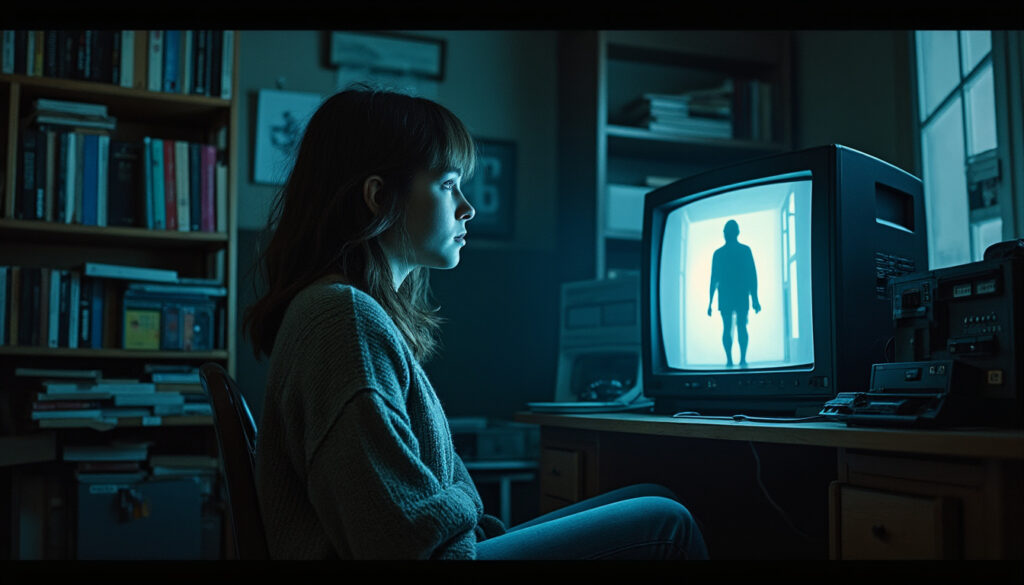
The tape reinforces this logic. During her first viewing, Ángela darkens the screen and initially accesses only sounds: screams, muffled noises, incomplete clues. This auditory experience troubles the separation between investigation and voyeurism. To seek the truth, the student must listen to what she would prefer never to hear.
The VCR as a disturbing window
In Tesis, recorded violence does not present itself as a sharp and immediate image. The grainy texture of the VHS, the faded contrasts, and the limits of framing distance horror while making it more unsettling. The home camera seems to have preserved a trace, but this trace never fully reveals itself.
The video medium thus becomes a sort of imperfect witness. It allows the scene to be revisited, paused, and scrutinized for every detail, without guaranteeing that the interpretation is correct. This relationship to the document echoes the stories of underground films that circulate as urban legends: their origin remains uncertain, but their grounding in reality is enough to provoke discomfort.
Looking, desiring, understanding
Ángela claims not to be complacent in violence; yet her interest in the tape gradually takes on an obsessive intensity. She listens to the recordings, searches for signs, and approaches the content she dreads. The character’s ambivalence feeds the suspense: is her investigation merely a search for truth?
The young woman is confronted with two forms of death. The first comes to her through a screen, filtered by the video tape; the second imposes itself on her in a tangible form when she faces a corpse. Amenábar thus contrasts the mediated experience with the brutal presence of the body. One allows for distance, the other makes that distance impossible.
The film does not simply condemn the curiosity of its heroine. It makes the audience feel the same attraction, sometimes uncomfortable, towards the clues and hidden images. The silences, sonic details, and character reactions lead us to share her point of view, without offering the safety of an outside position.
A mise en abyme of the cinematic gaze
Bosco is introduced through his camera, as if the device first defines his relationship with others. He films Ángela during an interview as she claims to hate being recorded. This gap reenacts, within the plot, the gesture of the filmmaker: framing someone, deciding what will be visible, and then inviting an audience to watch.
Chema embodies another relationship with images. Armed with his knowledge of horror films, he examines the tape as a technical object and methodically deconstructs its signs. This rational approach contrasts with Ángela’s apprehension, yet it does not dispel the unease. The tools of analysis can illuminate a shot; they do not neutralize what it represents.
Between urban legend and ordinary horror
In the 1990s, stories of banned films and urban legends circulated long before online communities popularized their own horror tales. Tesis takes hold of this unease without resorting to the supernatural. The possibility, never established, that criminal images exist is enough to unsettle the viewer.
This absence of the fantastical gives the narrative a particular tone. Nothing explains fear through an invisible force or a creature from elsewhere. The threat seems rather linked to individuals, choices, and devices capable of recording the worst. It is a horror all the more disturbing as it takes the form of a possible news item.
The film engages in discourse with American paranoid thrillers and works that question the circulation of violent images. It also reminds that cinema can transform an act into spectacle, and then the spectacle into an object of analysis or consumption. In another register, this interview with Christopher Andrews on the representation of violence and the filmmaker’s responsibility usefully extends this reflection.
The viewer caught in the investigation
As new evidence emerges, the audience is encouraged to examine it alongside the characters. A cut, a zoom, or a missing image can alter the meaning of the scene. The investigation then resembles a deciphering exercise where the slightest clue seems crucial.
This immersion, however, has a downside. By following the students, we adopt their desire to see and know, even when the object of their investigation inspires disgust. The film does not leave us completely safe: it reveals that critical curiosity can coexist with a form of fascination.
A visual grammar at the service of suspense
Amenábar already masters camera movements and variations in point of view that will give the film its energy. Fluid movements in academic spaces alternate with more unstable passages, akin to handheld camera shots. This diversity is not merely about virtuosity: it accompanies the changes in tension and assurance of the characters.
The desaturated photography contributes to the impression of coldness. The buildings appear unwelcoming, almost anonymous, and the corridors become places where a threat can emerge without warning. The atmosphere stands out from the bright colors often associated with Movida, as if the film deliberately chooses a more austere and less immediately seductive appearance.
Between American references and Spanish identity
The narrative relies on familiar codes of American thrillers, particularly the investigation led by young adults and the gradual revelation of a scheme. Yet it does not simply mimic these models. The Madrid university setting and the concerns related to Spanish audiovisual culture situate the plot within a precise context.
In a classroom scene, a professor discusses the students’ potential and the ambition of cinema capable of shining beyond borders. The remark resonates like a statement of confidence in the possibilities of the medium. It also echoes Amenábar’s trajectory, whose first feature would attract attention far beyond Spain.
Readers interested in the unique forms of European cinema may also explore the interview with Bruno Dumont, about fiction and the freedom that artifice allows. This question of the false and the fabrication of images sheds light, by contrast, on the specific unease created by the recordings of Tesis.
A film reinterpreted in light of our image culture
Upon its release, VCRs and tapes were still familiar objects capable of transporting images outside official circuits. Today, digital technology has profoundly changed their circulation, but the film’s intuition remains relevant: a recorded image can be sought, copied, examined, or shared, without its viewing being harmless.
The VHS material nevertheless gives the narrative a strong historical signature. Its grain, defects, and limits evoke an era when switching from one tape to another could reinforce the mystery instead of dissipating it. The thriller thus captures the fears specific to a moment of transition, before unsettling content becomes accessible and viral with just a few clicks.
The theme resonates with other works that question violence, its staging, and the power of the image. The interview dedicated to Patrice Chéreau and La Reine Margot allows for an exploration of another way to shape historical violence. That on Émilie Blichfeldt and her story of the wicked stepmother opens a reflection on how cinema transforms tale figures and their shadowy areas.
The discovery of a filmmaker
The success of Tesis placed Amenábar among the new talents to watch. His taste for enigmatic narratives and characters confronted with an uncertain reality would continue in later works, although each takes a different path. This first film, however, retains a particular audacity: it adopts the codes of the thriller while directing them toward a questioning of our responsibility as viewers.
Thirty years after its release, its restoration and reissue on video allow viewers to rediscover the details of its direction and the rawness of its universe. These new editions also invite observation of how a film can document the imaginaries of one era while remaining alive for subsequent ones. As future genre narratives approach, the discovery of the unique universe of Adilkhan Yerzhanov with Turgaud offers another glimpse into the unexpected paths taken by contemporary cinema.
Violence on screen, a disturbing gaze
In Tesis, Alejandro Amenábar makes filmed violence much more than a plot device: it becomes the heart of a questioning about our manner of seeing. Ángela, a film student, seeks to understand the origin of a tape showing a murder. But each clue brings her closer to images she dreads as much as she desires to see. This contradiction feeds the discomfort of the film: the curiosity that drives one to discover the truth sometimes resembles the morbid fascination attributed to others.
The filmmaker, however, chooses to almost never show the atrocities frontally. The screams, the reactions of the characters, and the grainy texture of the VHS suggest what the image conceals. By keeping horror off-screen, Amenábar transforms absence into threat and forces the viewer to confront their own expectations. The gaze thus becomes a moral issue: wanting to see everything, does it mean seeking to understand, or participating in the spectacle of suffering?
This reflection resonates with a time when urban legends about snuff movies circulated as possible stories, without belonging to the fantastical. The danger is not only that of a mysterious video but that of an audience capable of consuming horror as entertainment. Chema, a genre cinema enthusiast, examines the images with methodical coldness; Ángela, on the other hand, oscillates between investigation and repulsion. Their reactions reveal different ways of negotiating the unacceptable, without providing comfortable distance.
The film also encapsulates the power of the camera. Filming, framing, editing: these gestures can document facts, but also manipulate the gaze and transform a victim into spectacle. As the investigation progresses, the line between observation and complicity blurs. Tesis thus invites consideration of not only what the images show, but also the conditions of their making, their circulation, and the troubling pleasure they can evoke. The screen, far from being a neutral window, becomes the place where curiosity, power, and responsibility intersect.