
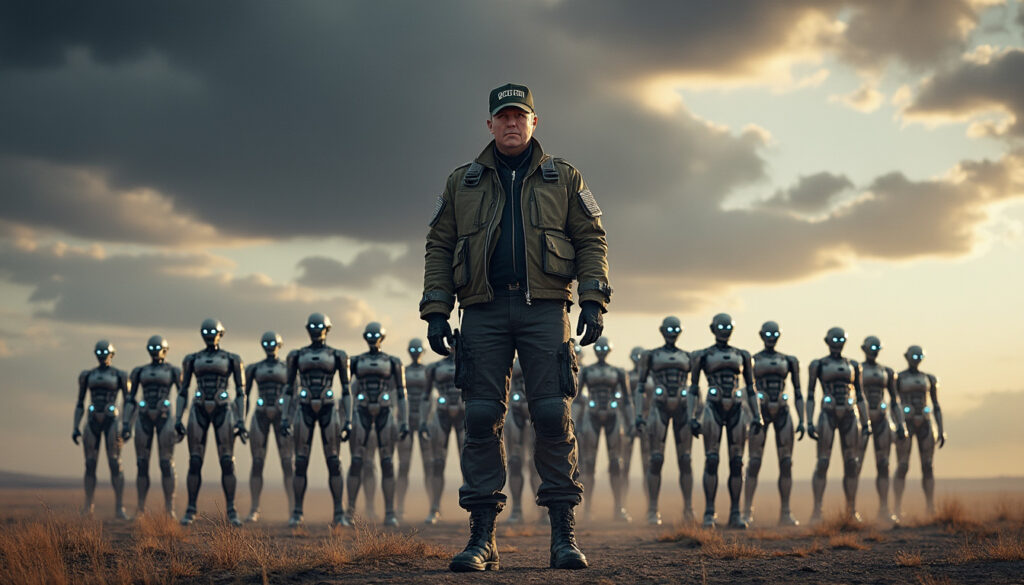
Eric Trump embarks on a bold venture by building a true army of humanoid robot soldiers. With the support of Foundation Future Industries, this endeavor is dedicated to developing humanoids for combat, inspired by futuristic visions of science fiction. As military technology evolves rapidly, the shift towards bipedal fighters raises many questions about their effectiveness and safety on the battlefield. Beyond the promises of innovation, it is essential to maintain a critical eye on this fascinating and potentially dangerous quest.
A new era of military technology appears to be emerging, marked by Eric Trump’s involvement in the development of a true army of humanoid robots. This ambitious project, coupled with his bold strategy, aims to revolutionize the battlefield with machines that can interact and act like humans. But behind this futuristic facade, what are the real implications of this technological adventure? Let us explore together the nuances and potential of this initiative.
A bold and controversial initiative
In a world where technology evolves at a furious pace, the idea of an army of humanoid robots seems almost normal. However, Eric Trump’s commitment as a strategic advisor raises questions. His involvement may provoke criticism, both in terms of ethics and feasibility. The robotics industry has always been fascinated by the prospect of machines having a human form, but reaching a goal such as this is fraught with challenges.
Robotics experts, like Rodney Brooks from MIT, believe that we are still far from an effective operational model. The challenge lies precisely in replicating human movements in varied environments, which presents a real puzzle for engineers. The quest for humanoid robots could easily become a vain obsession, a distraction from more viable technological solutions.
Despite this, enthusiasm around the project simmers. The familiar faces of captivating robots imagined by cinema intrigue investors and the public alike. The idea that machines could become the “soldiers of the future” fuels the imagination. Yet, this technological dream comes with sometimes unsettling realities, notably that of potentially dangerous robots.
The technical challenges to overcome
Creating robots capable of moving with human fluidity across diverse terrains is a colossal technical feat. Indeed, most current robots, though advanced, will encounter notable limitations. Movement, stability, and obstacle management are challenges that must be addressed if we want to fulfill this promise. The performances of robots must meet expectations, but this requires considerable advancements.
Military robots, such as those developed by other companies, often focus on specific applications. In contrast, Eric Trump’s ambition extends into the collective imagination where a robot soldier could partake in various operations, which is not without technical problems. The design of versatile machines could lead to unforeseen risks.
A mix of enthusiasm and skepticism
Despite the fascination, enthusiasm quickly meets a form of skepticism. Figures such as Angela Collier, a YouTuber specializing in the field, criticize the excitement for humanoid robots. She points out that most inventions merely aim to raise funds without genuinely considering their utility. The truths behind this quest often seem dark; the functionality of devices is often neglected in favor of appearances.
Meanwhile, the fear of robots being omnipresent on battlefields remains persistent. Having machines operating with artificial intelligence on the ground may seem like an advance, but it also entails considerable dangers. Incidents, such as those where machines fail in their tasks, raise many questions about responsibility and the ethics of decisions. Should society really endorse such a direction? What will be the long-term effects?
Towards an uncertain future
While Foundation Future Industries frolics around the glorious visions of a robotic army, reality necessitates critical reflection. We must not lose sight of the fact that the road to such technological evolution is fraught with uncertainties and mysteries. The illusion of an army of human-like machines, while enticing, is only one facet of a quest that raises questions. Indeed, the dialogue surrounding the use of military robots deserves to be deepened and informed.
Perhaps in the future, battles will not only be fought between humans but also between technological creations and artificial intelligences. This implies not just a transformation, but a redefinition of human relationships and social interactions.
If popular imagination sees robotic heroes in a coming world, the technological and ethical challenges will be inseparable from this adventure. For now, questions remain: at what cost will this evolution occur? Is humanity ready to welcome these innovations? Only time will tell.
In a world where technology and robotics are advancing at a breakneck pace, Eric Trump’s initiative to create an army of humanoid robots is provoking mixed reactions. While some view this project as a fascinating advance in the military field, others point out the technical challenges that remain to be overcome before these androids can truly be effective on the battlefield.
The company Foundation Future Industries, led by a determined team, is banking on bipedal robots to conquer the future of military applications. That said, the very idea of replacing human soldiers with machines raises ethical and practical questions. Many robotics experts emphasize that realistically replicating human movements is a colossal challenge, and that the idea of filling the battlefield with humanoid robots might be more of a utopia than a near reality.
As Eric Trump holds a role as a strategic advisor, one might question whether his involvement truly adds value to the project. Doubts persist about the funding and feasibility of such weaponry. While government contracts allow for dreams of profits, it is crucial to keep in mind that functionality always takes precedence over appearance.
For now, the excitement surrounding humanoid robots seems to be fueled more by popular culture than by real-world applications. With technology still in its infancy, it remains to be seen whether these ambitions can transform into tangible results, and if Eric Trump’s futuristic vision will ever become a reality. The path that lies ahead in terms of robotics, efficiency, and practicality is likely to be fraught with obstacles.


