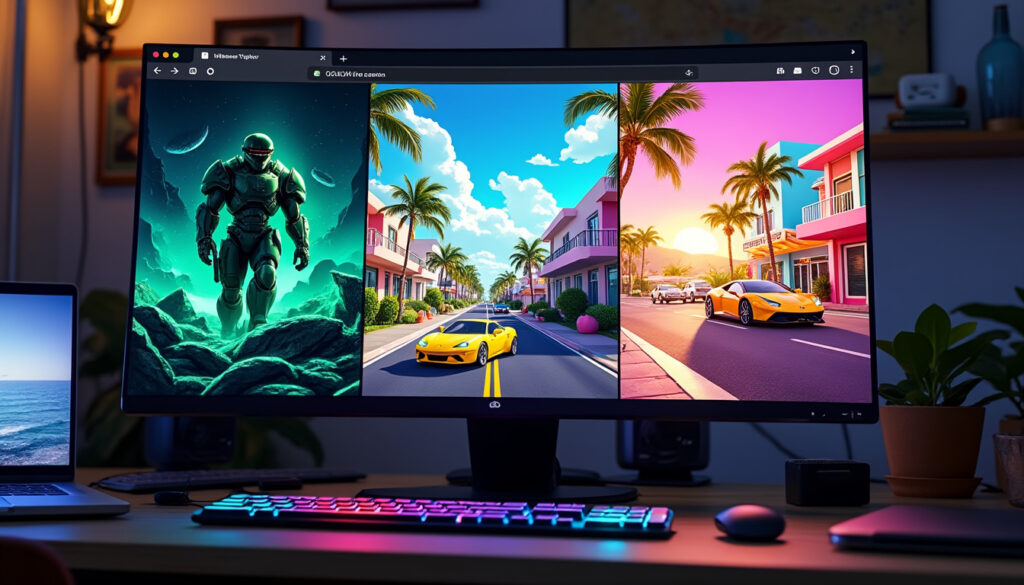
Playing Halo: Combat Evolved, The Simpsons: Hit & Run, or GTA: Vice City directly in a browser, without installing the game, still seemed improbable. Yet, ports created through vibe coding appear surprisingly smooth — a feat that reignites concerns over copyright and the future of video games.
We might be doomed: these versions of Halo, The Simpsons: Hit & Run, and GTA: Vice City, created by “vibe coding,” seem to run beautifully in a browser
Games once reserved for consoles and local installations are reappearing as playable versions in a simple browser. Their arrival, facilitated by advances in artificial intelligence and decompilation, raises a dizzying question: if these adaptations are so quick to produce and so convincing to run, how can publishers still retain control?
We might be doomed: these versions of Halo, The Simpsons: Hit & Run, and GTA: Vice City, created by “vibe coding,” seem to run beautifully in a browser
For a few weeks now, games and emulators presented as “vibe coding” projects have proliferated on the Web. The principle is to rely on artificial intelligence tools to analyze existing software, understand its functionality, and then reconstruct a version adapted to another environment. Titles like Halo: Combat Evolved, The Simpsons: Hit & Run, GTA: Vice City, and Call of Duty: Black Ops are cited among the games accessible directly in a browser.
The most troubling aspect is not just seeing them appear in a tab. According to reported tests of these projects, some adaptations run with astonishing fluidity, to the point of giving the impression of an almost native experience. Versions of Halo: Combat Evolved are said to have even offered responsive online servers, while The Simpsons: Hit & Run reportedly achieved particularly high frame rates.
Accelerated decompilation changes the game
The technical difficulty explains why such a phenomenon would have seemed improbable not long ago. Reconstructing the inner workings of a game without having its source code could take experienced teams months of analysis, testing, and corrections. Recent AI tools promise to significantly shorten this work chain.
An update of Claude Opus, noted for its performance in decompilation, is particularly cited as a factor in this acceleration. A model can examine large amounts of code and help deduce the mechanisms, resources, and interactions. It is not a magic wand, but an assistant capable of quickly handling a portion of the repetitive work.
The “vibe coding” adds another dimension: instead of manually designing each line of code, a developer can describe a desired outcome, request modifications from the AI, and then test successive versions. This method does not eliminate the need for technical skills or serious verification. However, it can lower the entry threshold for projects that previously required sharp expertise and a lot of time.
Why do these old games run so well in a browser?
The answer lies partly in their age. Many of the titles circulating today date back to the PlayStation 2 or PlayStation 3 era, whose hardware capabilities are modest compared to modern computers. A modern web page can utilize a significantly larger amount of memory than some of these consoles had at their disposal.
This comparison does not imply that browsers are automatically capable of running any game. It requires adapting the architecture, managing the controls, translating graphics calls, and resolving numerous compatibility issues. But the performance of contemporary devices makes it feasible to replicate games that once seemed inseparable from their original console.
The browser has also become a true software platform. Web technologies can leverage the graphics processor, handle complex multimedia content, and execute code at high speed. For internet users, the promise is attractive: open a tab, wait a few seconds, and find a game without installing the full title. The simplicity of this experience greatly contributes to its appeal.
But a good launch does not guarantee a perfect experience. Stability depends on the device, browser, the quality of the reconstruction, and the servers used. Some projects may work remarkably well during a demonstration, only to reveal slowdowns, bugs, or missing features as the game progresses.
Impressive fluidity, but not always synonymous with fidelity
A quick adaptation can give an impression of mastery without exactly reproducing the original game. Animations, collisions, menus, or character behavior may diverge. Even when the screen looks familiar, small technical differences can transform the experience.
A higher frame rate may make movements smoother, as seen in the versions of Hit & Run mentioned by players. However, increasing the number of frames per second does not alone prove that the port is faithful. Some games tie their internal logic to the frame rate, which can speed up actions or cause anomalies.
The controls represent another challenge. Games designed for a controller must be adapted for keyboard, mouse, or connected controllers. The result varies depending on the accuracy of the emulation and how inputs are interpreted. A slight latency can be enough to make an action game less enjoyable.
Online functions are even more sensitive. Accessible servers and low ping may be surprising, but these elements do not necessarily provide information about the longevity of the service, the security of connections, or the origin of the files used. Before launching a randomly found port, it is better to avoid associating personal accounts and be wary of additional downloads.
The legal puzzle of unauthorized ports
Companies that hold the rights to these works have legal means to have unauthorized versions taken down. Cease and desist letters can target sites, file hosting, or individuals distributing copies and protected resources. Removal requests can interrupt a distribution, but they do not mechanically erase all copies that have already been created.
This is where the situation becomes particularly difficult to contain. If an adaptation can be produced faster than before, the shutdown of one project is likely to be followed by the emergence of another. Files can circulate between multiple hosts, while internet users replicate the steps with different tools. The fight against dissemination then takes the form of a large-scale game of cat and mouse.
However, it is essential to differentiate between several practices often grouped under the same term. Emulating a console, decompiling a program, distributing a copy of the game, and creating a port are not necessarily the same technically or legally. The rules that apply depend in particular on the rights involved, the files used, and the countries where this content is hosted or accessed.
Publishers also have an economic reason to respond quickly: their old licenses remain brands and commercial catalogs. An amateur port can divert sales, complicate the marketing of a reissue, or falsely suggest that a product is endorsed. Conversely, the existence of such projects reveals the persistent interest of the public in games that are sometimes difficult to purchase or run on recent hardware.
For studios, the issue is therefore not limited to sending takedown notices. They can invest in accessible reissues, communicate about official options, or provide simple ways to preserve their old titles. A practical legal offer does not solve all disputes, but it can reduce the appeal of dubious versions and meet the demand from nostalgic players.
When the browser becomes a console
Seeing Halo: Combat Evolved, The Simpsons: Hit & Run, or GTA: Vice City running in a simple tab feels surreal. These games belong to an era when discs were inserted into consoles, loading times were part of the ritual, and every machine had its boundaries. Now, artificial intelligence tools seem capable of helping to cross these boundaries at a speed that would have seemed unimaginable a few years ago.
The most troubling aspect is not just that these versions exist, but that they can offer an surprisingly smooth experience. A browser is no longer a mere window on the Internet: it becomes a gaming platform, sometimes able to revive titles that are generations old without traditional installation. For players, the promise is attractive: starting a game in seconds, rediscovering a beloved universe, and sharing it as easily as a video. For studios, this ease raises a significantly less enjoyable question: how to protect their creations when a copy can reappear almost immediately after deletion?
Legal procedures can make a specific version disappear, but they do not erase the knowledge or tools that allowed it to be reconstructed. This is where vibe coding changes the game: work once reserved for specialists for months could be accelerated, automated, and reproduced by more people. The boundary between preservation, experimentation, and unauthorized exploitation then becomes particularly delicate.
It remains to be seen what these demonstrations herald for the games themselves: more amateur creations, new ways to play, or a long battle among developers, publishers, and communities. If a work can be reborn in a browser with so little friction, who will decide the form this rebirth takes — and where it stops?