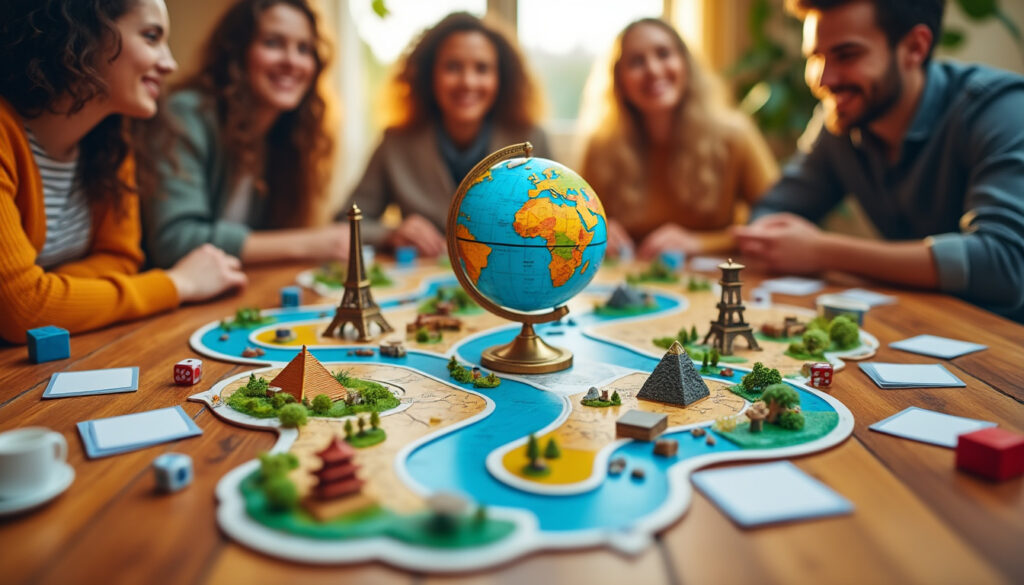
Set off to discover the cultures, landscapes, and curiosities of the world with The World Tour in 1000 Questions. This board game invites both young and old to test their knowledge and travel together, question by question.
The World Tour in 1000 Questions invites players to travel without leaving the table, appealing to curiosity, memory, and a taste for discovery. Through questions related to countries, landscapes, traditions, and major historical milestones, this game transforms geographical knowledge into a collective adventure. Here’s how to appreciate its spirit, prepare a friendly game session, and inspire a desire to explore the world differently.
Discover the fascinating board game: “The World Tour in 1000 Questions”
Its principle evokes an expedition marked by challenges: each question opens a window to a region, a culture, or an amazing fact. Players advance with their answers and discover how many surprises the world has to offer, even to those who think they already know it well. The destination counts as much as the journey, because a good game mixes learning, exchange, and the joy of playing.
The one thousand questions suggested by the title promise a wealth of material to vary the themes and renew the games. Depending on the version and the rules provided, answers can rely on general knowledge, clues, or choices among several options. The key is to stay attentive to the wording, as certain details can make all the difference.
An invitation to explore countries and cultures
A game about the world is not limited to capitals and borders. It can also reveal languages, culinary specialties, natural sites, popular festivals, or significant inventions. This diversity gives everyone the opportunity to shine, whether they are geography enthusiasts or simply curious about ways of life elsewhere.
Rules that encourage discovery
Before starting, take the time to read the rules of the edition you have. The modalities of movement, the number of players, and the way to validate an answer may differ from one version to another. A clear explanation avoids hesitation and allows players to focus on what matters: playing together.
To set up the game, prepare the indicated materials and choose a pace suitable for the group. A short round is well-suited for a lively evening, while a longer game allows for more discussions and cultural detours. The joy does not depend only on the score: sharing an anecdote or debating an answer can become the best moment at the table.
Adapting the game to the participants
Players do not all have the same references, and that is precisely what makes exchanges interesting. To balance the meeting, you can form teams mixing different ages or levels of knowledge, if the rules allow. Younger players often bring spontaneous curiosity, while adults may recall travel memories or reading.
A friendly experience, between competition and sharing
The format of the questions naturally encourages conversation. An answer can recall a trip, a documentary, or a meeting, transforming a few seconds of play into a collective narrative. The board then becomes a starting point to explore memories as much as territories.
Competition can remain light: everyone takes their chance, but mistakes also become opportunities to learn. If an answer surprises the players, check the information in the resources provided with the game or in a reliable source. This habit distinguishes established facts from persistent misconceptions, especially concerning countries and cultures.
To preserve the energy around the table, alternate turns without letting discussions stretch out systematically. However, you can reserve a little time after each round for explanations and anecdotes. A good balance between pace and curiosity makes discovery enjoyable without turning the game into a lecture.
Board game enthusiasts may also be interested in the specific rules applied during playful events. For comparison, this British convention dedicated to board games illustrates how a community can come together around common practices and principles. The atmosphere of a game at home remains more relaxed, but the joy of sharing an activity remains central.
How to make the most of the questions
Reading the statement carefully is often as important as knowing the answer. A place name, a period, or a geographical clue can guide you towards the right path, as long as you don’t answer too quickly. Collective reflection helps to spot these details.
When a player hesitates, others can propose hypotheses without immediately revealing the solution. This way of playing turns memory into an investigation and keeps the suspense until the last moment. It is particularly suitable for groups where knowledge levels vary.
To extend the discovery, note the topics that generated the most questions or astonishment. After the game, everyone can choose a country or a theme to explore further through an atlas, a book, or a report. A simple question then becomes the beginning of an exploration that goes beyond the board.
Desires to travel do not only arise from landscapes: cinema can also spark interest in a universe, an era, or a unique aesthetic. Readers drawn to the bridges between culture and imagination can explore this article dedicated to the cinematic universe of Jean Rollin. This detour reminds us that cultural curiosity feeds on very different forms.
Making room for anecdotes and debates
A game gains in depth when players explain why an answer surprises them or seems familiar. Certain facts invite comparisons between regions, discuss customs, or distinguish a legend from a historical reality. However, keep a benevolent tone: the goal is to learn, not to catch others out.
The game can also reveal the limits of our knowledge. Confusing two names, forgetting a capital, or attributing a tradition to the wrong country happens to everyone. Welcomed with humor, these mistakes maintain a good mood and make new information more memorable.
Who is this general knowledge game for?
This type of game is suitable for families, groups of friends, and quiz enthusiasts who enjoy discovering various subjects. It may also interest travelers eager to test their knowledge before a trip or to rediscover, around a table, the pleasure of discussing the world. The experience mainly depends on the composition of the group and the willingness to participate.
Occasional players can join the game without particular preparation. Geography enthusiasts, on the other hand, may sometimes find the opportunity to compare their knowledge with others while discovering areas they are less familiar with. This mixture of profiles prevents the game from being reserved for specialists.
For those who love fictional universes as much as general knowledge questions, other articles may complement the exchanges. For example, you can read this presentation of Beast of Reincarnation, which explores the links between video games, creatures, and adventure. The connection to a board game is different, but it showcases the variety of ways to tell stories and explore worlds.
Creating an atmosphere conducive to travel
A comfortable space, good lighting, and a clear table are enough to host most games. A few maps or images can add a decorative touch without distracting players from the questions. You can also prepare drinks or specialties inspired by a chosen country for the evening.
Background music is optional, but it can accompany the theme if it stays discreet. Prefer an instrumental playlist or pieces that do not drown out conversations. The goal is to create a welcoming atmosphere, not to complicate listening to the questions.
Choosing the right moment to pull out the box
A game easily finds its place during an evening, a family afternoon, or a rainy weekend. The game can serve as the main activity or fit into a meeting that also includes a meal and other entertainment. In any case, allow enough time to explain the rules and let players settle in.
Before gathering everyone, check the contents of the box and the indications about the number of participants. If you are playing with young children, make sure the level of the questions allows them to participate in the discussions. Mixed teams can help everyone contribute without reducing the game to a string of difficult answers.
Evenings combining games, movies, and discussions sometimes offer unexpected associations. After a game, some groups will enjoy discussing how a scene tells a story or presents a conflict; this article analyzes, for example, the flaws of a new film on the war of the worlds. This type of reading can enrich a cultural conversation, even if the subject differs from travel and geography.
A traveler’s perspective on the game
Philomène Martinelli, founder of the travel blog Globe-Trotting since 2011, shares itineraries, practical advice, and feedback designed to help prepare realistic trips. Her many years of scouting have led her to test transport, accommodation, and routes around the world. This experience nourishes an approach attentive to the concrete details that enrich a destination.
A game dedicated to countries can resonate with this way of traveling: paying attention to places, but also to the daily realities that make them unique. A question about a region can inspire comparisons of distances, seasons, or modes of transport. Discovery often starts with a detail, and then expands into a whole itinerary.
The links between popular culture and games also offer unexpected discussion points. The story of a creator who transformed the scandal of a kiss cam during a Coldplay concert into a game shows how a publicized event can inspire a playful experience; the article can be read here on this creation around the kiss cam. From geography to cultural phenomena, conversation topics abound around a table.
A journey around the world through questions
The World Tour in 1000 Questions invites players to explore countries, cultures, and major curiosities of the world without leaving the table. The principle echoed by its title is based on a vast collection of questions that mark an exciting journey. Each game becomes an opportunity to mobilize one’s knowledge, attempt an answer, and learn through discoveries.
The themes can take players from continent to continent: geography, history, monuments, traditions, languages, or local particularities. This diversity gives the game an accessible dimension, as everyone can rely on their areas of interest while being surprised by less familiar subjects. The questions naturally generate exchanges, travel memories, and discussions among participants.
The game can gather close ones of various profiles and ages, especially when players enjoy quizzes and cultural discoveries. Answers are not just a way to advance or score points: they can also open a window of curiosity about a destination, a custom, or a significant fact. This approach transforms the playful moment into a collective exploration, where one sometimes learns as much from the answers as from the accompanying exchanges.
For travel enthusiasts, the theme evokes the preparation of an itinerary and the desire to better understand the places visited. For the curious, it offers a friendly way to travel the world through varied questions. The World Tour in 1000 Questions thus fits into the universe of board games that combine reflection, general knowledge, and the joy of sharing, with a promise of renewed escape through the cards and topics discussed.