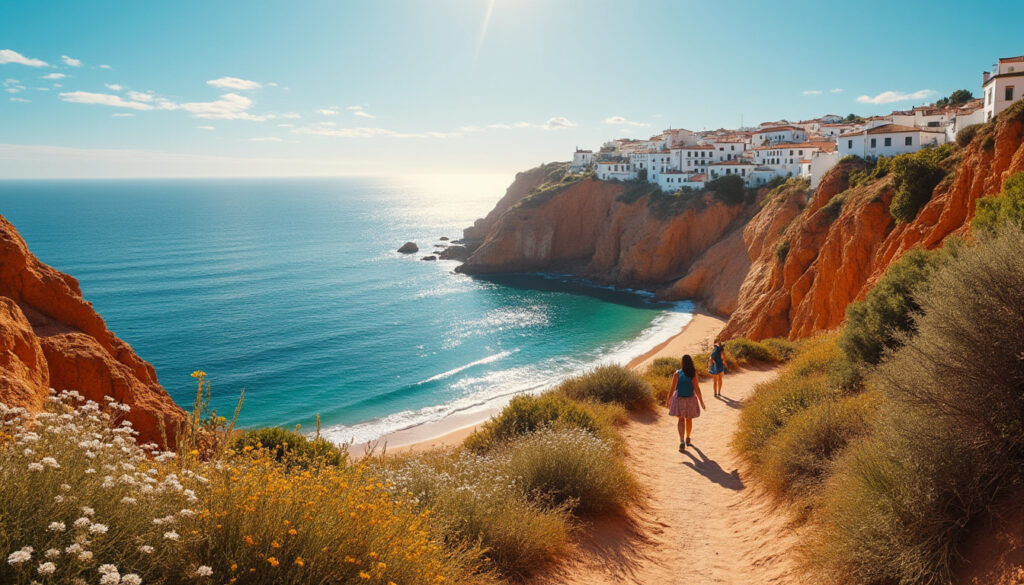
Portugal is not only discovered under the August sun. In May and October, foreign travelers hold a particularly important place, while visitors are more evenly distributed throughout the year. Another way to explore the country, between vibrant cities, the mildness of the interseason, and an atmosphere less dominated by summer vacations.
Portugal is not limited to crowded beaches in August. In 2025, tourist attendance was more evenly distributed throughout the year than at any point since 2013, and foreign overnight stays weighed particularly heavily in October and May. For travelers, these months offer a different rhythm: more visits and strolls, fewer national holidays, and regions that are discovered away from just the summer backdrop.
A country that travels more and more with the seasons
The cliché of Portugal reserved for summer vacations still holds, but the figures tell a more nuanced story. According to the 2025 report from the Portuguese National Statistics Institute, the country welcomed 29.9 million non-resident tourists, an increase of 3.3% compared to 2024. The French made up 10.9% of these visitors, behind the Spaniards and the British.
The growth rate slowed after a strong rise the previous year. However, another indicator captures more attention: the seasonality rate reached 36.4%, its lowest level since 2013. In plain terms, stays are less concentrated in a few months and are more evenly distributed across the different periods of the year.
Less concentrated vacations in summer
The high season has not lost its appeal. Beaches, cities, and terraces remain very crowded in July and August, but these weeks no longer solely define the Portuguese tourist calendar. Foreign visitors are even less seasonal than residents: their seasonality indicator is at 34.4%, compared to 40.4% for the local population.
This evolution opens the door to stays with different atmospheres. In spring, the days lengthen and the landscapes regain color; in autumn, the heat subsides and the historic centers invite more to leisure. For those looking for travel ideas according to the period, our overview of favorite destinations of the French also helps to put Portugal in perspective with other desires elsewhere.
Why May and October attract an international clientele
The provisional data from INE on accommodation activity reveals a peculiarity of 2025: each month, foreign visitors represented the majority of overnight stays. Their share peaked in October, at 74.8%, and then in May, at 74.4%. In other words, during these two periods, about three out of four overnight stays were booked by travelers from abroad.
However, it is essential to read this indicator carefully. It measures the proportion of overnight stays attributed to international visitors, not the total number of tourists present in the country. Therefore, October and May are not necessarily the most crowded months; they are simply those where the clientele of accommodations is the most international.
A different atmosphere from national holidays
Conversely, Portuguese residents hold a more significant share of overnight stays in December and August, with 38.7% and 35.8% respectively. The end-of-year holidays and summer vacations partly explain this more pronounced presence. In May or October, the streets and terraces are rather shared with foreign visitors, while local daily life continues as usual.
This difference does not mean that the cities are deserted or that the beaches are empty. It primarily changes the composition of the audience and the rhythm of the stay. For a traveler, it is an opportunity to focus on walks, museums, and gastronomic discoveries without organizing their entire itinerary around the summer holidays.
Three regions that tell three different journeys
Overnight stays in 2025 are concentrated mainly in three regions. The Algarve tops the list with 25.4% of the total, followed by Greater Lisbon at 23.9%, and the North at 18%. Together, they account for more than two-thirds of the overnight stays recorded in the country.
These figures represent the shares observed in 2025; they do not predict the attendance of the next season. However, they provide an insight into the most frequented territories and the types of stays they attract. Between coastal areas, the capital, and the landscapes of the north, the choice of region transforms the experience just as much as the month.
The Algarve, always focused on the coastline
The leading region for overnight stays, the Algarve remains associated with beaches, coastal villages, and seaside holidays. Outside of summer, the region can lend itself more to visits and excursions, even if the Atlantic Ocean remains cool and some localities operate at a slower pace. Before booking, it is advisable to check the opening hours of restaurants, accommodations, and seasonal activities.
Faro serves as a good entry point to explore the region at one’s own pace. Its old town, streets, and proximity to the landscapes of the Ria Formosa create a program that does not depend solely on swimming. To organize your days, check out our guide to discovering Faro in a week.
Lisbon and Porto, between urban culture and getaways
Greater Lisbon relies heavily on foreign visitors: they account for 81.4% of its overnight stays. The capital is particularly well-suited for a visit in spring or autumn when strolls through the historic neighborhoods can play a central role in the itinerary. Porto and the North also attract travelers due to their heritage, gastronomy, and the landscapes of the Douro Valley.
The Portuguese coastline also offers more spectacular experiences. In Nazaré, giant waves have shaped a worldwide reputation, but conditions vary, and observing from the coast doesn’t guarantee witnessing an exceptional swell. To understand what makes this site so unique, discover our article on Nazaré and its most impressive waves on the planet.
Madeira is the region most geared towards foreign visitors, with 82.5% of its overnight stays attributed to non-residents. The archipelago can appeal to travelers in search of volcanic panoramas, hiking trails, and a generally mild climate. As connections and activities may vary depending on the season, it is wise to check the schedules before building a tight itinerary.
The choice of a destination also depends on budget, type of vacation desired, and traveling companions. For families comparing multiple options, our dossier dedicated to a budget-friendly and family-friendly vacation destination can help clarify priorities. The interseason does not automatically guarantee lower prices, but it allows for considering a stay differently than in the height of summer.
The Alentejo, the region where the change of season is most felt
The Alentejo has the highest seasonality rate in the country: 43.6% in 2025, the same as the previous year. The Setúbal Peninsula follows with 41.4%, while the national average stands at 36.4%. These percentages show that the tourist activity of the Alentejo is more concentrated in certain periods than that of other regions.
Traveling in spring or autumn can significantly alter the landscape and the rhythm of the stay. Évora reveals its lime-washed streets and Roman temple; Monsaraz overlooks the plains from its ramparts; the Alentejo coastline unfolds wild landscapes, often less built-up than the most well-known coastal areas. Between markets, villages, and large expanses of cork oaks, the region invites you to slow down.
Discoveries closer to local daily life
Outside the peak season, visits can be organized around villages and landscapes rather than just the beach. Markets, local festivals, and local products also add another dimension to the stay. Check municipal calendars before departing: a fair or celebration can transform an ordinary day into a lovely detour.
The season does not account for everything. Some establishments reduce their hours, and services for visitors may be fewer than in summer. Inquiring in advance allows you to enjoy the calm without discovering, once on site, that the chosen address or anticipated excursion is closed.
Preparing for a stay in May or October
The interseason requires a bit of organization, without necessitating complicated preparation. The hours of monuments, museums, and boats can change after summer; it is therefore advisable to consult official websites before setting the stages of an itinerary. This verification is especially useful for excursions to the islands or trips to the beaches.
The weather also deserves special attention. Days can be mild, but evenings can get chilly, especially near the sea or at altitude. The Atlantic remains often cool for swimming: if swimming is a crucial element of the trip, it is better to check typical conditions rather than rely solely on air temperature.
Adapting your itinerary to the rhythm of the season
In October, Lisbon, Porto, Évora, and the Douro Valley lend themselves well to walking tours and cultural discoveries. In May, longer days promote excursions and outdoor walks. In both cases, a light jacket fits easily into your luggage.
Transportation warrants careful verification if you are traveling without a car. Some bus lines, seasonal connections, and ferry crossings may be less frequent outside of summer. Check the schedules of regional trains and local transportation before confirming an itinerary that relies on several transfers.
Finally, book with some flexibility if you plan to stay in a seaside resort. Restaurants or accommodations may temporarily close or reduce their activity after the high season. As for the budget and the weather, no month alone promises a good deal or a cloudless sky: the appeal of this period lies primarily in a more evenly distributed attendance and a different ambiance.
Choosing based on travel desires
Spring and autumn do not meet the same expectations as a full summer stay. They can be favored for walking, exploring historic centers, or combining several regions, without making the beach the primary objective. For those who primarily want to escape the cold, our selection for traveling warm in February offers other avenues to consider based on the calendar.
October and May, Portugal out of sync
In Portugal, the tourist calendar changes color as summer recedes. In May and October, the country hosts a particularly international clientele: foreign visitors account for 74.4% and 74.8% of overnight stays in accommodations. These figures do not mean that these months are the busiest in volume, but rather that they attract a larger share of travelers from afar.
Choosing these dates means discovering cities and landscapes in a different light. In spring, the days lengthen and the alleyways of Lisbon, Porto, or Évora lend themselves to strolls, while the terraces come back to life. In autumn, the softer light accompanies visits and escapades in the Douro Valley or the Alentejo plains. The experience thus shifts from the beach to neighborhoods, markets, villages, and heritage.
The contrast with August also lies in the local rhythm. In the height of summer, Portuguese vacations animate the beaches and seaside resorts. In May and October, the country follows its daily routine more closely, even if tourist spots remain visited. The Alentejo, the region with the most seasonal attendance, can notably reveal a different atmosphere outside of major holiday periods: quieter villages, cork oak-lined roads, and landscapes conducive to impromptu stops.
This interseason, however, requires a few checks. The hours of some monuments, the connections to beaches or islands, and the opening of restaurants can vary depending on the period. The Atlantic also retains a freshness that invites not to base the entire stay around swimming. A light jacket will also find its place in your luggage, especially for evenings by the sea or in the interior.
In May as in October, Portugal lends itself to itineraries combining urban discoveries, heritage, and nature. Lisbon can precede a stop in Évora; Porto, a getaway to the Douro vineyards; and the Alentejo, a few days through its villages and vast plains, far from the rhythm of summer vacations.